Tacoma gets $1.3 million to plant more trees in effort to protect kids, cool the city
Parts of Tacoma are so lacking in trees they look more like a desert than the Evergreen State. That could change soon now that the city and the nonprofits it partners with are getting $1.3 million in grants aimed to get more trees in the ground.
Public Lands Commissioner Hilary Franz met with urban and community forestry grant program recipients Wednesday outside Mann Elementary School in Tacoma’s South End to announce the funding and tour the neighborhood.
The state Department of Natural Resources (DNR) dolled out $8 million in grant money for 45 projects across the state Wednesday. Tacoma was the top beneficiary.
Out of 122 applications for grants, Tacoma’s SafeTREE Routes for Schools was ranked number one, according to DNR spokesperson Will Rubin. The proposal aims to increase tree coverage along walking corridors at six Tacoma schools located in the city’s under-served neighborhoods. Tacoma Public Schools will add an urban forestry school curriculum during the 3-year-long plan.
Fewer trees equal hotter cities
Franz cited the June-July 2021 heat dome event as a clarion call in the state’s response to climate change. More than 250 people died in the United States, including some in Tacoma, during the event. Heat events are often cited as one of the country’s leading natural disasters in coming years, she said.
Trees can help mitigate damage. They shade homes without air conditioning and reduce bills in those with it. They keep the hot sun from heating up heat-retaining pavement.
Tree equity
DNR-run studies showed a direct correlation between tree density and the racial and economic demographics of a city’s neighborhoods, including Tacoma, Franz said.
“We found actually that there’s a 13-degree difference between low-income communities and communities of color, and wealthy white neighborhoods,” she said.
Trees are in short supply on the streets surrounding Mann Elementary, compared with the leafy neighborhood’s of Tacoma’s wealthier North End.
“Where we sit right now today is an example of that, where throughout this neighborhood, there is actually an 11-iu degree difference in temperature from areas that have higher wealth,” Franz said.
Getting to school
Summer’s hot season is coming sooner and lasting longer. Shade trees can make a student’s trip home a little cooler. That’s especially true for high school and middle school students who first walk to an elementary school to meet up and walk home with a younger sibling, said Cailin Henley, the safe routes to school coordinator for the city’s public works department.
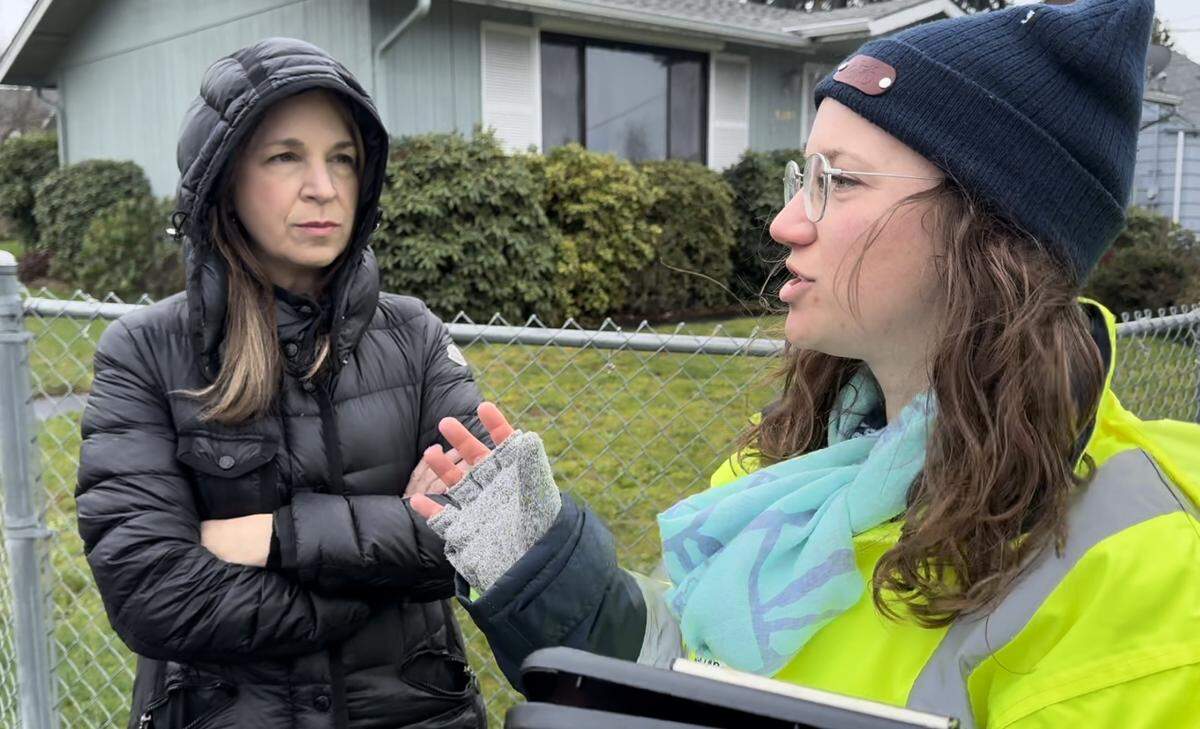
Trees also make roads safer. Studies have shown that drivers tend to slow down when they perceive roads to be narrower, Henley told Franz. Slower cars means fewer accidents and a safer route to and from school for children.
More money
Until this year, the DNR had given out about $550,000 in grant money annually. Franz asked for more funding for the 2008 Evergreen Communities Act.
“You can’t do much with half a million for the entire state,” Franz said. “So we were able to secure significant money in there — over $5 million from the state Legislature.”
DNR initially had $2 million earmarked for the grants and then allocated an additional $1 million of climate commitment funding. The remaining $5 million comes from the Inflation Reduction Act awarded to DNR by the USDA Forest Service in 2023.
Green blocks
The Tacoma Tree Foundation received a $350,000 grant from DNR for its Green Blocks program. Partnering with the city, the foundation will focus on Tacoma’s Hilltop neighborhood. The goal is to plant 600 street trees on residential properties over three years.
The 3-year project will involve deep community engagement, partnerships and residential education on planting, maintenance and community-based urban forestry.
“We’re going to be doing a lot of work to connect people with the resources of free trees, but also just to get them excited and engaged in the issue of urban forestry,” said foundation executive director Lowell Wyse.
Getting homeowners excited about the benefits of street trees is a door-by-door effort, Wyse said. So is dispelling myths and misconceptions. Many homeowners just haven’t considered a tree in their yards or on their parking strip.
“When we tell people Tacoma has the fewest trees of any city in the Puget Sound region, people are surprised,” he said.
Some homeowners want to do the work themselves, and others take advantage of the foundation’s free programs that help plant and care for the trees in their first few years after planting.
Disparity
Tacoma has set a goal of a 30 percent tree canopy, up from its current 20 percent. The challenge, Wyse said, is that the city’s plantable surface area is only 11 percent once buildings, roads, parking lots, sidewalks and other impermeable surfaces are factored in.
“So we need to find spaces to plant, basically, all the available land with trees,” he said.
In 2019, DNR said it received only one application focused on tree equity. In 2023, more than half of the applications came from programs geared to increase environmental health and address equity and environmental justice.
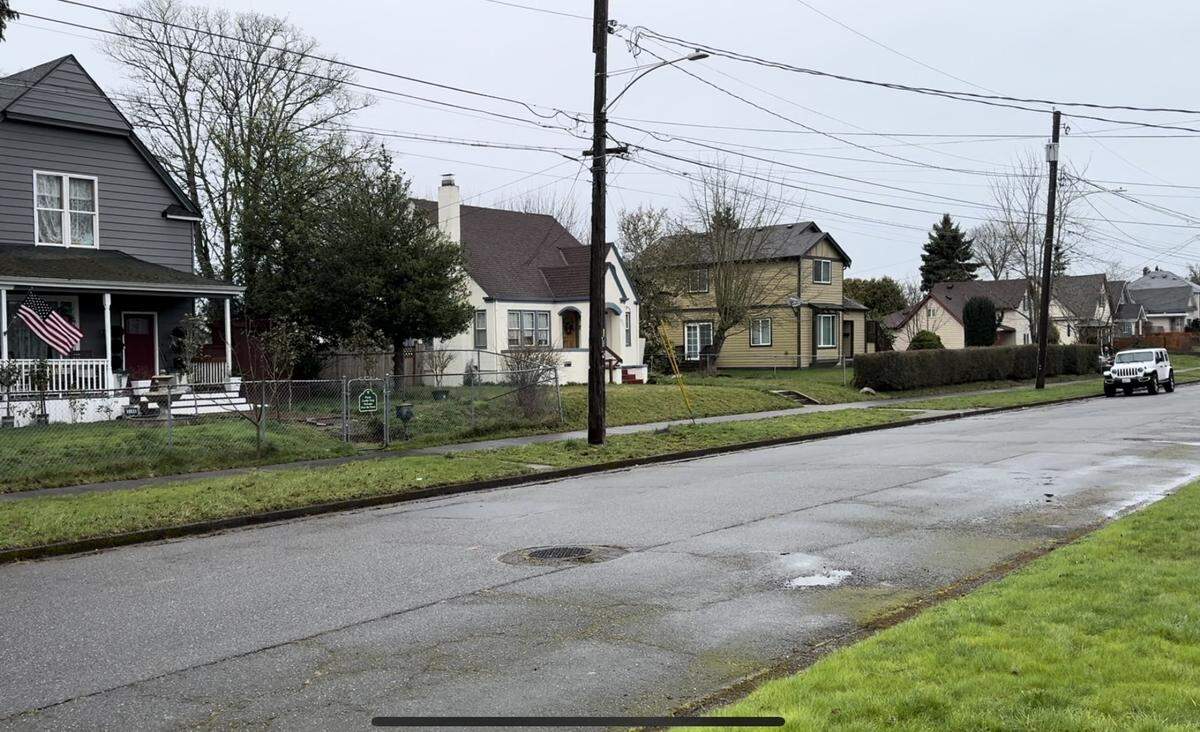
In Tacoma, increasing attention to tree inequity combined with the city’s goals to increase tree canopy are factors that have increased the number of workers, volunteers and organizations dedicated to adding more leaves across the city, according to the city’s urban forest program manager, Michael Carey.
“One of the greatest, I think most powerful things in Tacoma specifically is a lot of the new partnerships that have been built in the last five and 10 years,” he said.
While the city has brought resources, planning, funding and other valuable aspects to righting the imbalance of trees, it doesn’t do as good of a job in one-to-one relationships with the public, he said.
“The Tree Foundation has been really critical in this partnership, because they have the opportunity, the time available to door knock, to have educational campaigns, to really work deeply with the community,” Carey said.
Walking tour
Franz took a short walking tour in the neighborhood as rain and wind pelted her and the group of urban forestry advocates and managers.
As Franz took a look up and down the tree devoid streets, Tacoma’s community tree program coordinator Lisa Kenny offered her take on the value of trees.
“They can connect us across the landscape and also through time,” Kenny said. “When we plant trees today, we’re improving our own livelihoods, but we’re also impacting generations in the future that we might not even get to meet. I think that is pretty cool.”
More grants
The other Tacoma-specific grants range from a food gleaning park to tree tallies.
▪ South End Neighborhood Council $171,000: This project in Tacoma’s South End will create a fruit and nut orchard at Charlotte’s Blueberry Park. This project will extend the variety of food and harvest period in the park.
▪ Metro Parks Tacoma $110,925: The agency’s urban forest management plan will create a 20-year framework of canopy goals, planting priorities, funding and engagement.
▪ Washington State University $348,369: A volunteer program will create a complete tree inventory and assess mortality rates for recent plantings.