Trees see protections in new Tacoma housing rules. What does that mean for affordability?
The city’s trees would see new protections if certain recommendations for Home in Tacoma Phase 2 take root.
Advocates say the package’s proposed landscaping and tree-canopy mandates are needed to safeguard livability in the city for decades to come. Critics argue that the requirements would have unintended consequences for the local housing market.
A public hearing will be held on the current Home in Tacoma Phase 2 package at the City Council meeting on Tuesday, Sept. 24.
What is Home in Tacoma Phase 2?
Home in Tacoma is a package of zoning changes and code amendments geared toward boosting housing supply, choice and affordability, as noted on the city’s website. It shifts focus from single-family zoning to allow for greater urban density, keeping with state mandates, and comes at a time when home costs have skyrocketed throughout the region.
The City Council approved Home in Tacoma Phase 1 in December 2021, which set an overall vision for new housing and foundational policy direction, The News Tribune reported this summer. Phase 2 homes in on residential zoning and new housing standards/types, plus additional implementation aspects.
Three “urban residential” zones under HIT’s zoning would allow for more middle housing: residential buildings somewhere between big apartment and condo sites and single-family homes, the newspaper previously noted.
What would Home in Tacoma Phase 2 mean for trees?
Strengthened tree protections are linked to positive effects on public health, the nine-member Planning Commission wrote in its June 5 findings and recommendations report.
Such changes would work to cut back on heat-related illness and urban heat, as well as cardiovascular and respiratory diseases, the report said, citing the project’s health-impact assessment. They would also be a boon to mental health.
Planning Commission Chair Chris Karnes told Cityline in June that trees are part of the city’s long-term adaptation and resiliency strategy. They provide shade over buildings during the summer and act as stormwater infrastructure, he said.
Robb Krehbiel also serves on the commission. He helped break down some of Phase 2’s tree-canopy recommendations in an interview with The News Tribune, including:
A minimum tree-canopy cover to be met for each city parcel, which would vary depending on population density
Protections for older trees. Large trees are virtually off-limits for removal; if a developer must do so, they have to ask the city for a variance and pay a fee aimed at planting new trees
If a developer uses the fee-in-lieu program, they would need to plant replacement foliage within a certain radius of the area to ensure more equitable canopy distribution
The City Council is free to accept, modify or ignore the commission’s recommendations, Krehbiel said. It’s his understanding that Tacoma is the first city in Washington state that is updating its tree-protection and housing-density policies simultaneously.
To him it shows that the city views trees as more than pretty plants used to decorate the front of houses. Krehbiel said trees serve a much greater purpose for Tacoma’s overall health and sustainability.
“It’s really important that as we densify our city with new developments, that we are doing it in a way that also leaves space for trees, so that the communities that we are creating are actually livable and healthy and pleasant,” Krehbiel said.
When zoning policies get updated to allow for more density and development, it often leads to developers buying a lot, “clear-cutting” it, then adding buildings, he said. Some beautifying plants come after.
Tacoma saw high mortality rates during recent heat-dome events, particularly among the elderly and younger people living without AC, Krehbiel said. Neighborhoods such as the Tacoma Mall get “dangerously hot.” Trees help protect against that.
If the City Council doesn’t adopt the committee’s recommendations, then Tacoma likely won’t hit its goal of 30% tree-canopy by 2030, Krehbiel said.
What do supporters say?
Tacoma resident Courtney Davis has advocated for greater local tree protections. She told The News Tribune that Home in Tacoma Phase 2 would set the stage for higher density in the city while avoiding suburban sprawl.
If the city only prioritizes development while bypassing the proposed landscaping code, it would be bad news for Tacoma, she said.
“The reality of what that would look like is that it’s just going to be a ton of housing and no livability within the city,” Davis said.
Tree preservation is a major area of concern, she said. New trees can be added, but sometimes they don’t survive after planting because of lack of maintenance like watering. Protecting heritage trees is crucial for preventing erosion and offering health benefits.
Davis said she’s heard a “false dichotomy” thrown around: Either you can get more trees or get more housing. She argued the reality is that you can — and need to — have both.
Lowell Wyse with the Tacoma Tree Foundation wrote in support of the tree recommendations in an article posted to the group’s website.
Wyse told The News Tribune that climate change is bringing more people to the region from states like California. That brings increased housing pressure and the need for a sound strategy.
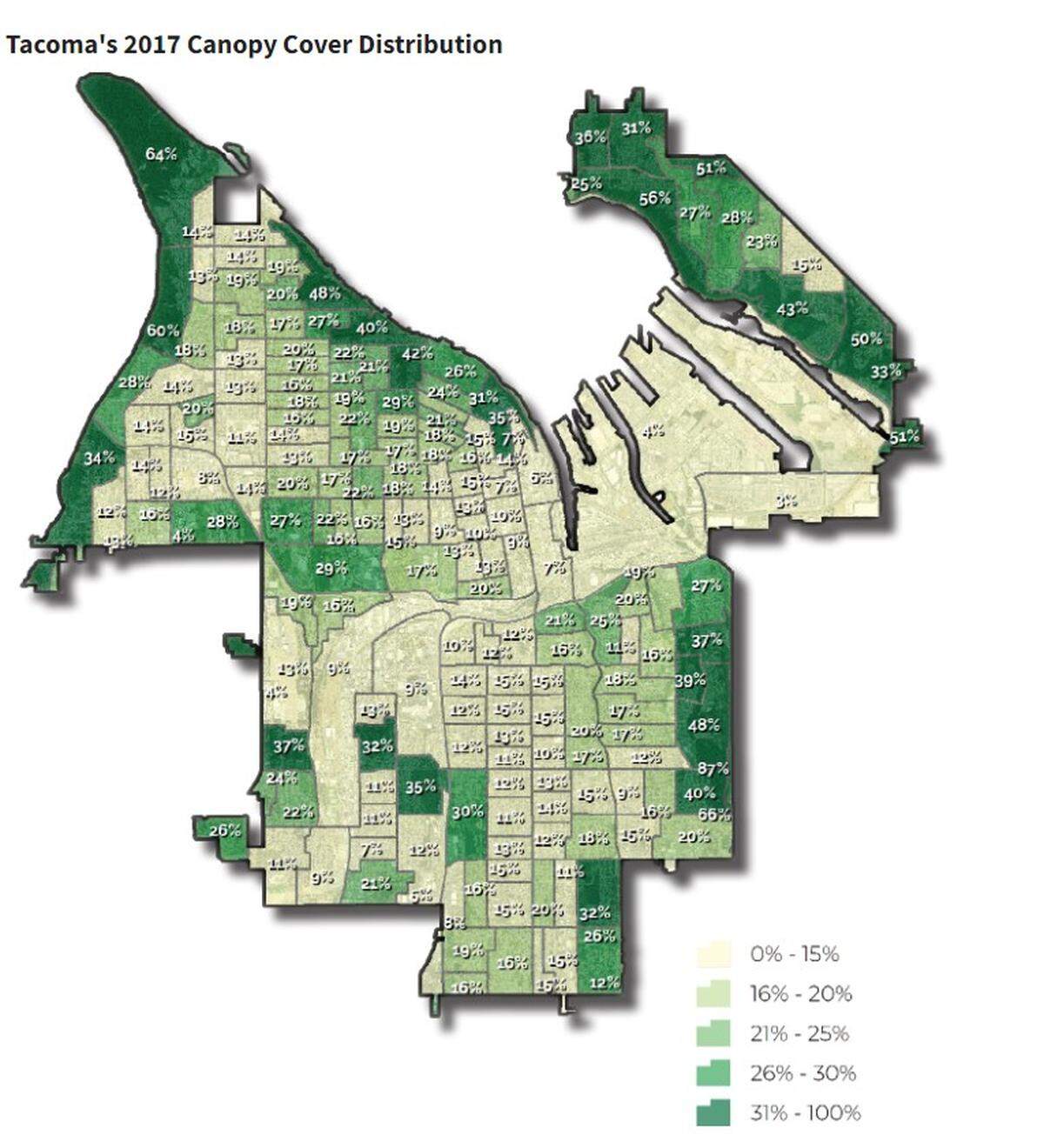
Today the city has about 20% tree canopy coverage, he said. He added that it’s the worst of any city in the region, including Seattle, which has a canopy of about 28%.
The South and Eastside Tacoma neighborhoods are particularly canopy-sparse with poor air quality, he said. Such areas are more likely to be developed, too, meaning that tree inequity could be perpetuated.
The most beautiful cities in the world have a solid mix of density and trees, he said. He wants Tacoma to enjoy the same.
“It’s not just about: How many people we can cram into a small space?” Wyse added. “It’s about what quality of life are they going to have once they are there, once we build more homes for them?”
What about critics?
The Puget Sound region has grappled with a years-long housing crisis, explained Evan Mann, president of the Master Builders Association of Pierce County. It has been “massively underdeveloped” when it comes to supply.
It’s great that Home in Tacoma encourages urban growth, Mann said, but he’s concerned that if trees on private property become regulated, the city’s housing targets won’t be met.
“When you have onerous codes in a city, it only continues to drive development out towards the periphery, right?” he told The News Tribune, adding that as a result, some developers might look to other parts of Pierce County that are friendlier toward development.
“Ultimately, the cost of these types of regulations is: Developers are just going to avoid the city of Tacoma,” he continued. “So, they’ll keep their trees, but they won’t get any of the housing.”
Mandatory retention for trees could hamstring the number of homes that would be delivered, he said. That would lead to more tree loss and more sprawl, regionally speaking.
Mann said the home-building association is not “anti-tree.” Instead it tries to operate by the saying, “Right tree, right place.”
He also argued that some of the older trees that would receive protections might look nice but could be nearing the end of their lifespans. While Mann understands the desire to hold onto established plants, he said at some point, it’s better to instead install young healthy ones that will be around for longer.
It’s not as though developers want to cut down canopy for the sake of it, he said. Every tree that gets removed costs them. If it can be spared, builders want to keep it around.
“If it works without taking a tree out, we’re going to leave the tree 100% of the time, because there’s no reason to remove trees that are existing and work with our development,” he said. “We recognize the value too, right? It’s not lost on us.”
Next steps for Home in Tacoma Phase 2
After the Sept. 24 public hearing, Home in Tacoma Phase 2 will go through the following steps, according to a presentation:
Oct. 8: Council study session (debrief input)
Oct. 22: Council study session (potential amendments)
Oct. 29: First reading of ordinance
Nov. 19: Final reading of ordinance
Feb. 1, 2025: Takes effect
This story was originally published September 24, 2024 at 5:00 AM.