LeeAnn Cooper was frustrated when she and her husband received a notice Jan. 8 from Progressive saying her home insurance won’t be renewed in March.
Cooper and her husband are retired, have high credit scores, and have cement siding on their waterfront home in Lakebay,she told The News Tribune. They filed a claim two years ago when a tree branch fell through their roof, but the letter she received and the agent she spoke to both pointed to wildfire risk as the reason for their nonrenewal, she said.
“We were just in dismay,” Cooper said. “We were going: ‘You don’t understand, we’re on the soggy side of the state.’ . . . It was just very sobering to be put in this bucket of wildfire threat when we’re (on) waterfront property.”
As firefighters battle devastating wildfires in Southern California that began sweeping through the Los Angeles area Jan. 7, attention is also turning to California’s challenging home insurance market, which has seen a wave of companies pull out of the state in recent years. Reuters reported that insurance companies are expected to lose as much as $20 billion from the LA-area wildfires.
Pierce County has its own share of areas where wildfires have occurred or could occur, The News Tribune reported, and KING 5 reported in August 2024 that there was a spike in insurance companies dropping Washington state homeowners because of wildfire risk during the first half of that year.
The News Tribune asked industry experts to explain how insurance companies analyze wildfire risk and make the call to drop policyholders, including in Pierce County, and whether major disasters elsewhere play a role.
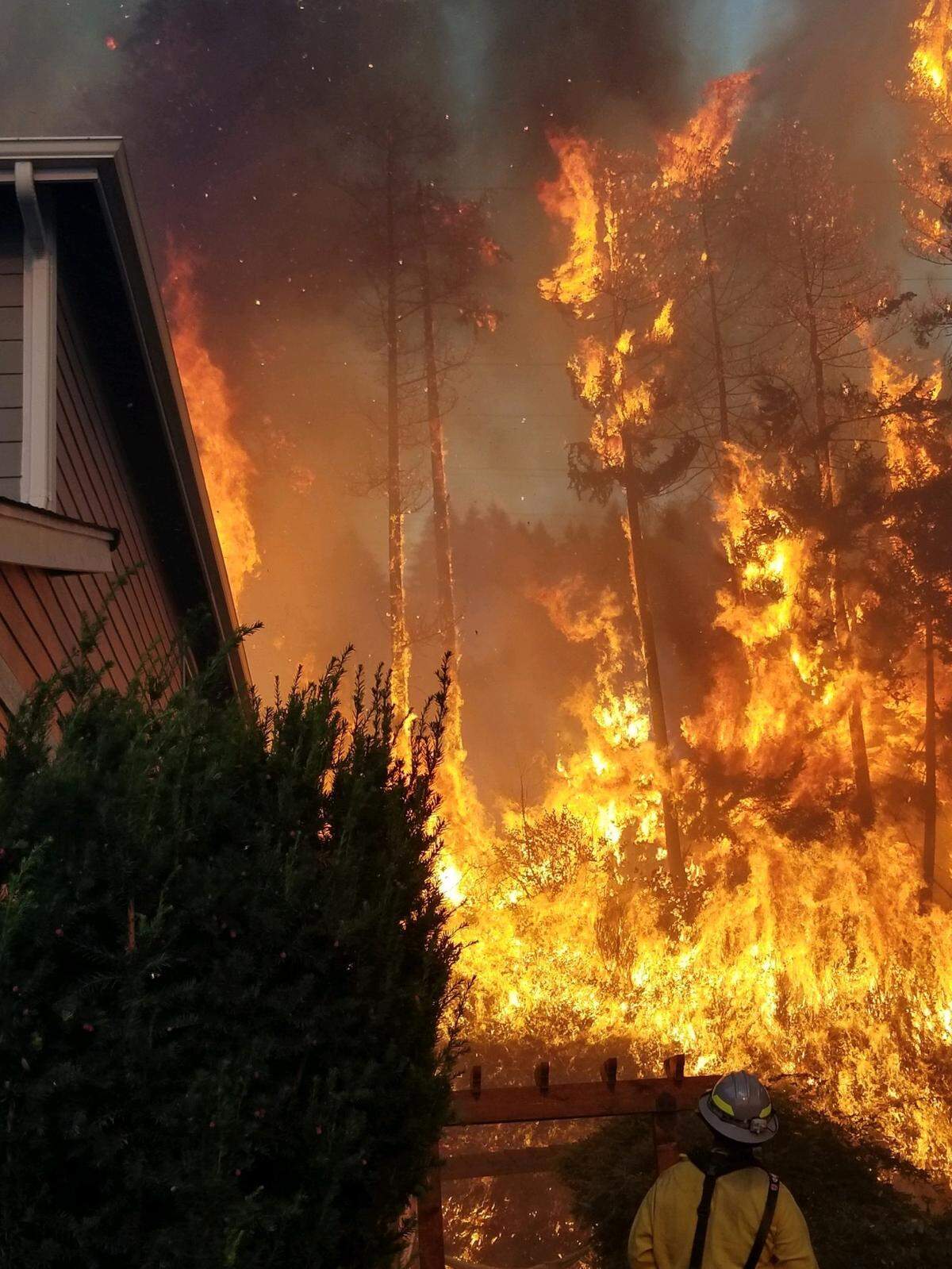
A firefighter stands in front of the Sumner Grade Fire blaze in September 2020. Courtesy East Pierce Fire & Rescue
Calculating risk and dropping customers
Janet Ruiz, a spokesperson for the Insurance Information Institute who focuses on the western United States, said the fires in Los Angeles shouldn’t impact companies’ insurance coverage in other areas of the country. Each state has its own regulations around insurance, and companies determine their pricing and risk areas for each state separately, she said.
To determine risk in an area, insurance companies rely on “catastrophe modeling” technology, Ruiz said. This can include looking at the potential impacts of events including wildfires, winter storms and hurricanes. Verisk is one company that provides this modeling to insurance companies, according to Ruiz.
The Verisk website displays a tool called FireLine, which assesses wildfire risk down to the address level based on many factors, including a property’s terrain and slope, access to roads and use of mitigation strategies to keep fires from approaching. The tool also uses information from remote sensing and digital mapping, according to the website.
Both calculated risk and forces in the national economy, which affects factors such as the cost of supplies and labor needed to rebuild a home, are part of insurance companies’ decisions to stop renewing some homeowners’ policies, she said. Companies look at the numbers of homes and businesses they insure in a certain area each year and make adjustments as they deem necessary.
No state can prevent an insurance company from canceling a policy, according to Ruiz.
The New York Times tracked home insurance nonrenewals across the country in 2023 and found it to be a nationwide trend: nonrenewal rates rose in 46 states that year. In Washington state, nonrenewals in 2023 were the highest they’ve been since 2018.
Factors impacting home insurance availability nationwide include inflation affecting the cost to rebuild homes, more people migrating to disaster-prone areas, more frequent and severe weather events and other factors, according to a report from the U.S. Department of the Treasury this month analyzing the home insurance market from 2018-2022.
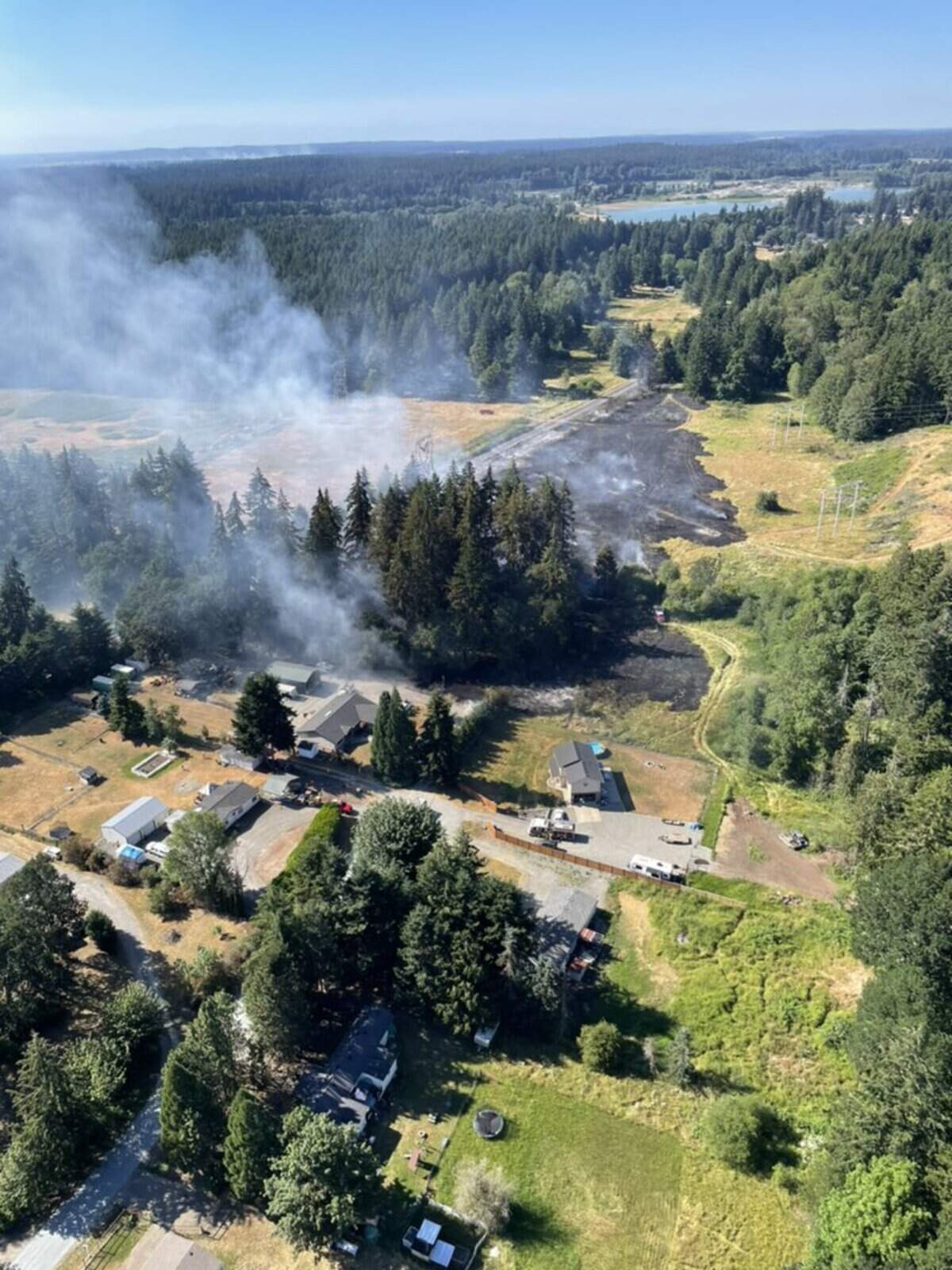
Crews responded to a large brush fire July 9, 2024 on state Route 507 south of Roy. Central Pierce Fire and Rescue
Local and state trends in home insurance and wildfire risk
Shawna Ader, a real-estate agent who’s worked with clients on the Key Peninsula and in Seattle, said she’s observed trends in the insurance market over the course of her 30-year career. While she’s not an insurance broker, she helps clients get reinsured when they move homes and said she’s observed a higher level of scrutiny from insurance companies recently than in the past.
“There’s a lot of chatter behind the scenes between real estate agents about the coming risks, and I would say the Key Peninsula, and then even places like in the east part of King County because of their proximity to forested areas, are seeing this higher level of scrutiny,” she said.
Data about wildfire risk across Pierce County isn’t widely available, but the Pierce County Department of Emergency Management is spearheading a Community Wildfire Protection Plan that will include this information, The News Tribune reported.
KING 5 reviewed public records to find that the state Office of the Insurance Commissioner received more complaints from homeowners dropped from their insurance companies because of wildfire risk in the first half of 2024 than the previous two years combined. The investigation also found that more people are switching to Washington’s FAIR plan, a program that provides insurance for homeowners who can’t find it elsewhere. The number of residents covered by the FAIR plan increased over 200% in five years, KING 5 reported.
The Washington State Office of the Insurance Commissioner tracks enrollment in the FAIR Plan and uses that data to understand how hard of a time people are having finding a company to cover them, according to Insurance Commissioner’s office spokesperson Aaron VanTuyl. The FAIR plan generally offers more limited coverage options and higher premiums than standard insurance companies.
The News Tribune asked VanTuyl if wildfire risk in the state is causing insurance companies to pull out entirely of certain areas in Washington. That’s not really the pattern they’re seeing, he wrote in an email.
“We’ve had anecdotal reports of people being non-renewed in riskier areas, but there’s around 130 companies writing home insurance policies in Washington, and I don’t think we’ve heard of anyone pulling out of specific areas altogether due to fire risk,” he wrote.
Wildfire risk in the state is something the Insurance Commissioner’s office is monitoring and “an issue we’re prepared to head off at the pass,” he continued. For now,he wrote, their office has been gathering information about homeowners’ insurance through meeting residents on the eastern side of the state and pushing initiatives to help people and communities take preventative measures against wildfire damage.
Finding a new insurance company
Cooper said she and her husband called a Progressive Insurance agent, but weren’t given any more specifics about how their area was deemed at risk of wildfire. She said they also learned they could appeal the decision with Progressive, but decided it wasn’t worth the effort after the agent said she had never actually seen an appeal approved.
The News Tribune reached out to the media contact email listed on Progressive’s website Jan. 17, but did not receive a response.
The couple also reached out to the state Office of the Insurance Commissioner, but were told the office wouldn’t be able to challenge the insurance company’s decision unless the company had failed to provide proper advance notice — which the state is raising from 45 to 60 days after July 1 after a legislative change — or otherwise violated state insurance regulations.
The alternate company that Progressive recommended to provide replacement coverage charged premiums over double what they currently pay, so she and her husband are shopping around for a new insurance provider, according to Cooper.
She told The News Tribune that she could understand it if the insurance company had said they’re pulling out of a region, but she’s frustrated that the insurance company seems to be able to choose which properties to drop. She’s confused about why a resident in the Palmer Lake area, also on the Key Peninsula, received his nonrenewal notice for wildfire risk from Progressive a year ago, while she and her husband received theirs more recently, she said.
Asked about these concerns, VanTuyl said via phone that “no two houses and no two situations are going to be exactly the same.” Two properties could be close in proximity, but factors like their distance from the nearest fire hydrant or fire station and their building materials could make their level of risk different for an insurance company.
He also told The News Tribune that the office hasn’t seen people struggle to find replacement coverage, based on enrollment data for the Washington FAIR plan.
“Our office has received complaints from people who disagree with their company not renewing their policy, but only a few of those folks have been unable to find new coverage,” he wrote via email.
If your home insurance policy is canceled, your options include working with an insurance broker for help finding replacement coverage or research on your own, The Bellingham Herald reported.
Ader, the real-estate agent, said she often recommends that her clients hire insurance brokers. Brokers can often help find insurance companies that are lesser-known, but offer good coverage options, she said.
Julia Park is the Gig Harbor reporter at The News Tribune and writes stories about Gig Harbor, Key Peninsula, Fox Island and other areas across the Tacoma Narrows. She started as a news intern in summer 2024 after graduating from the University of Washington, where she wrote for her student paper, The Daily, freelanced for the South Seattle Emerald and interned at Cascade PBS News (formerly Crosscut).