Should Tacoma expand the areas where homeless encampments are not allowed?
AI-generated summary reviewed by our newsroom.
- Tacoma Council proposes expanding no-camping buffers around shelters, schools, parks.
- Proposal responds to 2025 shelter closures that removed five prohibited buffer zones.
- Enforcement will use police and HEAL outreach; cited people may enter therapeutic court.
The Tacoma City Council will consider an amendment to the city’s public-camping ban that will expand the areas in which people living unhoused are prohibited from camping.
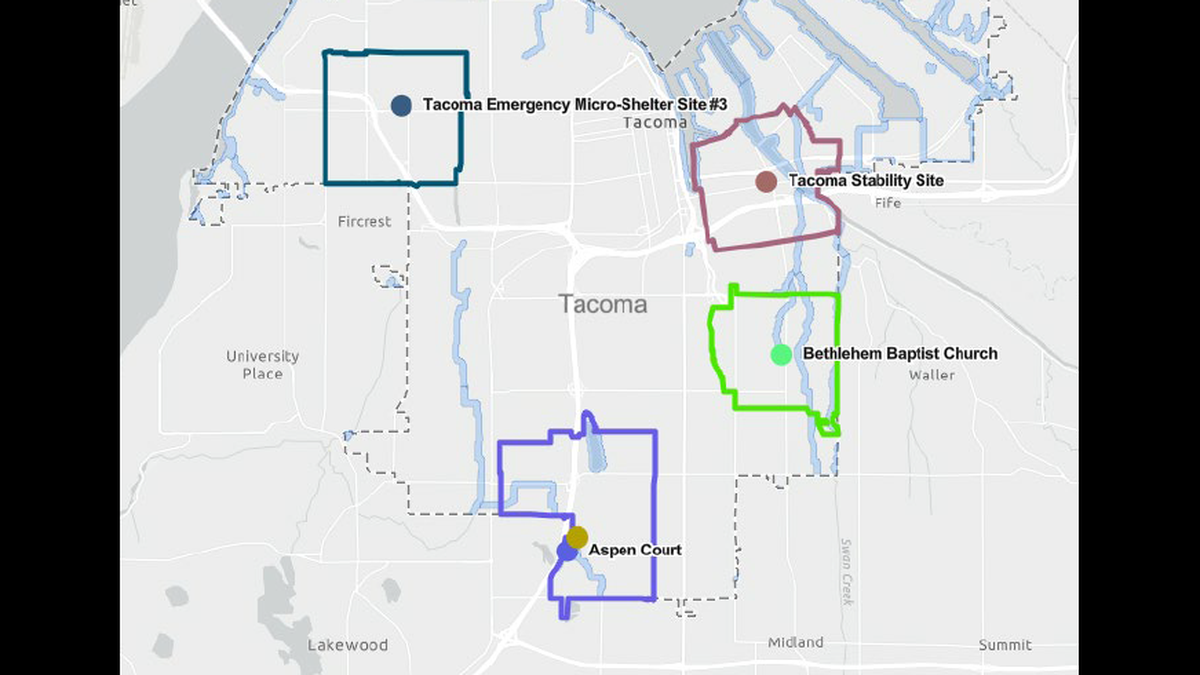
In October 2022, the Tacoma City Council passed an ordinance that prohibits camping and the storage of personal belongings in a 10-block radius around temporary shelters and all public property within 200 feet of Tacoma’s rivers, waterways, creeks, streams and shorelines. Under the ordinance, violators face fines of up to $250 and up to 30 days in jail.
On Oct. 1, City Council member John Hines proposed an amendment to the ordinance which expands additional buffers prohibiting encampments within 10 blocks of permanent shelters, temporary shelters and transitional housing as well as a five-block buffer zones from public schools, parks and libraries.
In an interview with The News Tribune, Hines said he proposed the expansion because of recent closures of temporary shelters, which have reduced the number of camping-prohibited spaces across the city.
According to the proposal, the city lost five buffer zones from 2024 to 2025 — almost all of which shared overlapping areas in downtown, south and east Tacoma.
Hines said the loss of those buffer zones has resulted in increased encampments in those areas. He said he came up with the idea for the proposal after seeing the reduction of buffer zones lead to increased 311 requests in certain areas.
“This is really about making sure those public spaces are open and accessible to the public,” he told The News Tribune.
Hines said he does not anticipate a significant net increase of camping-prohibited spaces in the city compared to 2024 if the proposal passes.
To enforce the ordinance, the city has used both police and homeless-outreach staff, known as the HEAL team. Members of the team make contact with people living in encampments. Their job is to get folks living unhoused to accept offers of shelter and services to help them get off the streets.
In previous years, the city’s HEAL team has reported that roughly half of the unhoused people they contact expressed interest in services and less than 10% are placed in shelters. In 2025, the city reported an increase in both interest in services and shelter placement, but a decrease in the number of people they contacted.
According to Maria Lee, a spokesperson for the City of Tacoma, fewer than five citations have been written to enforce the ordinance as of September 2025.
The proposed amendment also dictates that anyone who is cited be referred to the city’s therapeutic court if eligible. Therapeutic courts connect participants with treatment services and community resources instead of traditional sentencing, such as jail or fines.
Hines told The News Tribune he was unsure if the changes to the ordinance would lead to an increase in the number of citations issued.
Hines is running to be the next mayor of Tacoma. His opponent, Ander Ibsen, told The News Tribune he thinks the cities camping ordinance is “reactive” and does not do enough to address the root causes of homelessness.
Ibsen, a former representative for City Council, District 1, said the city should work regionally to address the homelessness crisis and should not “silo” itself from pooling resources and coordinating efforts with other cities and agencies.
“My concern is that it amounts to more of the same,” Ibsen told The News Tribune about Hines’ proposed amendment to the camping-ban ordinance.
Hines said he understands that the ordinance is not intended to address the root causes of homelessness as he believes more transitional housing and supportive services are necessary to address the crisis.
“Encampments can be unsafe for people and neighborhoods,” he told The News Tribune. “This is meant to address the community impacts of encampments.”
Homeless advocates in the community are already expressing opposition to the proposal.
Rob Huff is the spokesperson for the Tacoma Pierce County Coalition to End Homelessness. During the coalition’s weekly meeting on Oct. 3, Huff and other advocates expressed their frustration with the city’s approach.
“This policy is not going to be good news for those who are currently homeless in our community, or really for our community in general,” Huff told members of the coalition. “The whole time that the camping ban has been in effect we have not seen a reduction in homelessness, and instead we’ve largely heard the city brag about hoe much trash has been collected as they chase people around and clean up camps over and over.”
Homeless outreach workers in Tacoma have previously expressed concerns with the city’s encampment removals as they claim the city does not offer enough alternatives for those living unhoused.
The ordinance will be discussed by the city council during the Oct. 7 study session.
This story was originally published October 7, 2025 at 5:15 AM.