Border Patrol searched Lakewood license-plate camera data, UW report says
Federal immigration authorities accessed data from automated license-plate cameras in at least two Pierce County cities this year, according to a new University of Washington report that states some police departments have opened the door for residents’ movements to be scrutinized.
Researchers with UW’s Center for Human Rights found that the Lakewood Police Department was one of eight law enforcement agencies that enabled its Flock Safety camera networks to be shared with U.S. Border Patrol.
Lakewood Police Chief Patrick Smith told The News Tribune on Oct. 21 that his department did not grant Border Patrol access to data from its 63 license-plate cameras and that Flock Safety had since revoked access.
The Oct. 21 report also revealed that Border Patrol had “back door” access to the networks of at least 10 police departments in the state that did not explicitly authorize Border Patrol searches of their data, including the Eatonville Police Department.
Eatonville Police Chief Jason LaLiberte told The News Tribune on Oct. 21 that his department was unaware Border Patrol had accessed data from its six license-plate cameras. He said the department has re-examined its system access and permissions and contacted Flock Safety about a national sharing network that it has now opted out of.
The Keep Washington Working Act prohibits cooperation between local law enforcement and federal immigration authorities. The UW report’s findings came from public-records requests the researchers filed with 48 law enforcement agencies across the state known to use Flock Safety’s cameras.
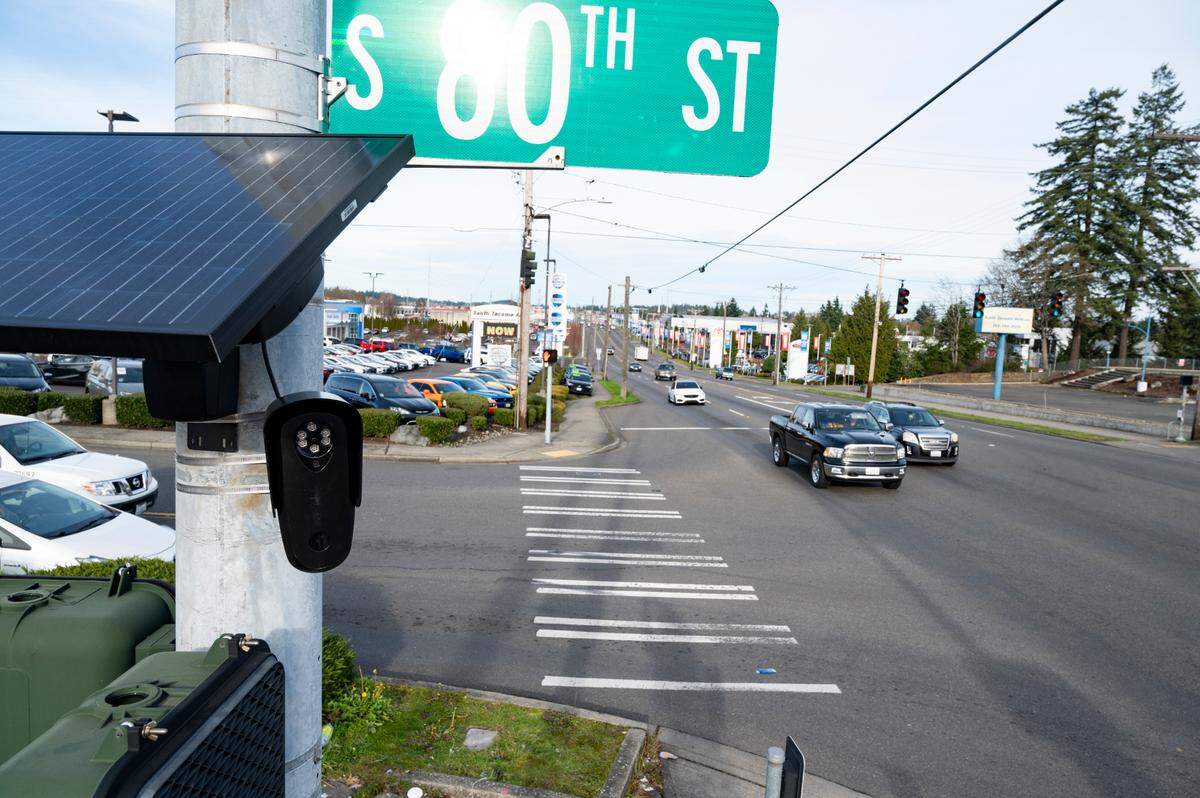
Automated license-plate cameras have become more common in Pierce County cities in recent years. The technology captures images of the rear of every passing vehicle, according to previous reporting from The News Tribune, and stores information about the vehicle in a database for 30 days. The info is often used to stop stolen vehicles and solve other crimes, but the devices have raised concerns about data privacy and surveillance.
Police departments with Flock Safety cameras create local networks of their cameras and data, according to the UW report, and their network-sharing settings allow them to open network access to other organizations. Researchers say copies of network-sharing reports showed that Lakewood appeared to have enabled sharing with organizations identified as Border Patrol at some point this year.
Network audits showed evidence of searches by Border Patrol during at least May through August 2025 in all eight law enforcement agencies identified as enabling the sharing of their networks, including Lakewood, the report states.
Additionally, network audits done by Flock Safety showed that Lakewood and other police departments’ data was exposed to “side door” searches by out-of-state law enforcement agencies appearing to conduct inquiries on behalf of immigration authorities. Searches have to include a “reason” field, which had responses such as “immigration,” “ICE,” “ERO,” meaning enforcement removal operation and similar terms.
Smith told The News Tribune the Lakewood Police Department was not aware Border Patrol could search its data.
“Unbeknownst to the Lakewood Police Department, somehow the US Border Patrol got temporary access to a Flock account and used the national lookup tool to query a few vehicles, we were told, it was not for immigration related business,” Smith said in a written statement.
Smith said the national lookup feature allows Flock Safety users to search for a specific vehicle that has been involved in a crime. He said Lakewood had that turned on, and it allowed the department to resolve serious crimes such as sex trafficking.
The UW report noted that discrepancies have been found between audits done by Flock Safety of searches within local networks and other documentation of organizations’ network-access settings, making it impossible for researchers to determine the scope of police departments’ access and exposure to searches by other Flock Safety users.
Flock provides customers with two monthly audits of searches on its network by internal and external users. Researchers said in many cases, the audits have shown thousands of searches of local networks by organizations that don’t appear in network-sharing reports or transparency portal lists of “external organizations with access.”
The Lakewood Police Department has that type of transparency portal, and while it lists many out-of-state law enforcement agencies, it does not list federal immigration authorities as having access. It does show access for two federal entities, the U.S. Postal Service and the Wright-Patterson Air Force Base in Ohio.
Phil Neff, a UW research coordinator, said Tuesday that agencies like Lakewood could restrict Border Patrol’s access to its data by removing it or out-of-state law enforcement agencies from its network-sharing lists. He said multiple agencies have said they never intentionally enabled sharing with Border Patrol but that those statements were impossible to confirm.
Puyallup also has Flock Safety license-plate cameras. UW researchers said a public-records request with the Puyallup Police Department remains pending. A spokesperson for the department said he was not familiar with the report and would need to wait for the records request to be fulfilled before commenting.
This story was originally published October 22, 2025 at 5:00 AM.