What happens to personal items displaced during Tacoma homeless camp sweeps?
AI-generated summary reviewed by our newsroom.
- Tacoma logged storage of personal items 136 times; owners reclaimed items 12 times.
- About 35% of recorded personal items were discarded, logs show.
- Advocates and unhoused say the policy is ineffective, “performative.”
The City of Tacoma has a policy that addresses what to do with personal belongings displaced during the removal of homeless encampments.
“We follow a respectful, careful, and clearly defined process to ensure personal property is preserved and easily retrievable,” Maria Lee, spokesperson for the City of Tacoma, told The News Tribune about the city’s storage program.
Records reviewed by The News Tribune show it is rare for the city to store those items and even more rare for them to make it back to their owners.
People living unhoused interviewed by The News Tribune called the policy ineffective, and at least one homeless advocate described it as “performative.”
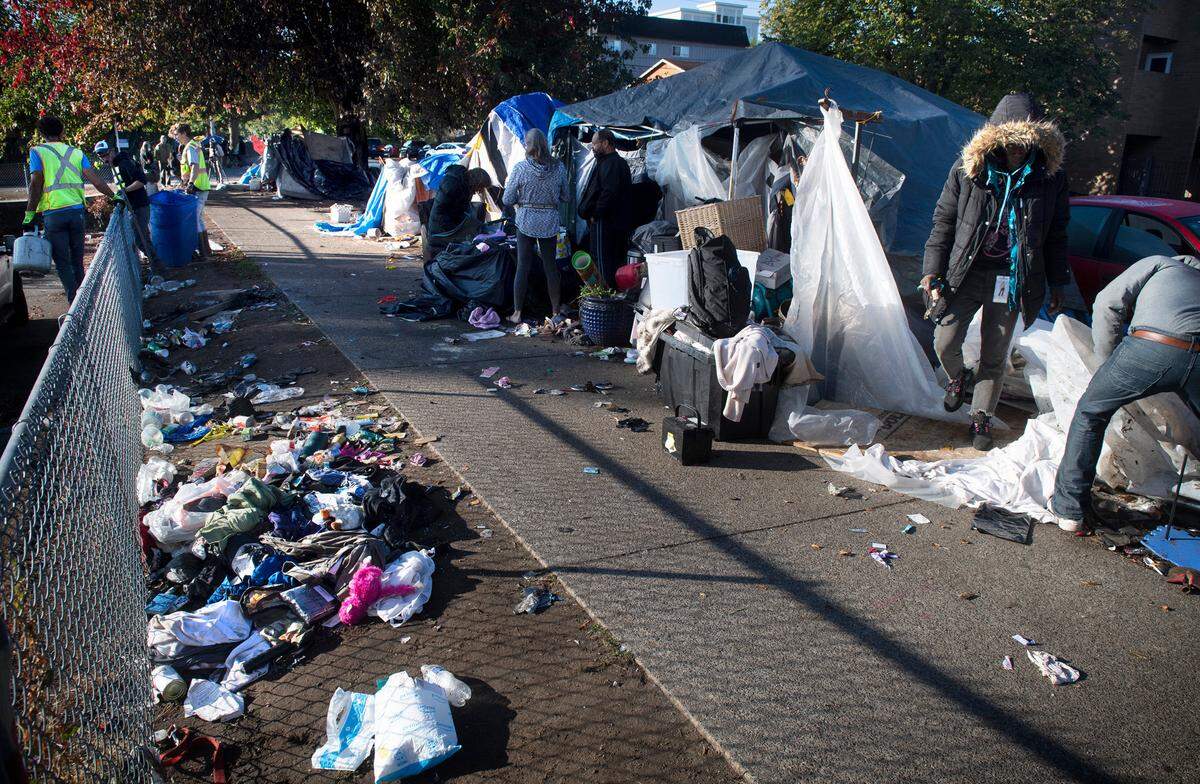
Mirriah Quintana told The News Tribune that encampments she lived in have been shut down and cleared out by the city dozens of times since she became unhoused in May. She said neither the city’s outreach team nor police officers who accompany it during the removals ever offered to store her belongings.
“They damn sure don’t mention it. You are just watching your stuff get thrown into the back of a truck,” Quintana told The News Tribune. “There is no humanity in it.”
The issue expands beyond Tacoma.
Since a U.S. Supreme Court decision last summer allowed cities to punish people for sleeping outside, even if there’s no shelter available, cities all over the country have been implementing more stringent policies on public camping. A ProPublica investigation of the policies intended to protect the property rights of the unhoused and make it easy to get their possessions back found those storage programs rarely accomplish their objective.
According to a ProPublica analysis of storage programs across 14 cities, people whose belongings were taken in encampment removals rarely got them back. Some cities with large homeless populations have been sued for depriving people of their property.
Details from Tacoma’s storage logs
Since Tacoma implemented a ban on camping in certain parts of the city at the end of 2022, it has removed more than 9 million pounds of items and debris from homeless encampments.
When it comes to personal belongings, Lee said the city uses a digital system to “meticulously log the items, take photos, and document the property.”
The News Tribune recently filed a public-disclosure request for “records related to property seized by the city at encampments and held as part of enforcement of TMC 8.12.180 since 2022.” The News Tribune asked for details including the quantity of items stored and claimed, as well as how long items were held.
The newspaper was not provided with photos of items stored. While detailed descriptions were rare, they often noted whether a bicycle was stored along with other items. Some belongings such as tents, air mattresses, and a Dell laptop were noted.
According to storage logs, the city has recorded storing personal items owned by individuals living at encampments 136 times from May 11, 2022 to Oct. 16, 2025.
During that same timeframe, items were recorded as “picked up” by their original owners about 12 times, with roughly 35% of personal items thrown away. Seventy-six items were not recorded as thrown away or picked up, according to the logs.
Lee said the city’s homeless-outreach team works directly with individuals at the encampment “whenever possible” to identify and inventory their belongings for storage.
“They focus on securing and storing personal property that is in good condition, and this process is respectful and collaborative, not punitive,” she said.
The city’s policy defines “personal property” eligible for storage as personal documents and identification, tents, bicycles, electronics, eyeglasses, prescription medications and jewelry.
“If, after the 90-day period, the items have not been claimed and the individual has not been in communication with the [outreach team], the property may be sent to Solid Waste,” Lee told The News Tribune. “This is truly a last resort.”
Lee noted the last time items were thrown away was in January 2025.
When asked about why it can be difficult for individuals to retrieve their belongings, Lee said unhoused individuals move around frequently and can be hard to stay in contact with.
“Individuals are often focused on daily, immediate survival needs,” Lee said. “The challenge is not the retrieval process itself, but the difficult and unstable circumstances these individuals face every day.”
Lee said people do not need formal identification to pick up their items. They only need to be able to describe their items with “particularity.” She said individuals can contact the outreach team or call the city’s 311 line, and the city will either transport the individual to the storage site in a city vehicle or transport the items directly to the individual’s location.
Some say they lose everything
On Nov. 13, Quintana and other people who had been living unhoused at a nearby encampment gathered at St. Vincent de Paul’s Community Resource Center in South Tacoma. That morning their encampment was removed by the city.
They came to the Community Resource Center to escape the rain and grab a bite to eat. Some asked St. Vincent de Paul’s staff if they had items to replace what had been thrown away by the city.
One asked for a jacket, another for an umbrella, Quintana asked for a tent. She was frustrated and worried about how she was going to stay dry that night.
Quintana told The News Tribune she had been collecting recyclable scrap to sell for some income, but the city had thrown it all away during the removal of their encampment. Quintana also said she had lost things with sentimental value, like pictures.
“Things that are irreplaceable,” she said. “You can’t go to the store and buy new ones.”
Lee Anthony Stansberry was unsure where he would stay that night following the encampment removal. He told The News Tribune that no one from the city had offered to store his belongings, but he would not trust them to do so if they did.
Stansberry said when members of the city’s outreach arrive at an encampment he is living at, his instinct is to leave.
“Take your most important stuff, and leave the rest,” he said. “They don’t care.”
Tacoma can do better, homeless advocates say
Some advocates are skeptical the city takes its storage policy seriously.
Sally Perkins is a local homeless advocate who does volunteer street outreach in Tacoma’s Hilltop Neighborhood.
“I personally think that the city offers ‘storage’ so that they can say they offer storage, not because the storage actually works,” she told The News Tribune. “Like so many of the city policies about homelessness, it’s performative. It makes it look like something is getting done when in fact the ‘solution’ doesn’t really work in most cases.”
Perkins said rather than focusing on the removal of encampments, the city should “provide appropriate shelter that is responsive to the circumstances of the people who are currently being left to survive on the street.”
Jake Nau is a homeless-outreach specialist at St. Vincent de Paul who has previously been critical of the city’s encampment removals. Nau told The News Tribune that he has never spoken with anyone who has had their items stored by the city and later retrieved them.
“You’d think I’d meet one,” he said.