‘I didn’t alter records.’ Ex-Pierce Co. drug-treatment CEO’s license suspended
AI-generated summary reviewed by our newsroom.
- The Washington state health department has suspended the license of Jeremiah Dunlap.
- Dunlap was previously CEO of a Pierce County substance abuse treatment provider.
- Dunlap denies making sexual remarks, altering patient records and other allegations.
Washington state’s health department has suspended the license of a man who formerly led three embattled Pierce County substance-abuse treatment centers.
Jeremiah Dunlap, who had been the CEO of Rainier Recovery, allegedly made sexually inappropriate remarks to multiple employees, permitted trainees to work unsupervised, altered patient records and retaliated against workers for refusing to change client documentation at his direction, according to the Washington State Department of Public Health.
In a news release Monday, the department announced that it had suspended Dunlap’s substance use disorder professional (SUDP) credential, prohibiting him from practicing in the state.
Dunlap, who has 20 days to request a hearing to contest the allegations, denied the accusations in an interview Monday.
“I think it’s all fluff,” he said. “There’s no evidence of this stuff.”
In a statement of charges, dated Nov. 3, the health department accused Dunlap of making sexually inappropriate comments to four employees on multiple occasions; engaging in sexual relations with an SUPD-licensed staff member during work hours; and permitting at least 20 trainees to work without a licensed staff member on site.
Dunlap or his designees also allegedly directed or strongly encouraged staff to work for no pay, according to the statement.
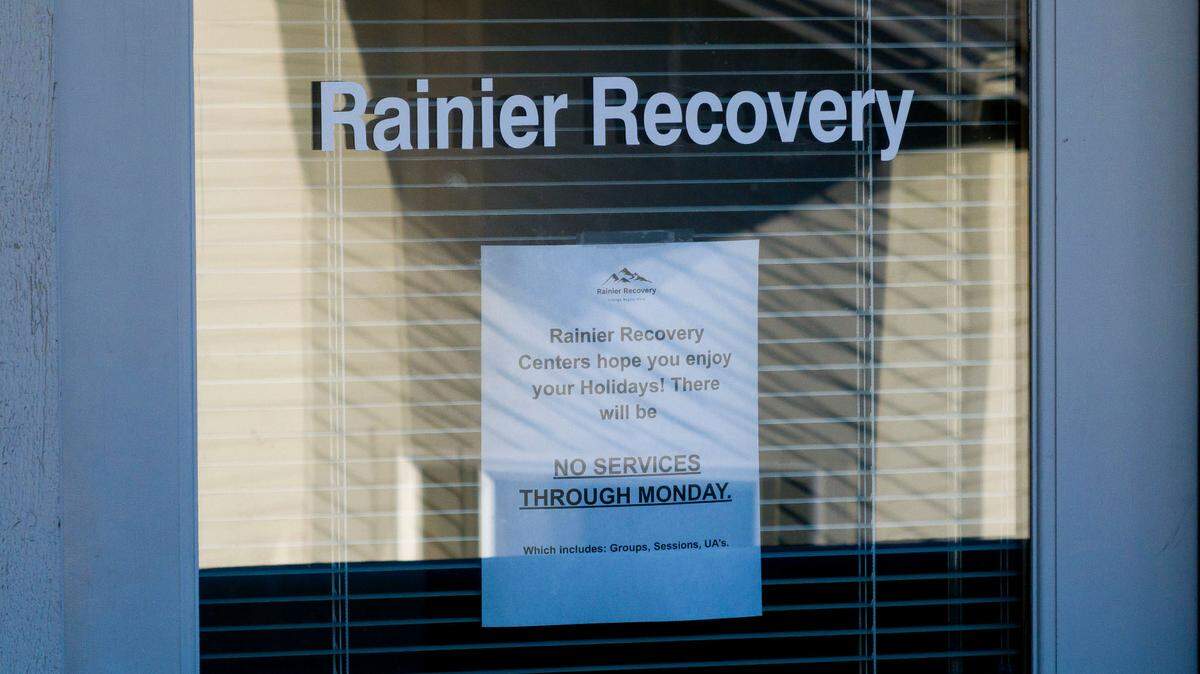
Rainier Recovery, which operated three facilities in Lakewood, Gig Harbor and Puyallup, was ordered in November 2024 to cease accepting new patients after the state suspended its licenses for purportedly jeopardizing patient safety. The substance-abuse treatment provider was soon after put on probation for at least a decade, as part of a settlement, before Dunlap said he sold the business, moved out of state and left the industry.
The statement of charges involving Dunlap’s license suspension provides details into claims that have been previously publicized, including that Rainier Recovery colluded with a law firm to ensure court-ordered clients were compliant with sobriety in exchange for continued business from the firm.
Roughly eight treatment-provider staff members told the Department of Health that Dunlap “had a mutually beneficial relationship with at least three attorneys,” according to the statement of charges.
“Clients referred to Rainier by these attorneys would be (1) given high priority, (2) reported to be in full compliance even if there was a record of less than full compliance, or (3) given lower levels of recommended treatment even if assessments showed higher levels of treatment were necessary,” the statement said.
Earlier this month, the mother of a 34-year-old Sumner man sued Rainier Recovery for wrongful death after her son died from fentanyl intoxication. The lawsuit alleges the provider failed him, including by concluding he required the lowest level of treatment despite evidence otherwise.
The patient’s death is also cited in the statement of charges, which noted that Rainier Recovery’s recommendations for his care “were not supported by the client’s clinical record.”
Dunlap, who received his SUDP license in 2015, said Monday that the health department’s move to suspend his credential was political in nature and part of a campaign against him motivated by “media pressure.”
“I did everything I knew how to do, to the best of my ability,” he said.
Dunlap acknowledged having “a mutual affair” with a staff member, but denied making any sexually inappropriate comments to employees, allowing employees to work without a state-certified credential, not having an SUDP or other supervisor on staff, or inappropriately changing any documentation.
“I didn’t alter records,” he said. “If I fixed something because there (were) errors or a typo, that is my job.”
Ultimately, he claimed, the allegations were based on hearsay, not facts.
“We just believe this Department of Health because they’re the authority, but they’re the crooks here,” he said. “They’re the ones who are the face of corruption, and I would ask the public to stop being sheep.”