Pierce County Jail made dicey hires to fight staffing crisis, review finds
AI-generated summary reviewed by our newsroom.
- Review says audit found 16 of 85 hires from 2023–25 shouldn’t have been hired.
- Urgent staffing needs led to questionable hiring decisions.
- Corrections deputy later arrested spurred audit, internal probe and leadership scrutiny.
Facing a staffing crisis in the jail in 2023, Pierce County officials hired people for corrections jobs who had admitted to domestic violence, had disqualifying prior drug use or had a poor driving record, a Clark County investigator has found.
One of the new hires, Cameron Boucher, was arrested after he allegedly backed his pickup over his ex-girlfriend’s head while intoxicated in downtown Tacoma on New Year’s Day 2025.
At the request of Pierce County Sheriff Keith Swank, the Clark County Sheriff’s Office last fall conducted an independent review of an internal investigation in the Pierce County Sheriff’s Office. The internal investigation looked at hiring practices in the Corrections Bureau between 2023 and 2025.
The review, which found no policy violations by the officials who made the hiring decisions, shows Boucher was initially disqualified from employment during the hiring process because he had a recently suspended driver’s license from Rhode Island and a history of driving infractions. The fact that a relative of Boucher’s worked at another law enforcement agency got his file another look, according to Clark County’s review. His disqualification was overturned.
He wasn’t the only one who investigators say should not have been patrolling the county jail.
Before the Pierce County Sheriff’s Office launched its internal investigation in summer 2025, the agency’s unit devoted to conducting background investigations for new hires performed an audit of everyone hired to work in the Corrections Bureau between 2023 and April 2025.
The audit found that of the 85 people hired, 16 should not have been hired due to background concerns, and 15 others were terminated. Swank told The News Tribune he fired six of them, including Boucher. The others were two employees who failed pre-academy training, two who failed their field-training program and another who Swank said cheated during their time in the police academy, the Washington State Criminal Justice Training Commission.
Swank said the others were terminated before he took office when Ed Troyer was sheriff.
Of the 16 who shouldn’t have been hired, six have been disciplined or counseled for unsatisfactory work performance, according to Clark County’s review. One of them falsified records, landing the corrections officer on county prosecutors’ list of law enforcement with credibility issues.
Put another way, in a two-year span, more than a third of individuals hired to work in the Corrections Bureau either shouldn’t have been allowed to work there or later lost their jobs.
Clark County’s review concluded that the leaders in charge of hiring at the time, Troyer and former corrections chiefs Patti Jackson and Kevin Roberts, did not violate any department policies. It did find that the urgency to fill vacant corrections deputy positions led to questionable hiring decisions.
In a statement to The News Tribune, Troyer said the Sheriff’s Office was experiencing critical staffing shortages when he was in charge, particularly in corrections. He said focused recruiting and onboarding efforts avoided an alarming scenario: shutting down housing units in the jail due to insufficient staffing, which he said would have meant releasing inmates early.
“All hiring decisions during that period followed established processes, and I was fully aware of and responsible for those processes,” Troyer said. “As the leader at the time, accountability ultimately rested with me — for both the successes and the challenges. That responsibility is not something I have ever avoided.”
Only Roberts remains employed at the Sheriff’s Office. Troyer is retired from law enforcement, and Jackson, who ran unsuccessfully against Swank in the 2024 election for sheriff, now leads the Tacoma Police Department as interim chief. She appears close to cinching the permanent job.
Before Swank requested that Clark County review the internal investigation, the sergeant in charge of it noted that Jackson had possibly violated a policy for unsatisfactory work performance based on candidates hired during her tenure. Clark County’s review disagreed, blaming any transgressions in skirting hiring standards on Troyer as the ultimate hiring authority.
Corrections deputy’s arrest prompted investigation
The genesis of an investigation into the Corrections Bureau’s hiring practices was the arrest of Boucher, who in January 2025 was a suspect in a felony domestic-violence assault. He was charged with DUI vehicular assault, pleaded not guilty, and his case is ongoing. The incident prompted Sheriff’s Office Chief of Administrative Services, Scott Mielcarek, to request a review of Boucher’s employment history.
That review found issues with Boucher’s driving record. Swank told The News Tribune the issues made him question what was going on with hiring in corrections, and he asked the agency’s unit devoted to doing background checks to conduct an audit of hires made between 2023 and April 2025.
That time frame coincides with part of Jackson’s tenure as corrections chief, covers when Roberts filled that role during the last eight months of 2024 and ends shortly after Swank took office. Based on Clark County’s review, Swank and his command staff appear to have focused on that period to both target Jackson and to include when changes were made to the hiring process.
In 2023, Troyer made changes in hopes of speeding up hiring — namely separating background investigations from a single unit to one in charge of law enforcement applicants and another tasked only with reviewing applicants for corrections. The change was Jackson’s assignment, and according to the Clark County investigation, Mielcarek was concerned Jackson had taken shortcuts to hire applicants who should not have been hired.
Clark County’s review shows Swank also accused Jackson of abusing her authority during a briefing with the sergeant who conducted Pierce County’s internal investigation. The investigator found no evidence that was true.
According to Clark County’s review, Swank and his undersheriff, Cynthia Fajardo, believed Jackson used hiring corrections deputies as an accomplishment she could point to during her 2024 campaign for sheriff. Clark County’s review pointed out that if she did make such statements, she didn’t benefit from them because she lost the election.
Swank frequently criticized Jackson in his campaign, claiming her time in the Corrections Bureau, where Jackson spent much of her career, didn’t prepare her for the responsibilities of a sheriff. He also liked to bring up a vote of no-confidence she received from the Pierce County Corrections Guild.
Jackson sought higher ground, eschewing personal attacks in favor of focusing on her experience running the jail and trying to relate to voters over the daily realities of public safety issues. At a campaign fundraising event, she asked attendees if they were tired of seeing an armed guard at Target or having to get someone to unlock a cabinet to get some detergent.
Reached by phone for this story, Jackson did not want to speak about the hiring practices investigation.
The Clark County investigator spoke with Jackson, and she declined a formal interview request but said the Corrections Bureau was and is facing significant hiring deficits like every other agency in the state. According to the review, Jackson said she had Troyer’s support for any hiring decisions she made. She said she has never worked for Swank’s administration and only wished it the best.
Pierce County’s audit of hiring in the Corrections Bureau was completed in June 2025. According to Clark County’s review, Swank and Fajardo then directed Mielcarek to start an internal investigation with the purpose of determining if hiring standards were followed while under Jackson’s supervision.
The sergeant who led the investigation conducted interviews with Corrections Bureau personnel who were involved in the candidate background-investigation process. According to Clark County’s review, she determined hiring standards were not maintained and that background investigators were not fully trained.
The sergeant apparently felt that Jackson had “possibly” violated a policy on unsatisfactory work performance, according to Clark County’s review. She reached out to Troyer to further understand how Jackson administered the background process, but the review states that Troyer did not return her calls (Troyer told The News Tribune he was never contacted).
On July 9, 2025, the sergeant gave Swank and Fajardo an update on her investigation. During the briefing, Swank brought up concerns about some of the findings. According to Clark County’s review, after two corrections candidates failed their psychological exams, Jackson contacted the psychologist to take another look, and the results were changed.
The concerns were reported to a deputy prosecutor in the Pierce County Prosecuting Attorney’s Office who oversees the committee on potential impeachment evidence, also known as the Brady list, a list of law enforcement with credibility issues. According to Clark County’s review, the deputy prosecutor did not believe the relevant state law applied, RCW 10.93.180.
Sheriff Swank suspended investigation for outside review
On July 14, 2025, Swank called the sergeant and asked her to suspend the investigation pending a review by an outside agency. At the time, the sergeant still had not interviewed Roberts. According to Clark County’s review, the sergeant believed he needed to be interviewed for possibly violating the unsatisfactory work performance policy.
Swank explained to The News Tribune that he wanted the investigation reviewed because it was beginning to make concerning findings. He was worried the investigation would be perceived by the public as retribution, and he wanted an independent law enforcement agency to determine if it was being conducted in a fair, unbiased and valid manner.
He said he selected the Clark County Sheriff’s Office because it was a larger sheriff’s office that runs its own jail and hires its employees, but that’s not accurate. Sgt. Chris Skidmore, a spokesperson for the Clark County Sheriff’s Office, told The News Tribune that the jail has been independent of the sheriff’s office since Jan. 1, 2023.
Asked why Clark County accepted the request to review Pierce County’s investigation, Skidmore said it’s not uncommon for one sheriff’s office to ask another to review an investigation if there’s perceived to be a conflict.
The investigator who did the review is a sergeant who has also helped out with Internal Affairs, Skidmore said. According to Clark County’s review, a Pierce County Internal Affairs lieutenant called the sergeant on Aug. 4, 2025, to ask for the review. Two days later, in Chehalis, the lieutenant and the sergeant who conducted the Pierce County investigation provided the Clark County sergeant with documents from their investigation.
In reviewing the documents, the investigator noted there were four former and current corrections deputies, including Boucher, he found of interest. He did in-depth analyses of the four hires. It’s unclear why those four were chosen.
The Clark County investigator concluded that Pierce County’s internal investigation was fair, impartial, unbiased and valid so far — it is not yet complete.
Swank shared a 29-page investigation narrative of Clark County’s review that was completed in October with The News Tribune. In an email Jan. 16, Swank said he thought he should share it after reading an article that reported that Tacoma officials appeared poised to promote Jackson to permanent police chief.
“I have had to fire several people that she hired during my first year in office,” Swank wrote. “Way more than usual, and some of these hirings will be a heavy financial burden to the county. I didn’t put this out before because everyone (including you) would have just said it was purely political.”
Now that the investigation is back with Pierce County, Swank wants to scrutinize the hiring decisions for the rest of the employees who possibly should not have been hired.
“I don’t have enough people in Internal Affairs to be able to do that, so we are going to try to figure out a way to do it,” Swank said in a phone call.
Former jail leaders defend hiring practices
The leaders at the center of Swank’s internal investigation defended the jail’s hiring practices in statements to the Clark County investigator or to The News Tribune.
In a statement to the newspaper, Troyer said personnel matters are confidential, but the conclusion of Clark County’s review speaks for itself.
“Without those employees, mandatory overtime would increase significantly, and housing units could once again face closure due to staffing shortages, causing mass releases of criminals back into the community,” his statement said.
Efforts to reach Roberts for comment were not successful. He sat down with the Clark County investigator for a two-hour interview along with a representative from the Pierce County Deputy Sheriffs Independent Guild on Oct. 20, 2025.
Clark County’s review says it was Jackson who mentioned that Boucher had a family member working at another police agency and asked Roberts to reconsider his disqualification. Roberts acknowledged in his interview that it was his decision to overturn Boucher’s disqualification.
The Clark County investigator asked Roberts if he would hire Boucher if he had it to do over again.
“Absolutely not,” Roberts said, according to the review. “Because of, you know, he wasted an opportunity that we took a little bit of a risk on him.”
“Lt. Roberts explained with the hiring deficit the Corrections Bureau was facing, he was willing to provide this person with an opportunity to better himself,” a synopsis of the interview states. “Also, Boucher would not be driving for the agency as a new corrections deputy. Lt. Roberts noted the Hiring Standards change all the time and they are standards not policies.”
At one point in the interview, when the investigator asked about Roberts’ awareness of the hiring audit, Roberts said he found the timing and specificity of the audit to be targeted. He said a hiring audit was not done on the law enforcement side of the Sheriff’s Office.
“If we as an organization are trying to make sure that we are doing a very good job globally, then one would look and go, well, let’s look at all of our backgrounds,” Roberts said, according to the review, “‘Cause then you could assume if we’re just doing corrections, that we’re just looking and targeting a specific bureau or leadership within that bureau, i.e., Chief Jackson or myself.”
Roberts described the jail’s staffing crisis as “massive” and said there were 43 vacancies when he was chief, causing excessive mandatory overtime.
Pierce County budget documents show that in 2024, when Roberts led the Corrections Bureau, 248 corrections deputies were budgeted to work in the jail. In July that year, records show the jail’s average number of inmates in custody was just below 800.
Corrections candidates failed polygraphs, psych exam
Clark County’s review of the hiring of four former and current corrections deputies included information from Internal Affairs documents and interviews with background investigators and a polygraph exam administrator.
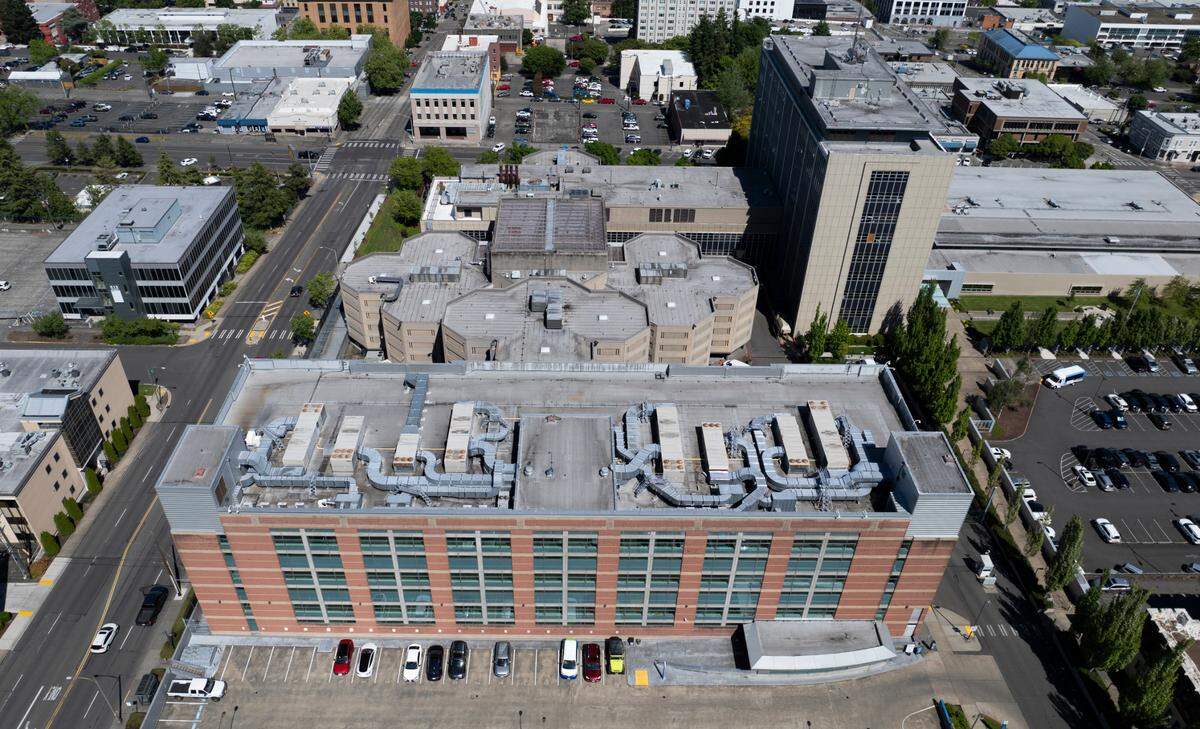
Background investigators for the Pierce County Sheriff’s Office complete background checks for candidates and sometimes provide recommendations about hiring them. Clark County interviewed two of them and the polygrapher on Oct. 2, 2025, at a Pierce County government office building on Pacific Avenue in Tacoma.
Clark County’s review found that the first employee, whose initials are A.C., failed a psychological examination in 2024 and received results that concluded “Suited with Qualifications” and “Poorly Suited.” According to Clark County’s review, the results were later changed to drop the “Poorly Suited” finding.
A Pierce County background investigator told Clark County that Jackson called the Federal Way-based psychologist and got the results changed. The backgrounder said changing the findings was unusual, but the conclusions for either exam weren’t automatically disqualifying.
Jackson held off on hiring A.C. for a few months, according to the Clark County review. The review stated that was done so the candidate’s last admitted drug use would be more than three years old. A background investigator said the type and frequency of drugs A.C. used in the past 10 years would have disqualified him — cocaine three times in 2016 and hallucinogenic mushrooms three times in 2020.
The second employee, whose initials are L.G., was allowed to take a second lie-detector test after she had a “Significant Reaction” in her first polygraph and a finding of “Deception.” Clark County’s review said civil service hiring standards should have automatically disqualified her.
The question that prompted the significant reaction was: “Are you withholding information about your involvement with illegal drugs?” In the second exam, which occurred nearly 20 days later, that was split into two questions: “Are you withholding information about your involvement with illegal drugs?” and “Are you concealing information about selling or delivering any illegal drugs?”
The Pierce County Internal Affairs polygrapher who was interviewed — but did not conduct L.G.’s exams — said he was not aware of any policy that would have allowed a second lie-detector test in the case. Swank told The News Tribune there also isn’t a policy that specifically precludes candidates from taking a second exam.
Roberts told the investigator allowing a candidate to take a second polygraph has occurred before on a case-by-case basis. According to Clark County’s review, Roberts said if there are specific reactions to a question, they commonly investigate it further to determine if the polygraph was appropriate.
L.G. also self-reported before the polygraph that she hit her boyfriend in the cheek and shoulder during an argument a year before she started the backgrounding process, leaving a bruise on his shoulder. No one called the police, but Clark County said that was an automatic disqualifier.
Records noted that Jackson was involved in L.G.’s background process and that Roberts was involved in a candidate-assessment meeting as chief, according to Clark County’s review. Information from the first polygraph wasn’t presented at the meeting because L.G. passed the second exam. The domestic-violence incident was noted in the meeting as a weakness, and Jackson was going to discuss it with Troyer.
The third employee, whose initials are K.B., also was allowed to take a second polygraph exam after her first yielded a “Significant Reaction” and an “Un-Truthful” finding.
A background investigator said K.B. came across as deceptive when she was asked if she had ever committed a serious crime she had not disclosed. The question was removed on the second polygraph, and K.B. was instead asked if she had ever been the aggressor in a domestic-violence incident. K.B. was not found to be deceptive.
Clark County’s review included information about K.B. potentially having been the victim of domestic violence. A background investigator said Roberts might have had knowledge of that, and that it might have been part of why she was allowed a second polygraph exam, but Roberts could not recall when he was asked.
The fourth employee was Boucher. Clark County’s investigation found he was disqualified at a candidate-assessment meeting for his recently suspended license and his poor driving record, but Roberts overturned the decision and gave him a second chance.
This story was originally published February 2, 2026 at 5:00 AM.