Lawyer looking to represent Sheriff Keith Swank takes another hit in court
A promise to pay Pierce County Prosecutor Mary Robnett’s attorney fees from the lawyer who has sought to represent Sheriff Keith Swank — if the Washington Supreme Court affirms she has to pay up — was not enough to convince a judge on Friday that she had satisfied requirements to put up the money.
The attorney, Joan Mell, had asked the court to accept a line of credit with a Montana bank as a form of alternate security after the Supreme Court ordered her to furnish a bond or other security equal to the amount prosecutors calculated she owed, $167,244.59, pending a review of a lower court order.
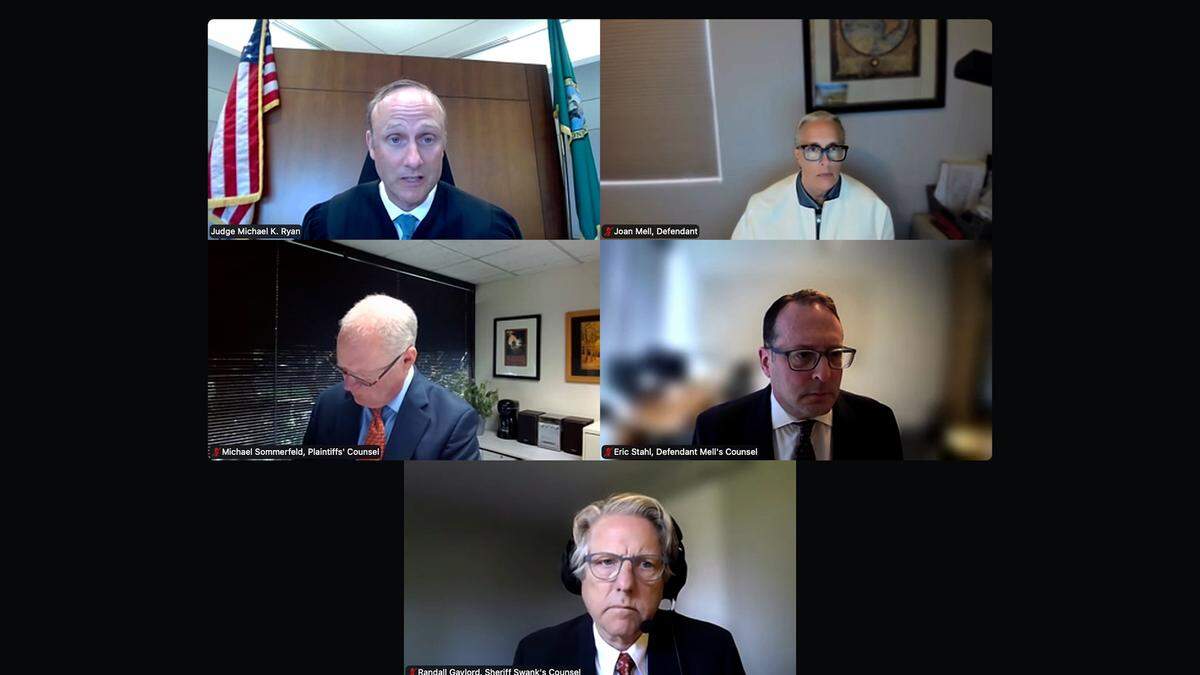
King County Judge Michael Ryan said during an April 24 court hearing on Zoom that he thought Mell’s arguments boiled down to the notion that as an attorney and an officer of the court, Ryan should trust that Mell would pay Robnett’s fees, and she has a lot at stake if she doesn’t. He added that he wasn’t passing on Mell’s credibility, but he didn’t know of any case that has held that.
“This is effectively a promise to pay and, ‘Please just trust me,’” Ryan said. “And I don’t think that that’s sufficient. I don’t think that Washington law would adopt the conclusion that somehow lawyers are treated differently than other litigants in our system. And so, at the end of the day, I’m going to deny the motion.”
Ryan said there was nothing prohibiting Mell from taking the money out of her line of credit and putting it into the court registry, where it would generate interest. Ryan was only tasked with deciding whether the line of credit was sufficient as alternate security, so what happens next will have to be taken up with the Supreme Court.
Robnett’s lawsuit against Mell seeking to permanently bar her from representing Swank in an official capacity, called a quo warranto action, has been on pause in Pierce County Superior Court since Feb. 12. A preliminary injunction still enjoins Mell from representing Swank.
Mell asked the Supreme Court for a stay on the proceedings in January after Ryan rejected her claim that she had a First Amendment right to represent Swank. The visiting judge refused to grant Mell’s motion seeking dismissal of the lawsuit against her under the Uniform Public Expression Protection Act (UPEPA).
Mell asked the high court to hit pause after four attorneys and three legal assistants calculated that they’d spent hundreds of hours battling her UPEPA motion. Her request was made before she responded to the amount of money Robnett was asking her to pay, and before Ryan could rule on what was a reasonable amount.
During the April 24 court hearing, Ryan questioned whether Mell and her attorneys had interest in mind when they moved for a stay on the proceedings. The judge said he thinks the motion to stay foreclosed prosecutors from earning interest while the parties waited on a ruling from the high court, which Ryan said could take years.
Mell’s attorney, Eric Stahl, said it wasn’t the primary driver of filing the motion.
“Did it cross our minds? I can’t swear that it didn’t,” Stahl said.
The high court’s list of accepted cases shows that the case could be reviewed during the justice’s fall term, which begins in September. But the court does not have a cutoff for how quickly it has to make a decision.
The Supreme Court on Feb. 12 agreed to review Ryan’s ruling on the UPEPA motion, including his order that Mell pay Robnett’s attorney fees, and it granted Mell’s motion to stay the lower court proceedings in the meantime. As a condition of the stay, Supreme Court Commissioner Michael Johnston told Mell to furnish a supersedeas bond, cash or other security in the amount of $167,244.59.
Johnston did not set a deadline, and more than a month passed before Robnett’s attorneys notified the Supreme Court that Mell had not yet posted the bond or other security and asked it to lift the stay.
Days later, on March 20, Stahl asked the Supreme Court to accept as security a $200,000 commercial line of credit with TrailWest Bank that would be available to Mell until at least July 24, 2028. Stahl wrote that procuring a supersedeas bond or posting cash were not practical options.
Attorneys for Robnett responded by saying the proposed alternate security was nothing more than a promise to pay any future judgment.
On April 3, Johnston transferred Mell’s request to accept the line of credit as alternate security back to Superior Court. He made note of the fact that Mell waited to make her motion for alternate security until Robnett called her out.
“The stay ruling did not set a date for obtaining a bond or alternate security, though I assumed, rather naively as it turned out, that Mell would do so with alacrity,” Johnson wrote. “Instead, nothing happened until March 16 …”.
In court April 24, Ryan asked Stahl why his client didn’t do something sooner. Stahl said the record showed that Mell did inquire about obtaining a surety bond the day after the Supreme Court issued the stay.
Mell made that inquiry and learned it would cost her more than the amount she was required to secure, according to her attorney’s motion for alternate security. Stahl also said in court that because there wasn’t a deadline and the court’s docket had grown quite large, they were reluctant to burden the Supreme Court with another motion.
Ryan seemed skeptical. He asked if Mell would have waited six months if attorneys for Robnett hadn’t said anything. Stahl said no.
Mell jumped into the back-and-forth with Ryan to defend her credibility and the sufficiency of her line of credit with the bank.
“I’m a credible person,” Mell said. “I’m not going to move it. I’m not going to spend it. The bank is not a fly-by-night bank. I don’t have a relationship with the bank where they’re going to disregard the significance of how this is playing out in the court as a favor to me and a wink and a nod. That’s not what’s happening here. I’m taking it very seriously.”
Mell said if she has to draw on the line of credit and move the money over into the registry of the court, she would have to start paying interest at over $1,000 a month. She said that would substantially impair her ability to operate nimbly in her line of work. Mell is the sole practitioner of her law firm, III Branches Law, which has offices in Montana and Fircrest.
“I’m trying to come up with options that do convince the court that I will pay it, and I’m taking it seriously if I have to and have the means to do it and have secured the means for doing it,” Mell said. “But I’d like to do it in a way that doesn’t impair my ability to practice and take income away from my family and my livelihood until such time as is deemed needed.”
Mell added that if it was necessary to calculate interest on the bond or other security, she had a sufficient line of credit to add $25,000.
“I think that a civil litigant like myself, as a sole practitioner and not a big corporate entity who can get a civil bond at a proportionate amount of the total judgment at risk, is substantially prejudiced because, simply because I don’t have the money that other people do,” Mell said.
During a response from Robnett’s attorneys, deputy prosecutor Michael Sommerfeld questioned why Mell couldn’t just post cash. He said Mell could make a request to the clerk and interest would accrue, and if Mell prevailed, she would get that interest back.
“The fact that one might not be able to, you know, make interest on funds, that’s the cost of litigation,” Sommerfeld said. “The award could have been lower if we had gone forward, but she is the one asking for the court not to have the hearing, and so she’s really put herself in this position.”
Ryan made a similar statement during the hearing. If Mell hadn’t asked the Supreme Court to order a stay and moved forward with litigation over Robnett’s attorney fees, Ryan said he could have determined that prosecutors were only entitled to $100,000 or $40,000 in fees.
“So now that number’s baked into the equation, the 167 number,” Ryan said. “I could have said, you know, they worked too many hours on this, or the rates were too high, you know, the standard lodestar calculation. But I never had that opportunity, right?”