It’ll cost many millions to fix salmon barriers in Gig Harbor. Culvert removal ahead
It’s not easy for fish to cross Harborview Drive next to Donkey Creek Park in Gig Harbor.
First, depending on tide and water flow, they have to jump about a foot to make it into the culvert underneath the road.
“A small-height jump for them is a big waste of energy,” Harbor WildWatch education director Rachel Easton said.
Then, without any places to take a break, they have to swim about 60 to 70 feet upstream to make it into North Creek on the other side.
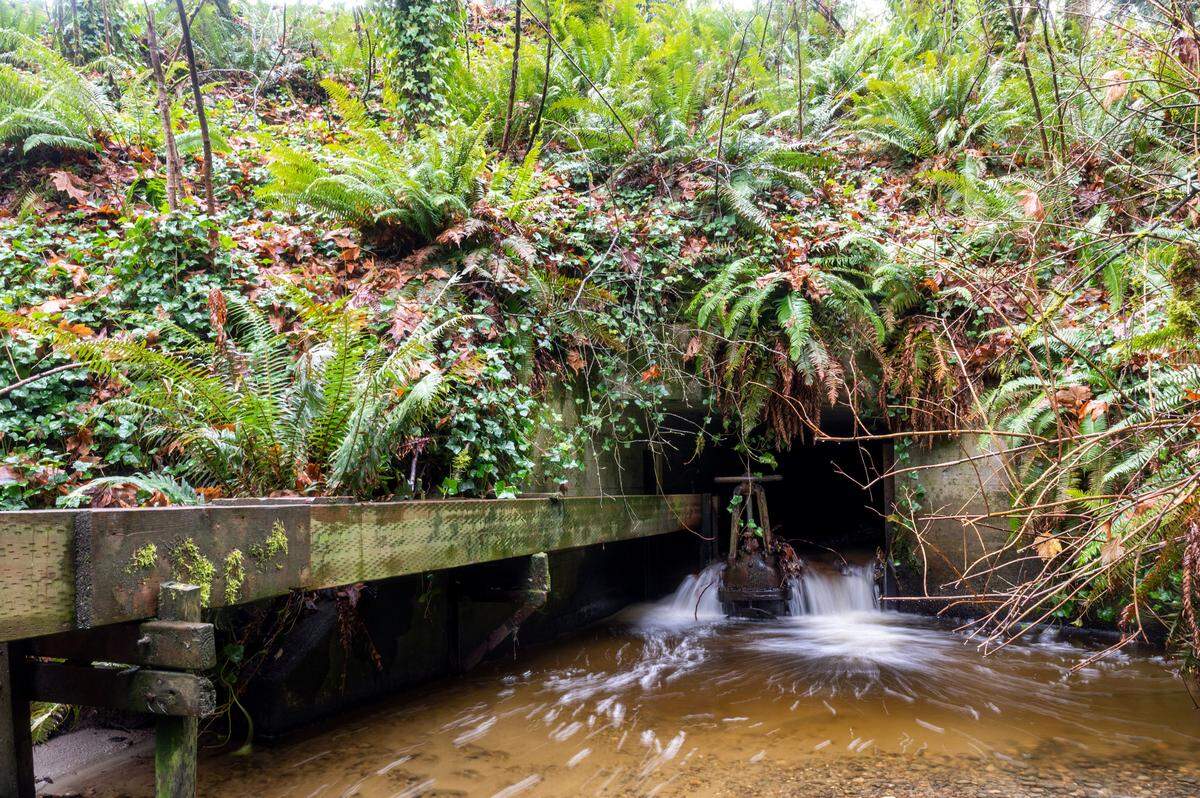
In the coming years, fish trying to make that journey — coho and chum salmon, as well as coastal cutthroat and Puget Sound steelhead trout — might get some help.
The barrier is one of Gig Harbor’s highest priorities on the list of culverts the city is looking to remove in the next few decades to help with salmon recovery.
The state Department of Fish and Wildlife’s fish passage map identifies city-owned culverts that need to be fixed. There are 14.
Like similar work happening across the state, that won’t be cheap.
Carl Schroeder with the Association of Washington Cities said there’s currently an estimated 1,600 city-owned culverts in Washington that are barriers to salmon recovery, and that it’ll cost roughly $2.9 billion to fix them.
“Cost is very site specific, how much fill, or how deeply buried the culvert is, length of the culvert, what sort of correction is needed such as a large box culvert versus a bridge, that sort of thing,” Schroeder said via email. “We have cities who own culverts of salmon bearing streams that stretch for over a mile under developed area of town, something like that would be very expensive to fix.”
A great deal of work has been done in recent years to fix state-owned culverts, following a lawsuit brought by Washington tribes with treaty-protected fishing rights and a subsequent U.S. Supreme Court decision that cemented a ruling that state-owned culverts be removed by 2030.
But addressing state-owned culverts, the AWC argues, won’t be enough.
“Fixing only state-owned culverts will make the state’s investment incomplete at best and ineffective at worst,” it said in a 2020 fact sheet. “On average, there are two downstream and five upstream culverts associated with each state barrier. Investing only in state-owned culverts without addressing all barriers will not achieve the goal of salmon recovery.”
Schroeder said cities aren’t “under a court order or direct regulatory push” to fix their barriers, but “there is a law making it illegal to own a fish blocking structure. We have been spending years trying to understand the scope of our challenge and how to prioritize our corrections.”
What’s been done, what’s next
Jeff Langhelm, Gig Harbor’s public works director, said the lawsuit applies to all jurisdictions that have “culverts on fish-bearing waters of the state.”
There isn’t a clear time line for when cities have to fix those culverts, he said.
While there isn’t a replacement schedule or replacement budget, he said it’ll likely cost Gig Harbor nearly $100 million and take a few decades.
The city has submitted permits for one of the projects on a tributary to North Creek and hopes to start construction next year. That culvert is close to the RV park at 9515 Burnham Dr. The city has budgeted $2.4 million for the work to replace it, and the hope is that permits would be approved and construction would start next year, Langhelm said.
Another major project, close to the Harborview Drive barrier at Donkey Creek Park, was already finished.
That 2012 project removed a nearby culvert downstream and was called the “daylighting” of Donkey Creek.
An 80-foot pedestrian bridge was constructed on North Harborview Drive to open up the creek, a footpath was installed underneath along the water, and a one-way bridge for cars was built. The bridge also has a bike and pedestrian path.
The work cost about $5 million, and the Harborview Drive project just upstream would probably cost more than that, Langhelm said.
Among possible sources of local, state and federal funding is the recent federal infrastructure act. The city is talking to U.S. Rep. Derek Kilmer about potentially applying for those funds to support the Harborview Drive project.
“There is money for salmon recovery,” Langhelm said.
The city hopes to design the project next year, then get the necessary permits, which would put construction into 2024.
‘Choke point’
The culvert is the first major barrier fish encounter from the saltwater of the harbor, said Easton with Harbor WildWatch.
The nutrients the fish bring help support the trees in the area, Easton said, and they’re a food source for other animals.
“This is a choke point,” Easton said about the project. “... If we can keep fish healthy here, we increase the health of everything else around.”
The culvert is next to a salmon-incubator project meant to increase the chum salmon population. There’s a wooden flume by the culvert that’s part of that project, the Donkey Creek Coop Egg Rearing Incubator. It hasn’t been active for a few years, but City Council member Robyn Denson said the hope is to get it going again.
Denson also said the culvert replacement work might bring chinook salmon, a primary food source for southern resident killer whales, to the area.
“We’re hopeful that this will attract chinook in time,” Denson said.
The culvert is next to 23 acres of undeveloped land and another 11.5 acres of undeveloped land — prime salmon habitat — that the city is in the process of trying to purchase to preserve.
The property has pools, shade and gravel that’s good for salmon spawning.
The city plans to pay $500,000 for the 11.5-acre property, The Gateway reported, with a grant from the Pierce County Conservation Futures Fund and matching funds from the Puyallup Tribe.
If the sale goes through for the 23 acres, $5.8 million would come from the city through a combination of funds and $1.2 million would come from the Conservation Futures Fund, a policy analyst told the Pierce County Council at its meeting Dec. 7, at which the county funding was approved.
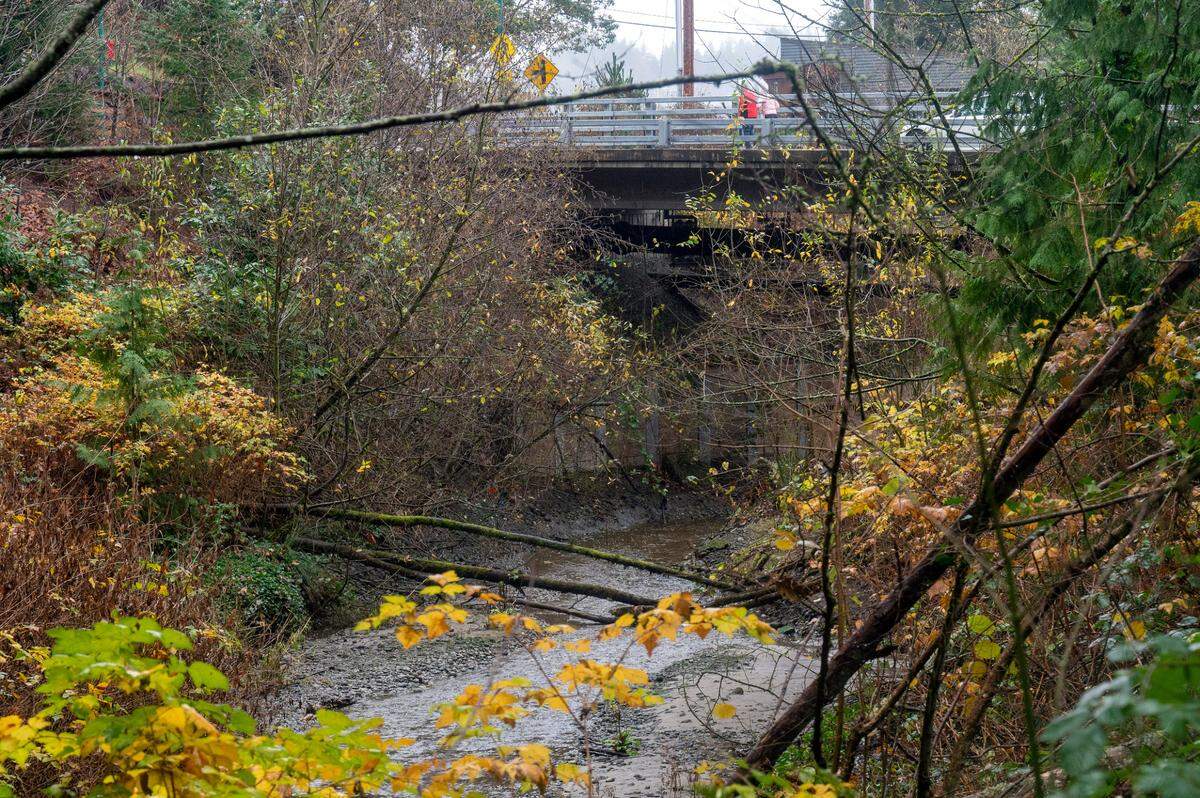
The area was part of the original village of the sx̌ʷəbabs people, a branch of the Puyallup Tribe.
“One of our main priorities is to recover lost tribal land, and this was part of a historical tribal village site,” the Puyallup Tribe’s land planner and assistant historical preservation officer, Jennifer Keating, told The Gateway earlier this year about the 11.5 acre property. “Equally important, it’s home to salmon, which are a critical part of our past and present culture. We’re losing our tree canopy, and salmon-bearing streams like this are getting harder and harder to find.”
Denson said her dream for the culvert-replacement project would be a meandering walking path underneath Harborview Drive, connecting through the undeveloped land to the Cushman Trail. A scaled-back version might be a smaller archway, big enough to allow salmon through, but not a walking path.
“This type of natural habitat just doesn’t exist anymore,” Denson said.
Editor’s note: A previous version of this article gave incorrect figures for the number of city-owned culverts in Gig Harbor that need to be fixed and the total estimated cost for those projects. There are 14 culverts, which should cost nearly $100 million to replace.
This story was originally published December 12, 2021 at 5:00 AM.