Puyallup targets streets for traffic safety changes, ‘stealth mode’ speed signs
Radar speed signs will be deployed soon as part of the city of Puyallup’s new proactive traffic-calming pilot program to help with safety.
The new program will be part of the city’s existing Neighborhood Traffic Calming Program in a more proactive approach, according to city spokesperson Eric Johnson. Currently, if there are traffic safety issues in a neighborhood, the existing program requires residents to take action first such as through a petition.
“The pilot program came out of our Council Retreat in February, in which staff presented the program to Council,” Johnson told The News Tribune via email last week. “Council directed staff to make the program more proactive. In other words, staff should be proactively looking at areas of the City that are good candidates for traffic calming measures and then bringing that to residents for feedback. Since then, staff have been working on a pilot program and will be implementing it in the coming weeks.”
Johnson said residents can still request neighborhood traffic calming through the normal application process. He added that the intention of the new pilot program is for staff to study areas proactively and then go to the residents with proposed traffic calming mitigations, if the findings determine that is warranted.
Johnson said the new pilot program takes the burden off residents from starting the process and creates a more collaborative approach between them and staff.
The current traffic calming budget is about $193,000 and comes out of city funds, Johnson said.
Ken Cook, development engineering manager for the city, presented the pilot program during the June 2 council meeting. City employees met with Pierce County to discuss their program using speed signs, which appeared to work well, Cook said. He said the city plans to incorporate a similar process into their program using mobile speed signs.
The city owns four radar actuated displays, and they will be used in the proactive traffic-calming program to collect speed data.
Cook said the goals of the program are to:
- Reduce speeding and improve neighborhood safety
- Apply a consistent evaluation process
- Use city resources efficiently
- Proactively respond to community concerns
According to Cook, the program will have a two phased approach. Phase one, which has four steps, is titled “Data Collection, Education, and Enforcement.”
“In the first step we will deploy the radar speed signs for two weeks,” he said. “For the first week of each deployment, the unit will be in stealth mode, which does not provide speed feedback and appears to be turned off.”
Cook said speed and volume data will be recorded discreetly “to accurately represent normal conditions.” The signs will be switched on the second week, so the driver can see what their speeds are. Some of the reasons for this, he said, is to see if there are any behavioral changes and to provide driver awareness.
Traffic engineering staff will evaluate the data and determine if there is a speeding issue along the corridor. If there is an issue, then the next step would be enforcement which is in coordination with the Puyallup Police Department.
“After collecting data from Phase One, we will review the data to see if traffic calming measures are warranted. If the data tells us this, then we’ll transition to Phase Two of the Pilot Program, which includes doing targeted outreach to neighborhoods adjacent to the study areas and share the proposed solutions with them,” according to Johnson.
Some proposed traffic calming solutions, Cook said, include speed humps, permanently installed radar speed signs and roadway striping.
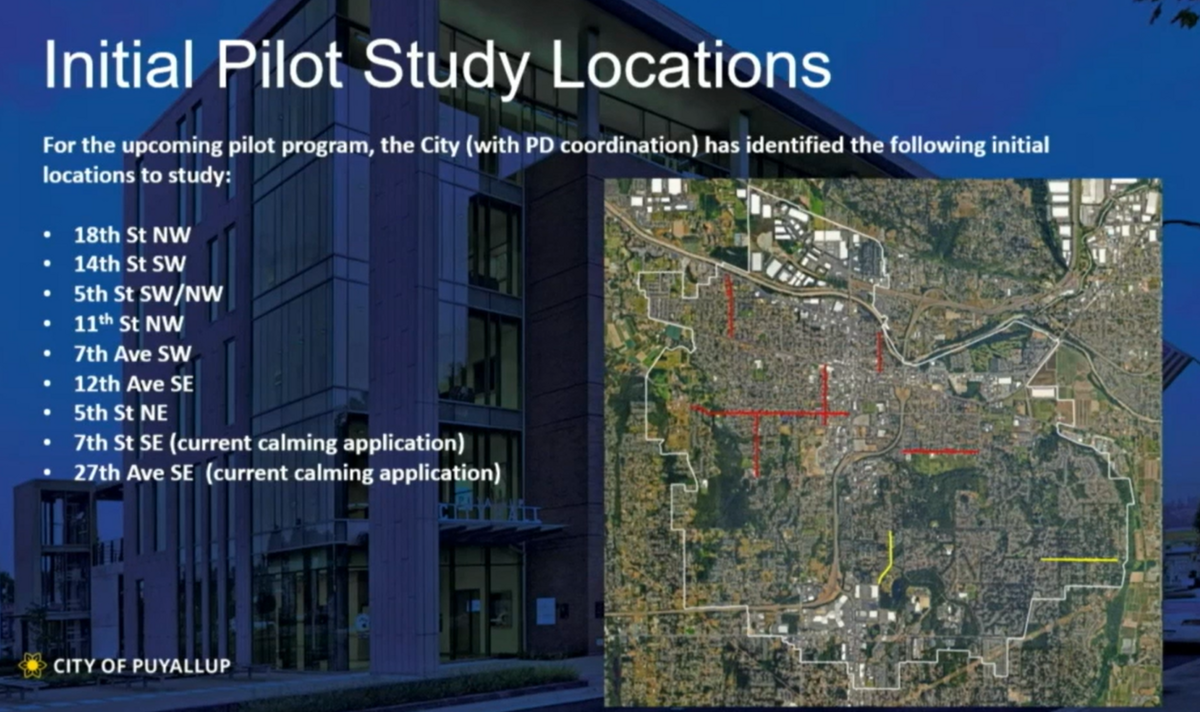
The locations where the initial pilot program study locations will potentially take place have a history of known speeding, Cook said. Some of these locations include:
- 18th Street Northwest
- 14th Street Southwest
- 11th Street Northwest
- Seventh Avenue Southwest
- Fifth Street Northeast
Cook said Seventh Street Southeast and 27th Avenue Southeast are where traffic-calming projects are happening now. Johnson said staff are replacing a speed display device and restriping the white edge lines to narrow the road to encourage drivers to slow down on Seventh Street Southeast.
On 27th Avenue Southeast, staff have installed new double yellow centerline striping and white edge striping. This is also intended to encourage drivers to slow down.
In the council meeting, Puyallup Police Chief Scott Engle said traffic complaints have been consistent in 2024 and 2025 with around 1,600. Traffic stops increased from 9,031 in 2024 to 11,069 last year.
Engle said traffic complaints and concerns are the number one topic the police department hears about.
Johnson said the radar actuated displays will be deployed in the next few weeks. The city has a scoring criteria they use to determine if traffic calming measures are warranted in a specific area. The city lists the criteria on their website. Some factors the city would look at are speed, average daily traffic and pedestrian volume.
Cook said after they collect the data from their nine sites they will go back to the council to discuss the results in about five to six months.
Issues with traffic safety in the past
In the past, Puyallup residents have brought up traffic safety concerns.
In October 2025, a vehicle hit and critically injured a 16-year-old high school student in the intersection of Seventh Street Northeast and Second Avenue Northeast.
Neighbors attended a council meeting after the crash. They told council members that traffic safety has been an issue in the area for a long time.
When The News Tribune asked if this crash is what prompted the program, Johnson wrote that the pilot program is not in response to any particular incident. He reiterated that it came at the request of City Council during the February retreat after staff presented the existing calming program.
“During that presentation, it was suggested by Council that the program be modified to be more proactive. In other words, the existing program relied on residents initiating the process rather than staff initiating the process,” Johnson wrote. “Council concluded that it made the program too onerous on residents and instead should focus on staff taking lead on identifying traffic calming measures city-wide. Council asked staff to take a look at the program and report back with recommendations on how to make the program more proactive.”