Police, civilian witnesses tell conflicting stories of fight that ended in Ellis’ death
The first physical contact in the fatal encounter between Tacoma police and Manuel Ellis was when an officer deliberately hit him with the door of a patrol car.
Ellis, a 33-year-old Black man, was walking home late March 3 after buying donuts and a bottle of water at a convenience store.
Tacoma officers Christopher Burbank and Matthew Collins, partners for nearly four years, were on patrol when they spotted Ellis standing in the middle of the intersection at 96th Street South and Ainsworth Avenue South.
The officers say Ellis approached a slowly moving car, waved his hands and grabbed at the door handle. They wondered if he was trying to carjack the vehicle, or if he’d been kicked out of the car after an argument.
The car made a left turn and sped away. The driver was never located.
“As soon as the vehicle drove off, the suspect turned and kind of fixated on our patrol vehicle,” Burbank told investigators when he was interviewed three days after Ellis died while being restrained by police.
Collins, who was driving the patrol SUV, called out to Ellis and asked him why he was in the road.
Both officers said Ellis jogged over to their patrol car and was sweating profusely, something they found unusual since it was cold outside; the temperature was 41 degrees.
“He stated something to the effect of, ‘I’m having a bad day, I need some help and I have warrants,’” according to a 26-page transcript of Burbank’s interview with Pierce County sheriff’s detectives.
Interview transcripts and recordings were released to The News Tribune by the Sheriff’s Department and the Washington State Patrol, which later took over the investigation into Ellis’ death at Gov. Jay Inslee’s request. State officials found the Sheriff’s Department did not properly disclose a conflict of interest: An off-duty sergeant responded to the scene and helped restrain Ellis.
These documents and the following narrative provide the first look at what the involved officers say happened. In documents released Wednesday, state officials identified a previously unknown fifth officer who played a role in restraining Ellis. The City of Tacoma said Friday it “was only recently notified of the officer’s reported actions on the scene.”
Officer Armando Farinas, the fifth officer, has been placed on paid administrative leave pending the final investigative report and charging decision by the attorney general.
Video of the incident and eyewitnesses contradict some of the police narrative. At least three witnesses who recorded video of the fatal encounter say officers were the aggressors and Ellis did not appear to be fighting back.
“The officers were remarkably inconsistent with reality,” said James Bible, an attorney representing the Ellis family. “When they didn’t know there were independent witnesses and videos, they created a narrative that was absolutely false. At this stage, it’s no longer about four officers, it’s about the entire system in Tacoma and Pierce County that allows for this type of thing to occur over and over again.”
The five Tacoma officers who restrained Ellis spoke to sheriff’s investigators but refused to be interviewed by the State Patrol on advice from their attorneys. Three eyewitnesses who recorded video of the incident did not speak with sheriff’s investigators but agreed to speak with the State Patrol. They said they didn’t feel comfortable speaking with sheriff’s investigators because some the police narrative was different from what they saw unfold.
After calling out to Ellis, Collins told him to wait on the sidewalk and they would help.
Instead, the officers say Ellis walked to the passenger door and threatened to punch Burbank in the face.
Burbank quickly rolled his window up just before Ellis punched the window up to three times, records say. Ellis reached for the door handle. Burbank locked it.
That’s when police say Ellis turned towards Collins, who had gotten out of the patrol car, and faced him in a “fighting stance” with clenched fists.
“As soon as I realized that he had focused on Officer Collins and was probably about to attack him or start fighting him, I used my door to actually door check him and hit him with the door to draw his attention away from Officer Collins and kind of divert him away from that,” Burbank told investigators.
Collins said he planned to handcuff Ellis and get him on the ground.
But Ellis grabbed Collins by his vest — using “superhuman strength” to lift Collins, who weighs 230 pounds with gear on — lifted him off his feet and threw him to the ground, records say.
“From this point on it’s, it’s just a melee,” Collins said. “It’s just wild. There’s fists flyin’.”
Somehow in the commotion, Ellis was knocked to the ground.
Collins tried to pin his upper body down while Burbank attempted to control Ellis’ legs. When that didn’t work, Collins attempted to use a neck restraint on Ellis but was unable to get in the proper position.
The officers unsuccessfully tried to get on the police radio to notify dispatchers they were fighting with someone.
Other officers on patrol heard microphone clicks coming from Collins’ radio and became worried. Dispatchers ordered everyone on patrol to stay off the radio. Police nearby flipped on their lights and sirens and sped toward the scene.
Burbank backed a few feet away from the scuffle and used a Taser on Ellis.
It allegedly incapacitated him for only five seconds before Ellis started to stand up and tossed Collins off of him, according to interview transcripts.
Burbank deployed the Taser a second time.
The shock of the Taser probes allowed Collins to get Ellis onto his stomach. Burbank tried to pull Ellis’ arms behind him so they could put handcuffs on him, but Ellis kept his arms beneath him.
“And the suspect almost feels like he’s doing, almost doing push-ups with us on his back,” Burbank said.
It’s then Burbank was able to hold down the button on his radio and scream their location to fellow officers.
Just miles away, officers Masyih Ford and Timothy Rankine heard Burbank come over the radio and were concerned by the panic in his voice. Burbank had trained both officers in the field and they’d never seen him anything but calm.
“When I heard him scream that, 96 and Ainsworth, I was like, the hair on the backs of my, like the back of my neck like stood up,” Ford told investigators when he was interviewed March 9. “I was like this is bad ‘cause both of those officers, both Officer Collins and Officer Burbank are incredibly trained and talented officers. So if they’re callin’ for help it’s really bad.”
It took Ford and Rankine two minutes to arrive on scene.
Meanwhile, Burbank and Collins continued to wrestle with Ellis so Burbank deployed the Taser a third time and they finally pulled Ellis’ arms behind his back.
Police said Ellis made animal noises, rocked his body and kicked his feet.
Sirens sounded in the distance, telling them help was coming.
As Rankine pulled up, Ford jumped out of the patrol car and ran to assist. He grabbed one of Ellis’ feet and told him to relax, records say.
Seconds passed before Rankine, noticing Ellis was throwing the officers “around like rag dolls,” helped restrain Ellis.
Collins was holding Ellis’ left foot, Ford had a grip on Ellis’ right foot and Burbank was straddling Ellis’ back.
Rankine placed his right knee on Ellis’ shoulder and left knee on Ellis’ lower back so he could grab Ellis’ arm. When Ellis allegedly bucked Burbank off him, Rankine moved all of his weight into the middle of Ellis’ back.
“I remembered thinkin’ to myself that I was like, I kind of was in this situation where I didn’t really know what to do,” Rankine told investigators. “One of the thoughts that came to my head was this might not really end well for all of us if this one individual can take all four of us and move us even though he was in handcuffs.”
It was just after Rankine shifted all his weight onto Ellis that Ellis said, “I can’t breathe, sir, I can’t breathe. Please, sir.”
Both Rankine and Ford later said Ellis spoke in a calm voice, which contradicts video taken of the incident and eyewitness accounts.
Neither Burbank nor Collins mentioned Ellis’ last words in their interviews. In fact, they claimed Ellis spoke no words during the encounter and only grunted and growled.
An officer on scene told Ellis to shut up after he said he couldn’t breathe, according to the State Patrol investigation.
“I remember telling the individual I was like if you’re talking to me, you can breathe just fine,” according to Rankine’s interview transcript.
The entire encounter lasted only four minutes.
Burbank grabbed hobbles from the glove compartment of his patrol car just as four other law enforcement officers arrived on scene. They were Tacoma police Sgt. Michael Lim, Tacoma officer Farinas, sheriff’s Sgt. Gary Sanders and sheriff’s Lt. Anthony Messineo.
Sanders and Messineo were both working off-duty security jobs nearby when they heard Tacoma police put out the call that officers were struggling with a suspect. They responded since they were so close.
Sanders helped Tacoma officers place Ellis’ right leg in the hobbles. Farinas placed a see-through mesh spit mask over Ellis’ head.
Someone called paramedics and asked them to hurry. Police said they believed Ellis was suffering from excited delirium, which can cause violent behavior, unexpected strength and very high body temperature.
Law enforcement groups and some experts say excited delirium is a legitimate condition. Critics often say it is used as an excuse to justify excessive police force.
After the spit mask was placed on Ellis, he became non-responsive. His temperature was “burning up,” his pulse quickened and he had a “1,000 yard stare,” records say.
Tacoma firefighters arrived within nine minutes, according to dispatch logs.
They asked police to remove all restraints from Ellis so they could treat him. Police reluctantly did so after warning firefighters that Ellis had been difficult to get under control.
Despite CPR and other life-saving attempts, Ellis was pronounced dead at the scene.
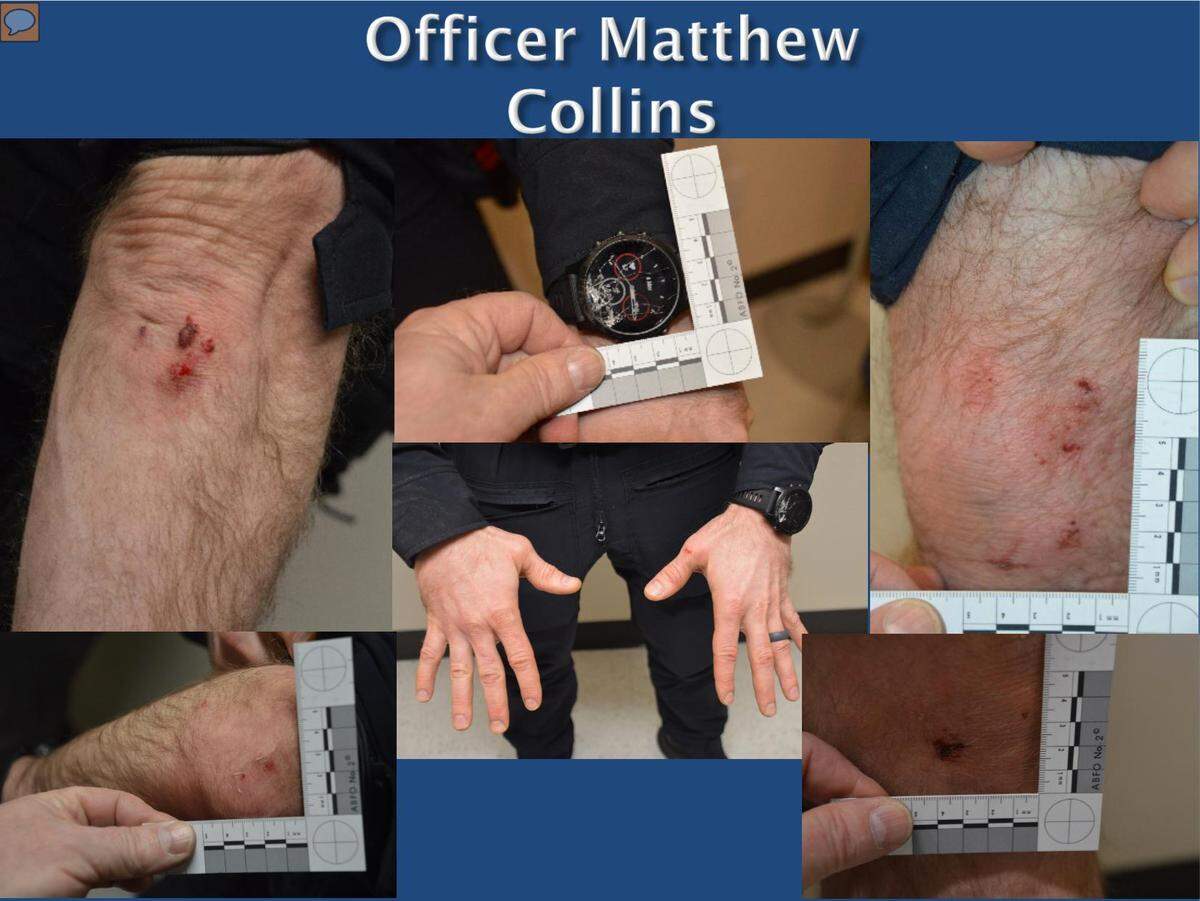
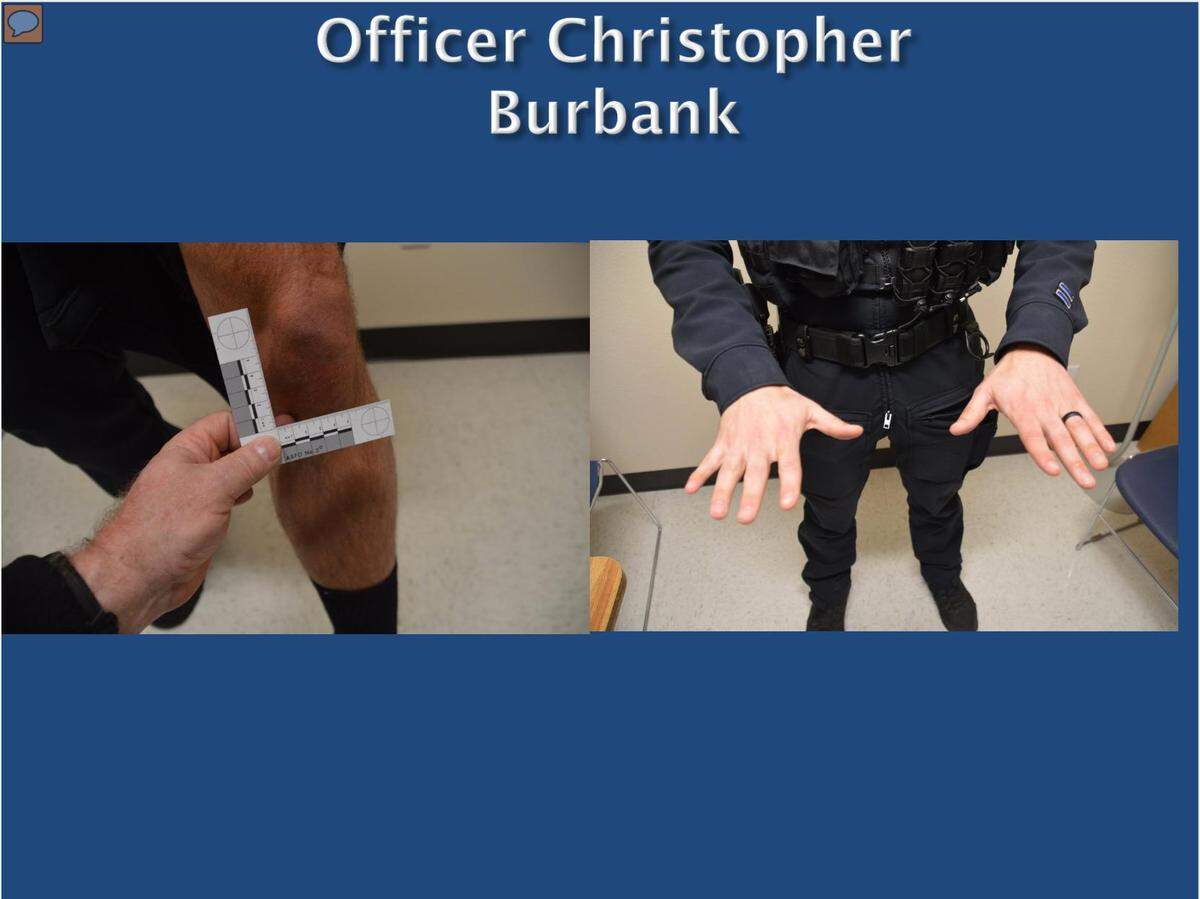
Burbank, Collins, Ford and Rankine were taken to a sheriff’s station after the incident to have their injuries photographed.
Collins had scrapes on his elbows and knees. He later told investigators his right knee swelled up. Burbank had no visible injuries other than a minor abrasion on one knee. Ford and Rankine had no injuries.
Photographs of Ellis showed both cheeks were badly scraped raw and bleeding, there were gouges around both his knees, cuts on one wrist and bloodied knuckles.
Former Medical Examiner Thomas Clark, who performed the autopsy, found that Ellis died of lack of oxygen due to physical restraint. He listed the positioning of the body and placement of the spit mask as “a significant factor, and possibly the most important factor” in Ellis’ death, according to a 14-page autopsy report.
Methamphetamine and heart disease were listed as contributing factors.
It has been ruled a homicide, which means one person killed another. It does not signify intent.
The Attorney General’s Office is reviewing the case and will decide whether criminal charges are warranted.
Burbank, Collins, Ford and Rankine remain on paid administrative leave. They briefly returned to duty two weeks after the incident, but were again put on leave after Ellis’ cause of death became public.
Although Farinas and Sanders also helped restrain Ellis, neither has been placed on leave.
This story was originally published January 1, 2021 at 11:00 AM.