Rash of catalytic converter thefts burdens Pierce County drivers. What can be done?
Tacoma resident Danay Conley says an “angel” working as a gas station attendant on New Year’s Day helped her realize why her car sounded like a souped-up big rig that wouldn’t go faster than 20 mph.
But his explanation was less than divine.
“They stole your catalytic converter, ma’am. How long you been driving like this?”
“My what?”
Conley is one of hundreds of people in Tacoma and Pierce County who in the last year have, whether they wanted to or not, come to learn quite a bit about the car part joined to their exhaust pipes.
Catalytic converter thefts have been skyrocketing in the city and county since the end of 2020, according to crime stats shared by the Pierce County Sheriff’s Department. Thefts continued to increase at the start of 2021, and the trend worsened throughout the year.
In 2021, Tacoma Police Department recorded 1,077 catalytic converter thefts, compared to 191 in 2020.
Thieves’ ability to steal catalytic converters within minutes and the fact that car owners often don’t discover the theft until hours later make the crime difficult to prosecute. The scale of the issue across Washington state has pushed lawmakers to draft legislation aimed at curbing theft.
It will be a while before the effectiveness of lawmakers’ work becomes clear. A bill moving through the Legislature, House bill 1815, proposes studying how to reduce catalytic converter theft while providing more training for law enforcement.
It also would require scrap yards buying catalytic converters to obtain yet-to-be-specified documentation from the seller indicating the part is being sold because they are replacing it on a vehicle registered to them.
While lawmakers figure out how to approach the issue, the scourge of theft continues in Pierce County, with sometimes stark consequences for people with less financial stability.
For some, falling victim means frustration, a trip to the mechanic and a few days of using another vehicle or relying on someone else to get them where they need to go.
A theft can put others in a precarious financial situation. It can mean weeks of missing work and raising money online to help pay for repairs.
“Two weeks down without working, when you’re essentially paycheck to paycheck, it hurts, and it’s still hurting,” said Conley, who had her catalytic converter stolen in early January.
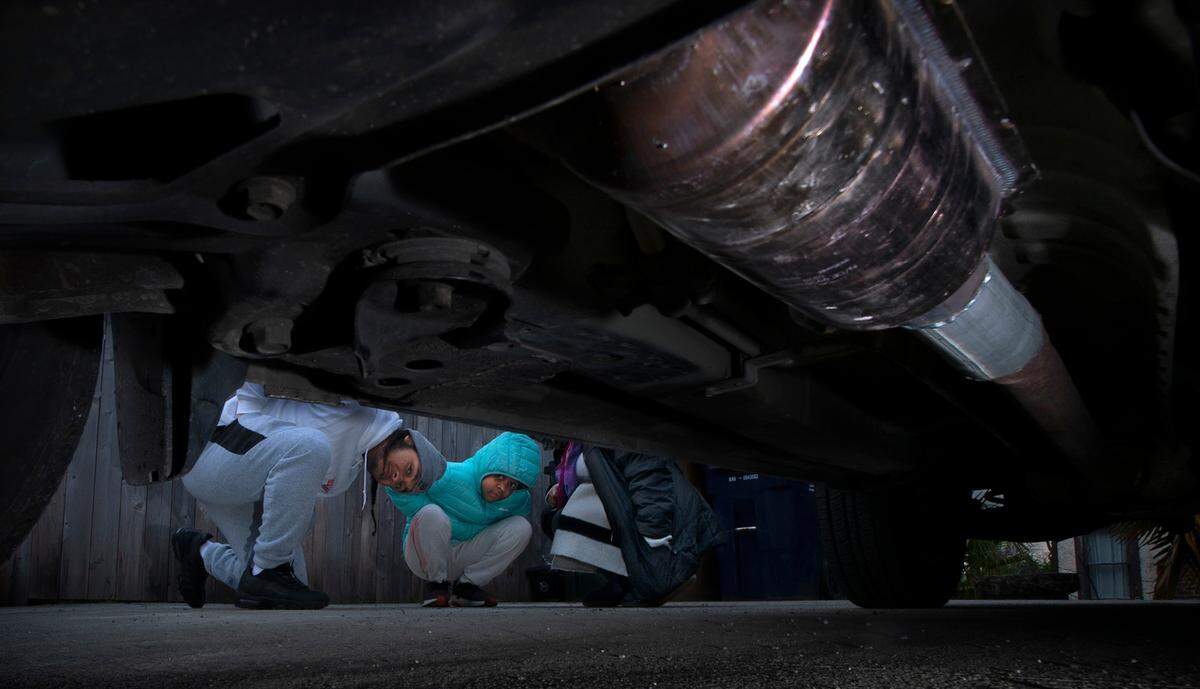
Where are stolen catalytic converters going?
It’s not hard to steal a catalytic converter. Thieves don’t need many tools or be car experts to know where to start sawing. It also doesn’t take long.
If it happens to you, the first sign will probably be the awful sound your car makes when you start it. One theft victim said her SUV sounded like a big rig. Another said her Volvo sedan sounded like it had morphed into a macho truck with a giant engine.
The owner of that Volvo, Pam Krayenbuhl, an assistant professor of film and media studies at the University of Washington Tacoma, was prepping for the first day of fall classes last year when her catalytic converter was stolen from a campus parking lot.
Luckily, Krayenbuhl’s insurance covered the cost of repairs — which included several other parts the thief sawed through to get to their prize. Krayenbuhl was one of several UW professors who had catalytic converters stolen from the same parking lot that day, and others without full coverage were left to foot the $2,000-some bill.
The reason catalytic converters are so sought after is they’re essentially pollution filters that contain several precious metals. Those metals, such as rhodium and palladium, are worth thousands of dollars on the ounce, according to Idaho-based precious metals dealer Money Metals Exchange.
Thieves aren’t getting rich selling palladium. Separating the precious metals from the catalytic converter requires industrial equipment or chemical processes. Typically, thieves can sell the parts for between $100 and $200 a piece, according to Northwest-based PEMCO insurance.
Addressing the thefts at an individual level is difficult. Short of police catching someone in the act, law enforcement — already strained by staffing shortages and rises in violent crime — doesn’t have many ways to track down a hunk of metal and tie it back to your car.
“In all honesty, dealing with metal theft in terms of the people who are committing it, it’s a bit of whack-a-mole,” Pierce County Council Chair Derek Young, D-Gig Harbor, said. “You want to basically deal with the demand side of it.”
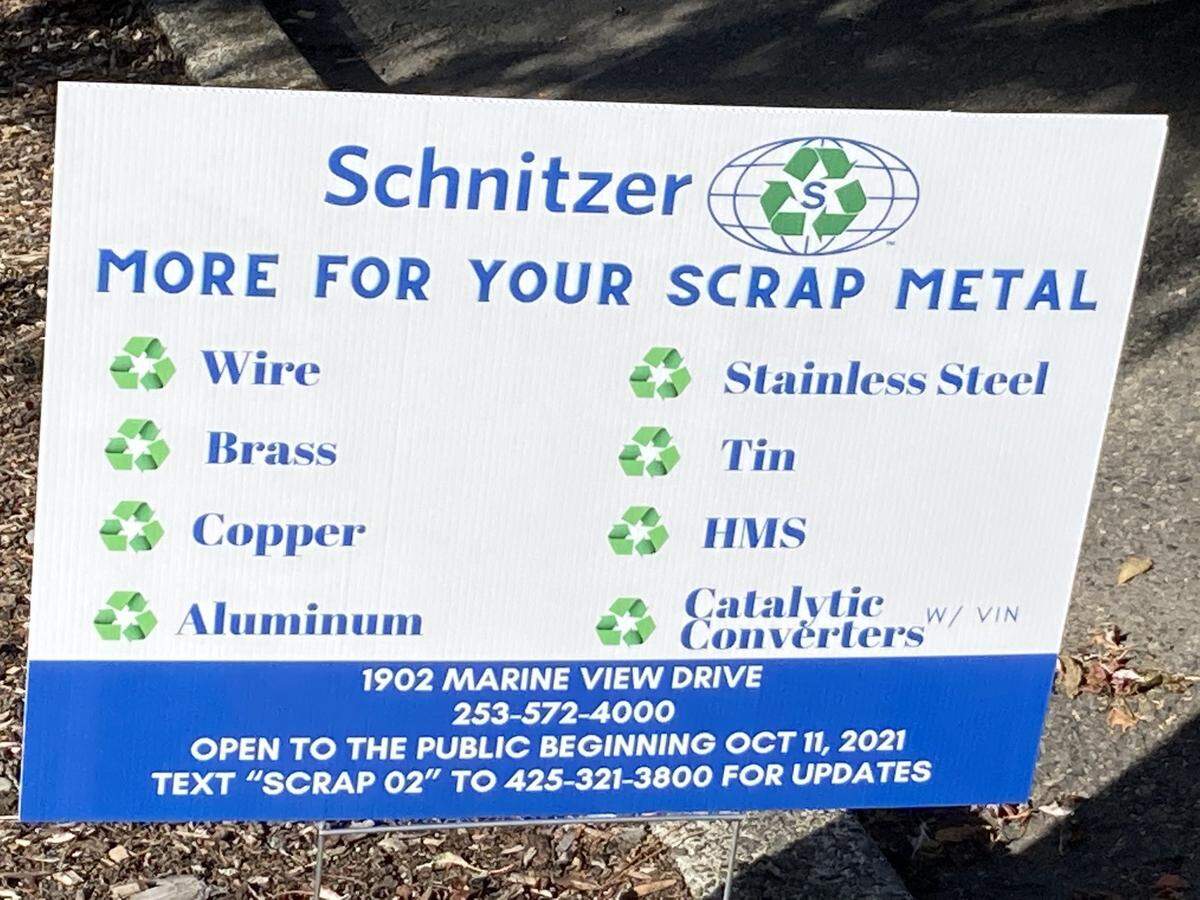
Young started looking into what could be done about the rise in thefts after signs began popping up around Tacoma in October advertising a place to sell scrap metal like wire, copper, aluminum and catalytic converters.
Schnitzer Steel, one of the largest scrap processors in the United States which also operates locally, posted the signs. “More for your scrap metal,” they read. In parentheses, next to catalytic converters, they noted that sellers needed the VIN number of the part they were selling.
Photos of the signs spread online, with some people noting several were placed near homeless encampments. Angry commenters saw the signs as exploitative, targeting people who were struggling and potentially desperate enough for cash to go out and steal.
The stir attracted the attention of Tacoma Deputy Mayor Catherine Ushka as well as Young, and both contacted the company to get some answers. The signs quickly disappeared.
In response to a News Tribune inquiry, spokesperson Tony Belot said the Schnitzer’s policies ensure its operation complies with the law and that it works responsibly to screen materials it accepts.
“Our recent effort to educate the public about our services that keep recyclable material out of local landfills missed the mark, and we swiftly removed the signs in question,” Belot said in an email.
As Young continued to look into catalytic converter theft, he found that as far as regulation of metal sales go, local governments don’t have much power.
Regulation falls to the state, and lawmakers are pushing through House bill 1815, sponsored by Rep. Cindy Ryu, D-Shoreline, as a starting point to address the rise in theft. The bill passed the House of Representatives Feb. 12 and is being considered in a Senate committee.
The gist of it: further study of the issue, a grant and training program to help cops target metal theft and more documentation of catalytic converter transactions between scrap yards and sellers.
The grant and training program has yet to be funded, but the chair of the House Transportation Committee, Rep. Jake Fey (D-Tacoma) said in a news release he would make sure the transportation budget includes that money.
The Senate’s Law & Justice Committee was scheduled to vote on the bill Thursday. During that committee session, Sen. Jeff Wilson, (R-Longview) is expected to propose an amendment to replace House bill 1815 with the language of Senate bill 5495, which did not make it out of a Senate committee.
That bill would keep the grant and training program but also slap a $1,000 fine on scrap yards found buying stolen catalytic converters. It also would make it a felony to try to buy or sell the stolen parts that would carry a $5,000 penalty per stolen catalytic converter.
Speaking in support of House bill 1815 at a Jan. 18 hearing, Brad Tower of Schnitzer Steel highlighted one criminal case in Kent that points to a need for further study of where stolen catalytic converters are ending up.
Multiple people were arrested by Kent police with more than 800 catalytic converters in their possession and $40,000 cash on hand.
“Most of the licensed entities in the state are either not purchasing catalytic converters or only purchasing them from commercial entities,” Tower said. “There is a significant flow of this material that is going somewhere that we have not identified.”
Holly Chisa, a lobbyist who represents the Institute of Scrap Metal Recycling Industries, offered one possibility for where the stolen parts are going: online platforms. Speaking against a now-dead Senate Bill also aimed at decreasing catalytic converter theft in a Jan. 25 public hearing, Chisa pointed to websites like Facebook Marketplace, OfferUp and Craigslist as hubs of possibly illegal sales.
“You will see boxes of catalytic converters where they can pay cash,” Chisa said. “We are limited up to $30, and anything beyond $30 has to be a check.”
Difficulties prosecuting catalytic converter theft
Wherever the final resting place of stolen catalytic converters might be — whether they’re being shipped to a shadowy overseas metal processor or soldered back onto a different vehicle courtesy of Craigslist — it’s not on the radar of Pierce County law enforcement or prosecutors.
Pierce County Prosecuting Attorney Mary Robnett said her office doesn’t receive many referrals to prosecute catalytic converter thefts, and even fewer regarding people knowingly purchasing stolen converters.
“It’s one of those victim crimes that’s very, very difficult, one for police to detect a suspect and two, I think it’s hard to prove,” Robnett said. “Catching somebody red-handed is the key to catching the thief.”
Most of the time, Robnett said, victims don’t discover the theft until hours afterward. Even if police caught someone with a stolen catalytic converter, the difficulty of proving they were knowingly in possession of stolen property would remain.
As far as scrap yards go, prosecutor’s office spokesperson Adam Faber said he wasn’t aware of any metal-theft cases involving local metal recyclers referred to the office in recent years.
Robnett said she knows what a huge imposition catalytic-converter theft can be to people who rely on having a running vehicle.
For theft victims like Tacoma resident Danay Conley, having her catalytic converter stolen wasn’t just a financial burden, it also made it difficult for her to get her 10-year-old daughter to her piano lessons.
Conley, 40, is a single mother to her daughter and teenage son, who plays football for Silas High School. Every day, she needs to get her kids to school, commute to her job at an eye-care center in Auburn and continue getting her children where they need to go after clocking out.
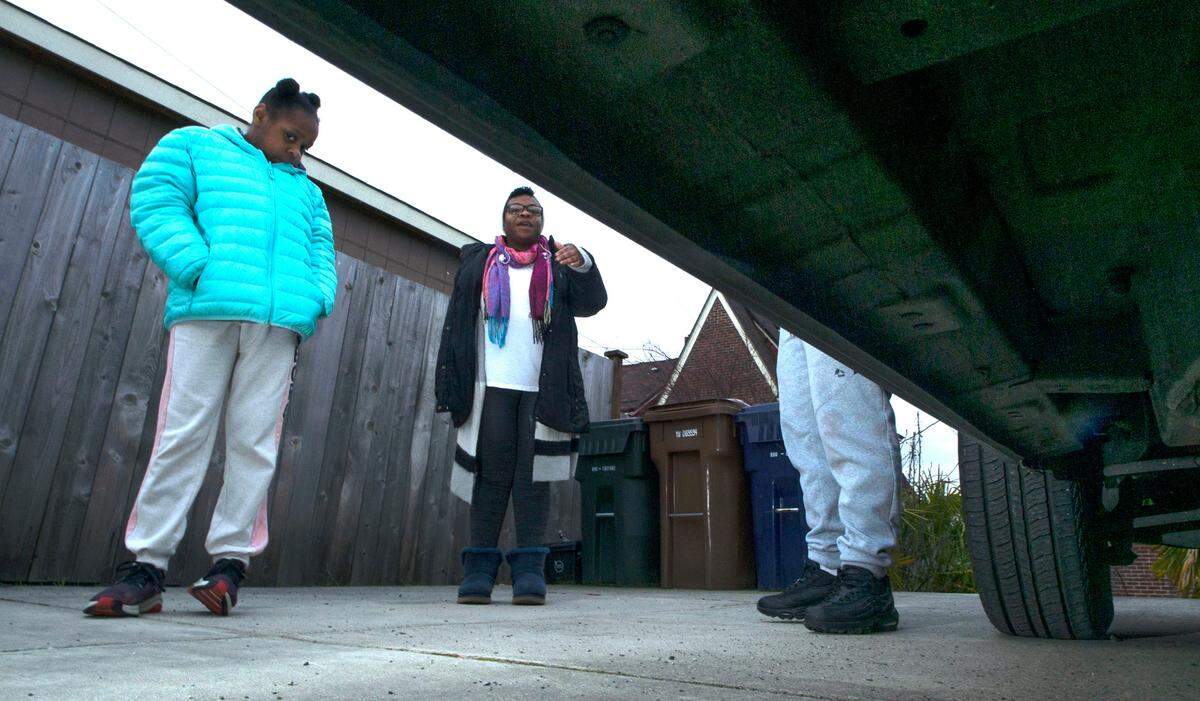
When her catalytic converter was cut from her Honda Pilot while it was parked outside the house of a friend she was visiting in Auburn, those responsibilities became nearly impossible.
“Without a car, you can’t do it,” Conley said. “As much as you would like to, you know, rely on public transportation and other means, for the environment itself, you just can’t with being a single mom on the go.”
Conley started a GoFundMe and was able to raise enough money to replace her catalytic converter to get back on the road. She knows others who have gone through the same, and she urged people who come face to face with a thief in the act not to confront them.
Interactions between car owners and thieves have led to some violent situations. In January, Fife police said a woman was shot while she tried to chase down a person who stole her car. On Key Peninsula, Pierce County deputies said a man located his stolen SUV and shot the man who was driving it.
“Even if you see it happening, make sure you go home to your kids,” Conley said. “The financial burden, at some point in time, can be taken care of. But you can’t get your life back.”
This story was originally published February 24, 2022 at 5:00 AM.