Live Updates: Attorneys in trial of Pierce Sheriff Ed Troyer deliver closing arguments
After days of witness testimony, attorneys for the prosecution and the defense in Pierce County Sheriff Ed Troyer’s criminal misdemeanor trial will sum up their cases for jurors Tuesday in county district court.
The trial opened at the end of last month with prosecutors from the state Attorney General’s Office and Troyer’s defense attorneys calling the case simple. The sheriff is accused of falsely reporting to 911 dispatchers that a Black newspaper carrier driving in his Tacoma neighborhood, Sedrick Altheimer, threatened his life during an encounter in January 2021.
Over nearly two weeks, prosecutors have focused on the police response prompted by Troyer’s call for help and how arriving Tacoma police officers investigated at the scene, one officer’s testimony that the sheriff told him that night he wasn’t threatened by Altheimer and apparent inconsistencies between Troyer’s call and his testimony. Questioning of the newspaper carrier honed in on Altheimer’s prior experiences being followed on his route and his assertion that he never threatened Troyer.
The defense has sought to push back on a Tacoma police report that stated Troyer walked back his allegation that Altheimer threatened him once police arrived, pressing officers on the accuracy of their memories of the incident and eliciting testimony from Troyer stating he never backtracked.
The sheriff’s attorneys have also tried to distance him from dispatchers’ decision to enter his call for help as the highest priority possible and downplayed the magnitude of law enforcement’s response, portraying the encounter as a “nonevent” spurred by miscommunication.
Underlying Troyer’s defense on the facts of the encounter are statements from the sheriff that the state Attorney General’s Office was politically motivated to charge him with false reporting and making a false or misleading statement to a public servant. The office began investigating him last year at the request of Gov. Jay Inslee. Troyer also criticized the news media in his testimony several times for how outlets reported on his run-in with Altheimer and the accuracy of those reports.
“The reason why I’m here testifying is the media has made me out to be a racist and the state has made me out to be a liar,” Troyer said during testimony last week.
The News Tribune is providing live updates of the proceedings, and the trial is being livestreamed on our website.
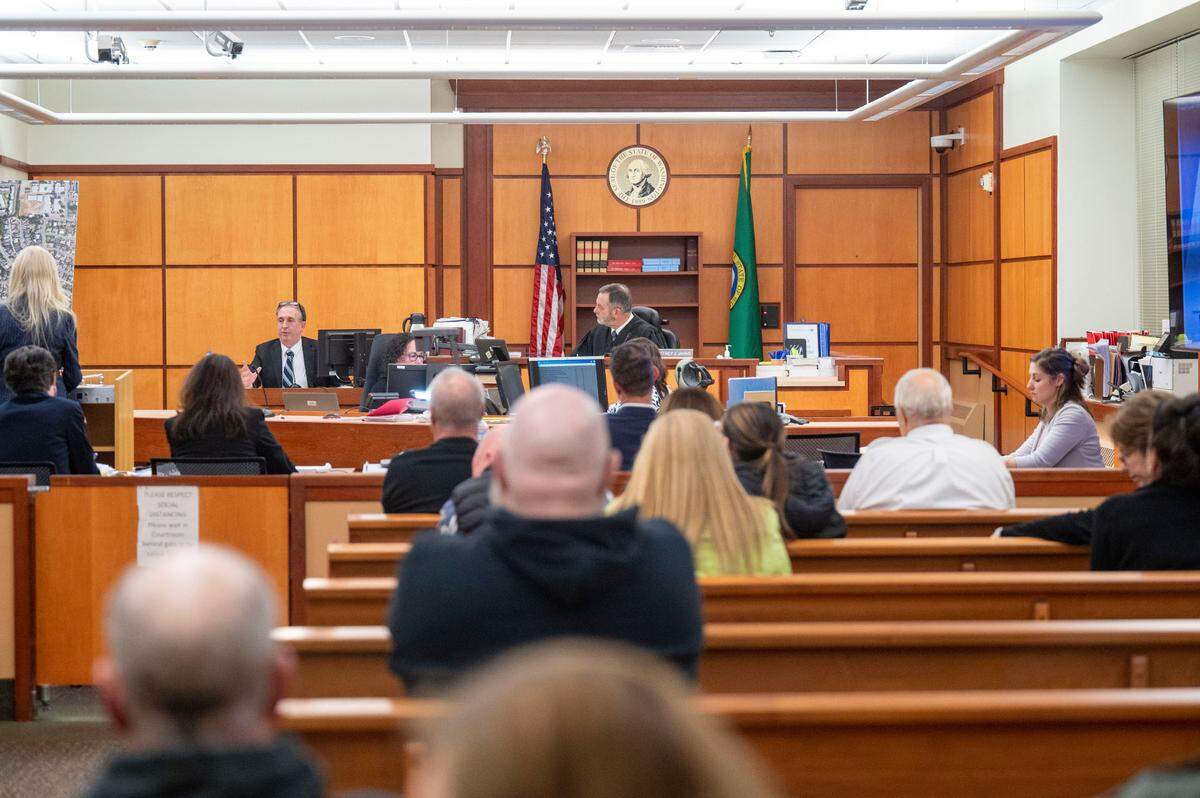
2:05 p.m.: After visiting Kitsap County District Court Judge Jeffrey Jahns went over the jury instructions with jurors, closing arguments began with state assistant Attorney General Melanie Tratnik presenting for the state. The defense will be up second, and then the state can offer rebuttal argument.
Tratnik began by telling jurors that Troyer’s statement to dispatchers on Jan. 27, 2021 that a man had threatened to kill him was a lie. She said that lie prompted at least 40 police officers to be dispatched, wasting department resources and “terrorizing” a newspaper carrier doing his job.
She said there is conflicting information between Troyer and Altheimer’s testimony, but what is undisputed, Tratnik said, is that after their first encounter, Altheimer left to continue his route, and Troyer did not leave. The state assistant attorney general said the sheriff could have ended the entire incident there, but he didn’t.
2:10 p.m.: Tratnik played a portion of Troyer’s call with dispatchers where he says there was a man outside his home who threatened to kill him. She said dispatchers immediately punched in the call as the highest possible priority, a type of call reserved for when an officer’s life is in danger or if Mount Rainier explodes.
She said all 40-plus officers would have responded to the scene if Tacoma police officer Chad Lawless hadn’t determined at the scene that the incident wasn’t as Troyer reported it. Tratnik said the sheriff specifically said four times that Altheimer threatened his life.
2:14 p.m.: The state assistant attorney general asked jurors to consider whether it makes sense that Altheimer would have threatened to kill Troyer. She said the man had been working that route for two years, and she said “it simply makes no sense” for the newspaper carrier to interrupt his route to threaten to kill someone, particularly someone who he thinks might be a police officer.
Tratnik then went through the jury’s instructions about the charges leveled against Troyer. She said the defense would argue that Troyer never dialed the numbers 911, but she said it doesn’t matter who he called, only that he initiated a false report. Troyer used a back channel line reserved for law enforcement.
On accusations that Troyer lied about the threat to his life, Tratnik said Troyer admitted in testimony that when he allegedly heard Altheimer tell him “I’m going to take you out,” the sheriff didn’t know what the man meant.
2:25 p.m: Tratnik turned to Tacoma police officer Chad Lawless’ testimony. She said the one thing the officer needed to determine when he arrived at the scene was if the sheriff’s life had been threatened, but instead of saying he was threatened, Tratnik said Troyer only complained about Altheimer’s suspicious driving.
2:28 p.m.: The state assistant attorney general said the defense may say that if only Lawless had remembered to grab his body camera, then a conversation between him and Troyer would have been recorded. That’s true, Tratnik said, but she told the jurors she believed it was a red herring to argue that this matters. She said Tacoma police weren’t yet required to wear them, and she argued that the state would still have enough evidence to convict Troyer if they did have that video.
2:30 p.m.: Tratnik began talking about Altheimer’s testimony that he never threatened the sheriff, and she brought up Altheimer’s $5 million claim against the county. She said police surrounding and detaining the newspaper carrier was “terrifying and humiliating,” and mentioned that officers were yelling at him and telling him to keep his hands in sight.
She said after police told him the only reason they were there was because the man who called for help was the sheriff, Altheimer believed Troyer would never be held accountable for the events of that night. Tratnik told jurors that Altheimer wanting to seek redress and compensation for what happened to him doesn’t impact his credibility because Altheimer has stayed consistent throughout the trial.
2:37 p.m.: The state assistant attorney general turned to Troyer’s testimony and inconsistencies between what Troyer was telling dispatchers on the phone and what was happening around him as he spoke. Tratnik asked why Troyer would have been getting out of his car in the first place if Altheimer had threatened to kill him.
She said the defense has argued that Troyer only wanted one or two cars to respond. Tratnik said that’s not what someone would ask for if their life had been threatened. Tratnik said Troyer couldn’t keep his facts straight, mentioning that Troyer at one point said Altheimer was blocking him in, then later said he was actually blocking the newspaper carrier in.
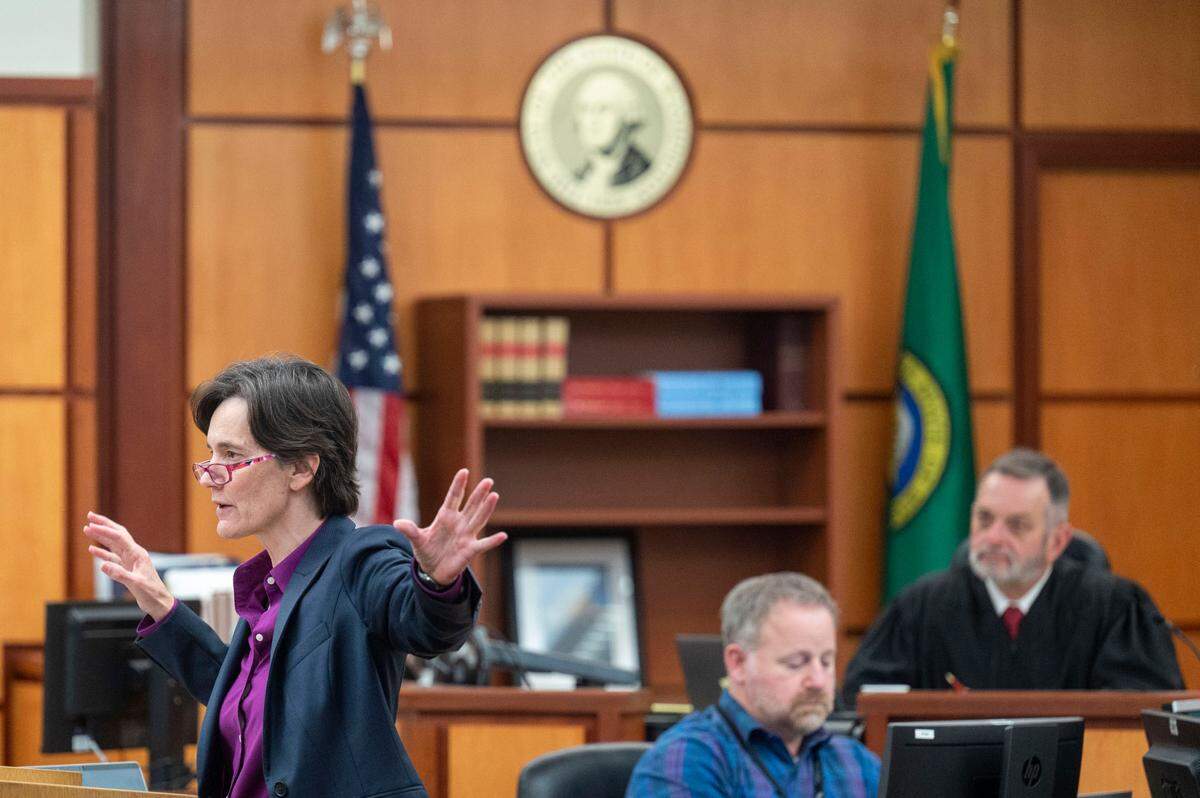
2:45 p.m.: The state does not have to prove motive in this case, Tratnik said. But she said Troyer’s tone and dismissiveness provided insight into why he called 911. She said the sheriff later referred to Altheimer’s car as homeless-looking, and mentioned being able to see a garage-door opener in the vehicle but not newspapers piled up in the backseat. The next day, Tratnik said, Troyer told a neighbor asking about the incident that Altheimer was living out of his car even though he knew that wasn’t true.
“His story just keeps evolving,” Tratnik said. “First there was no threat, then it was clear he wanted to fight, and now that Mr. Altheimer said he was going ‘to take him out’. But he didn’t say that to Conrad Shadel, he didn’t say that to Officer Hobbs, and he didn’t say that to Officer Lawless.”
2:50 p.m.: Tratnik went through each element of both offenses Troyer is charged with and what evidence from the trial proves them.
On false reporting, Tratnik said the final element of the defense is that Troyer knew the false report was likely to cause an emergency response. The state assistant attorney general said this doesn’t have to be a massive response and that the element is easily met because Tacoma Police Department officers rushed to his aid when he said his life was threatened. Tratnik said that even though the defense argues Troyer only wanted one or two units to respond, even that amounts to an emergency response.
Tratnik described Troyer’s allegedly false report as “weaponizing” the police force to settle a personal score with a man who Troyer felt didn’t treat him with the respect and deference he deserved.
On making a false or misleading statement to a public servant, Tratnik said the third element — essentially that Troyer knew dispatchers would rely on what he told them over the phone — is obvious because “of course” when a police officer calls 911 for help, the dispatcher isn’t going to hesitate to send all on-duty officers because every second matters.
The state assistant attorney general said all seven dispatchers working the night of the incident responded the same way and dispatched all available officers. Tratnik said police from 19 law enforcement agencies including the Washington State Patrol and tribal police sent officers and others attached themselves to the call to help.
3 p.m.: Tratnik asked the jury to return a verdict of guilty on both counts. The court went into an afternoon recess before the defense presents its closing arguments.
Sheriff Troyer’s defense attorney presents closing arguments
3:20 p.m.: The jury was seated again and attorney Anne Bremner began closing arguments for the defense.
The attorney began by thanking the jurors, then referred to Troyer’s statement that the media has made him out to be a racist and the state Attorney General’s Office has made him out to be a liar. Neither are true, Bremner said. She said the sheriff has maintained the same testimony throughout the ordeal.
Bremner then said Troyer has an “amazing” record for having such a long career in law enforcement. She said Troyer testified that he hasn’t had any complaints for racism, racial discrimination, sexual harassment or abuse of power, and Bremner said the prosecution has never contradicted this.
Referencing Tratnik’s comments that Troyer wasted resources, Bremner said this entire trial has been a waste.
3:26 p.m.: Bremner said it was Altheimer who confronted the sheriff by yelling at him. She said the man testified he’d been pulled over 10 times by the police, and she questioned why this time he became angry enough to confront Troyer.
3:30 p.m.: The defense attorney brought up the testimony of Josh Harris, a former Pierce County Council candidate. He testified about an encounter at his home with Altheimer after Harris questioned him one night. Bremner said Altheimer banged on his door late at night and left a newspaper with a disparaging note in it. She said Harris felt threatened.
Bremner compared this incident to what happened between Altheimer and Troyer, saying “lightning doesn’t strike twice.”
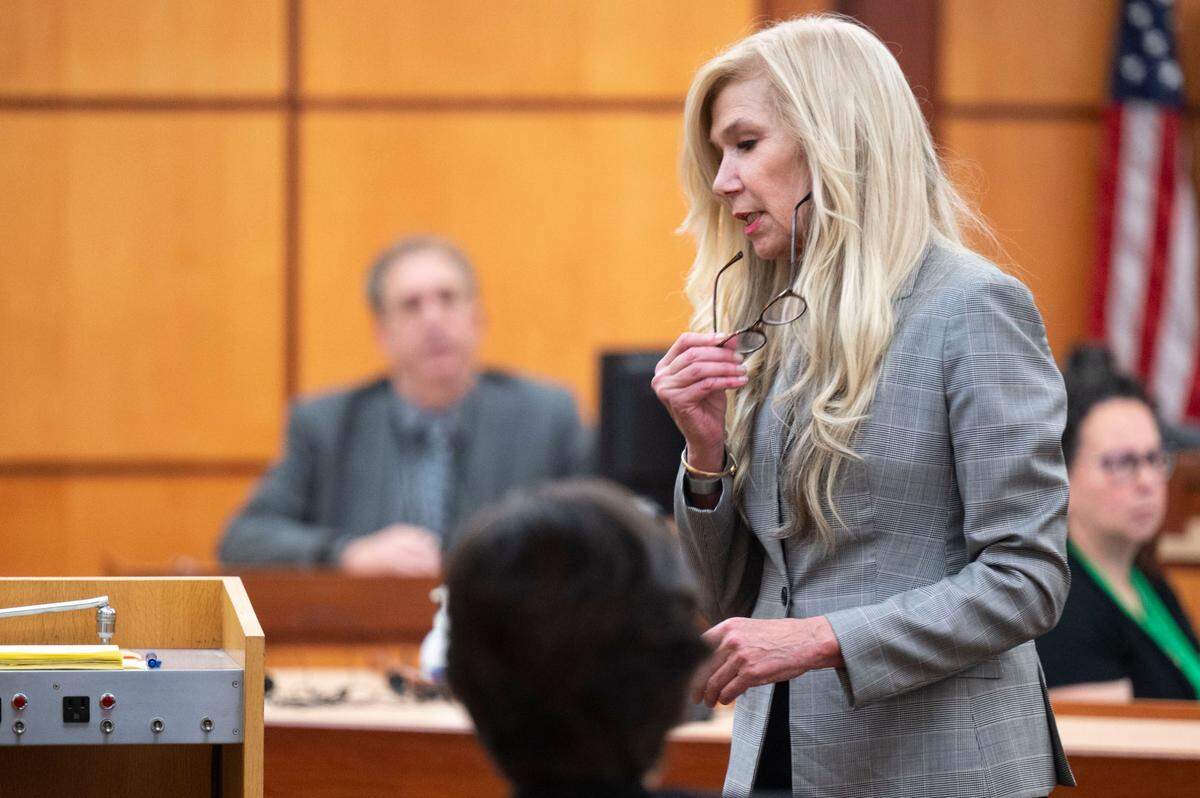
She asked the jury to use common sense in making their decision. She asked them to think about why Troyer would lie and say he was threatened by Altheimer and what purpose it would serve.
3:35 p.m.: Bremner turned to the testimony of Officer Chad Lawless, saying that he took the 5th Amendment against self-incrimination 400 times, including regarding a question about the accuracy of the police report he authored about the encounter the next day.
She said the quotation “no good deed goes unpunished” is fitting for what happened here. Bremner said Troyer let Altheimer go, but he could have had the man investigated.
3:40 p.m.: Bremner said that Officer Corey Ventura’s body camera footage showed that Altheimer was agitated and dropping “F bombs.” She said this corroborates the way Altheimer acted with Troyer off-camera.
The defense attorney then began calling Altheimer’s credibility into question, saying that guns weren’t drawn on him even though the man said there was, disputing Altheimer’s statement that he wasn’t the aggressor in the situation and saying the man’s statement that he was in an all-white neighborhood when this happened was false. Bremner said the neighborhood was diverse.
3:48 p.m.: “He could have just said he was a newspaper carrier,” Bremner said. She said Altheimer’s response to that has been that he didn’t have to do that. The defense attorney said that doesn’t mean the sheriff should have to be sitting in a courtroom charged with a crime.
Bremner then said she wanted to address some things brought up by the state. She referred to Zachary Hobbs body camera footage and said that after another officer asked him what Troyer said, Hobbs reply included that the sheriff said his life was threatened by the newspaper carrier.
The defense attorney said that in the circumstances Troyer was in, he had no need to make something up to get one or two police units to respond. Bremner said the idea that Troyer would purposefully waste police resources makes no sense.
3:55 p.m.: Bremner began talking about what reasonable doubt means and offered examples. “If you find yourself back in the jury room wishing that Officer Lawless or Hobbs had body camera on, you have reasonable doubt,” she said.
3:58 p.m.: The defense attorney said she wanted to turn to the prosecution’s cross-examination. She said that after all the lead up to it, prosecutors only questioned him for 20-30 minutes. She said the state began by asking him if he was asleep before the incident, then asked him about a Facebook exchange with a neighbor the next day. Otherwise in cross, Bremner said, there was nothing else from the state, and Troyer was steady in his testimony.
4:05 p.m.: Bremner finished her closing arguments. “I ask you to find him not guilty and free him from all of this,” she said. The state will now offer rebuttal argument.
Trial comes to close with rebuttal argument
4:06 p.m.: Tratnik told the jurors that the only thing they have to determine is what happened the night of the incident. She said it doesn’t matter what good things Troyer did before or after, only whether he violated the elements of the crime.
The state assistant attorney general said that the alleged threat from Altheimer to Troyer that he was going to “take him out” was never heard on the dispatch call or body camera footage. She said those words weren’t heard until they got to court, and even then, Troyer testified that he wasn’t certain what Altheimer meant by that.
4:10 p.m.: Tratnik began calling Troyer’s credibility into question. She said the sheriff repeatedly contradicted himself in his phone call with dispatchers and said that the way he answered questions in court showed he wasn’t credible.
The attorney said that in closing, she heard that it was everyone’s fault except for Troyer.
On the police report that was created the next day, Tratnik said that “of course” Officer Lawless wasn’t going to get what happened wrong at a scene where everyone who responded thought Troyer had been threatened with death.
She mentioned questions to Lawless and others about a group chat where they insulted the sheriff. She said the officers called him a “bitch” because they felt betrayed by the sheriff, but that this didn’t make them less credible.
4:20 p.m.: Tratnik concluded her rebuttal and asked the jury to return a verdict of guilty on both counts. The jury was dismissed for the day. They were asked to return to the jury room at 8:30 a.m. Wednesday. They won’t begin deliberating until Judge Jahns tells them to.
This story was originally published December 13, 2022 at 2:06 PM.