Potential jurors in Tacoma police trial talk news, law enforcement ties, verdict concerns
A pool of potential jurors in the trial of three Tacoma police officers accused of killing an unarmed Black man began to thin last week as attorneys and the court inquired about their availability and biases.
No one has been selected to serve on the 12-person panel which will decide whether officers Christopher Burbank, Matthew Collins and Timothy Rankine are to blame for the March 3, 2020, death of Manuel Ellis.
Ellis was walking home from a convenience store in the South End when he encountered Burbank and Collins and an altercation ensued, ending with Ellis’ death by oxygen deprivation. Burbank and Collins are charged with second-degree murder and first-degree manslaughter. Rankine is charged with first-degree manslaughter.
Pierce County Superior Court Judge Bryan Chushcoff and attorneys for the prosecution and defense have focused their efforts on weeding out jurors whose schedules or pressing circumstances make it impossible to attend the lengthy trial, which is projected to begin with opening statements the first week of October and stretch into December.
Attorneys have questioned some jurors over ties to law enforcement, what news stories and podcasts they’ve consumed about the case over the last three-plus years, their participation in 2020 protests, how familiar they are with the neighborhood where Ellis died, their ability to be impartial and individual concerns about rendering a verdict.
Jury selection continued Monday with voir dire questioning of the 35 people remaining in a first group of potential jurors. Voir dire is a process where attorneys and the judge can ask prospective jurors questions to determine their suitability to serve. The total pool of 150 Pierce County residents was split into two large groups and a third smaller group because the courtroom’s capacity only allows 65 potential jurors to be in the room. A second large group was called in on Tuesday.
Both the prosecution and defense are allowed to make motions to remove potential jurors for cause, and they have a number of strikes which empower them to remove jurors without reason.
Prosecutors confirmed they and the defense have nine strikes they can use in choosing the 12 jurors, and an additional seven strikes that can be used in choosing the four alternates. No strikes have so far been used.
Chushcoff said Thursday that to have enough people to pick a jury, there need to be 48 prospective jurors who can attend.
Selection began Sept. 19 with 64 prospective jurors. The group appeared to skew older and whiter. Some said they came from Central Tacoma, South Tacoma, Hilltop, the South End, Browns Point, Lake Tapps and Graham.
Among them were schoolteachers, aerospace workers, retired folks, a military serviceman, a radiologist, a pastor, a college instructor, a warehouse worker and others. They shuffled into court each morning wearing flannel and sweatshirts, Tevas and Nikes. One carried in a Michael Kors backpack, and another held a hemp UW Huskies bag.
Views about law enforcement
One woman questioned about her views of law enforcement said she has relatives who have worked as police officers in Seattle and Bellingham. Special assistant attorney general Patty Eakes read a portion of her jury questionnaire, in which said she believes police officers are being targeted by news media and the government to limit what they can do in their jobs.
The potential juror agreed that she would find officers’ testimony more credible than other witnesses, and it would be difficult for her to return a guilty verdict against them. She was later excused. At least one other woman discussed similarly held views. She said police testimony would be more believable because they have police reports to look back at.
On Thursday afternoon, following about two days of voir dire questioning, Brett Purtzer, an attorney for Rankine, asked a number of people if they were interested in being a juror or not. One man said he wanted to serve on the jury because his great-grandfather died wrongfully in the custody of Seattle police in the 1960s. He said despite that, he believes he can be impartial because he has been a victim of violent crime, so he understands police are needed.
Being associated with deciding a verdict was a common concern for potential jurors. A man who once served as a military police officer said he would lose friends and family over the decision. Another said he feared being ostracized by family who are former law enforcement. Others were more worried about getting unwanted attention from journalists or the public.
Some concerns were about how a verdict could affect the community. One potential juror said they’ve seen “great reactions of despair” and “riots” in some cities when verdicts have come down in comparable cases, and another said they thought that whatever the outcome, it would affect the lives of everyone in the courtroom and the community.
Media consumption, bias
The topic of news and media consumption also drew much discussion, and several prospective jurors were questioned separately about what they’ve read or listened to. Purtzer first raised the question Wednesday, asking whether anyone saw something about the case on the news the night before. At least four people raised cards with their juror numbers on them.
“I just happened to turn on the news and all of a sudden there it was,” one said.
Purtzer and other defense attorneys asked the group about the credibility of news media, and there were a range of replies. One said the media lies, another said reporters are operating on limited information, a third thought the media was more concerned with getting clicks than being accurate.
Attorneys for Burbank have argued in court filings that publicity and public artwork could prejudice a jury against him, specifically citing the Seattle Times and KNKX’s podcast, “The Walk Home,” and a “Justice for Manny” mural blocks from the courthouse. Both have come up in jury selection.
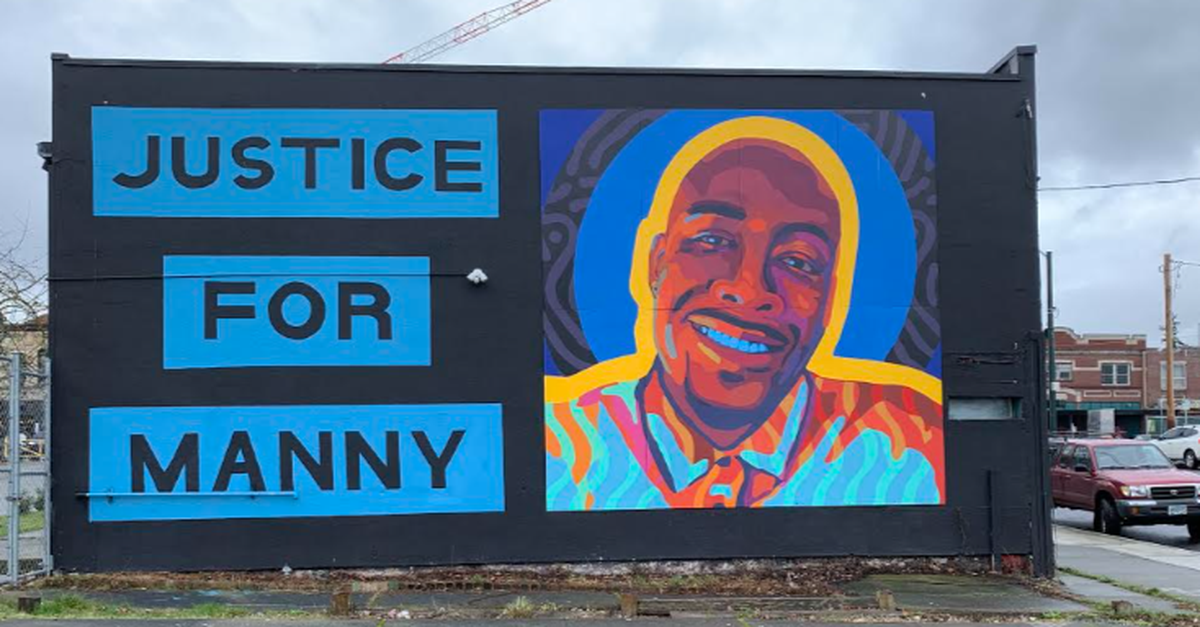
One woman questioned privately about “The Walk Home” said she listened to the entire series. Wayne Fricke, an attorney for Burbank, asked what interested her in it.
“It’s in my town,” the woman said.
She also said she heard a news report about the case, and other podcasts mentioned “The Walk Home,” was beginning soon. Only bits and pieces of the episodes were in her memory. Asked for her opinion on the case, she said she thought the officers murdered Ellis. She was later excused.
Questioned about the area of South 96th Street and Ainsworth Avenue, where Ellis encountered the defendants, at least nine prospective jurors said they were familiar with it. Most agreed it was an unfriendly area known for high crime and public drug use. One said it wasn’t somewhere to walk alone.
Underlying many of the attorneys’ questions were attempts to understand the personal biases that potential jurors have from life experiences and how those biases might affect their ability to be impartial. One man who attended several Black Lives Matter protests in 2020 and other demonstrations, including one that traced the path Ellis walked the night he died, was asked if he could put aside his experiences to be an impartial juror. He said it would be difficult and was excused.
One man from Central Tacoma who was excused said the case has been a constant source of conversation in his social circles, and when he takes the bus through Hilltop each day, he sees the “Justice for Manny” mural. Fricke asked him what goes through his mind when he sees it. The man said he feels ashamed, and that he thinks Ellis’ death almost certainly could have been avoided.
This story was originally published September 26, 2023 at 5:15 AM.