Jury seated in Tacoma police officers’ in-custody death trial. Here’s its makeup
A 12-person jury seated Monday to decide whether three Tacoma police officers are to blame in the 2020 in-custody death of Manuel Ellis includes two Black people and a third person of color.
Prosecutors from the office of state Attorney General Bob Ferguson paid close attention to how many people of color appeared in the pools of potential jurors questioned before the jury was seated, and they successfully stopped two of the defendants’ attorneys from striking a juror from the panel because he is Black. The defense has paid similar attention to the issue, with officer Timothy Rankine’s attorneys convincing Judge Bryan Chushcoff to bar the state from striking a pro-police juror who said she is mixed race.
The state’s prosecutors and the defendants’ attorneys are expected to make their opening statements Tuesday morning, likely laying out for jurors what testimony and evidence they can expect to hear during the trial, which is expected to continue into December.
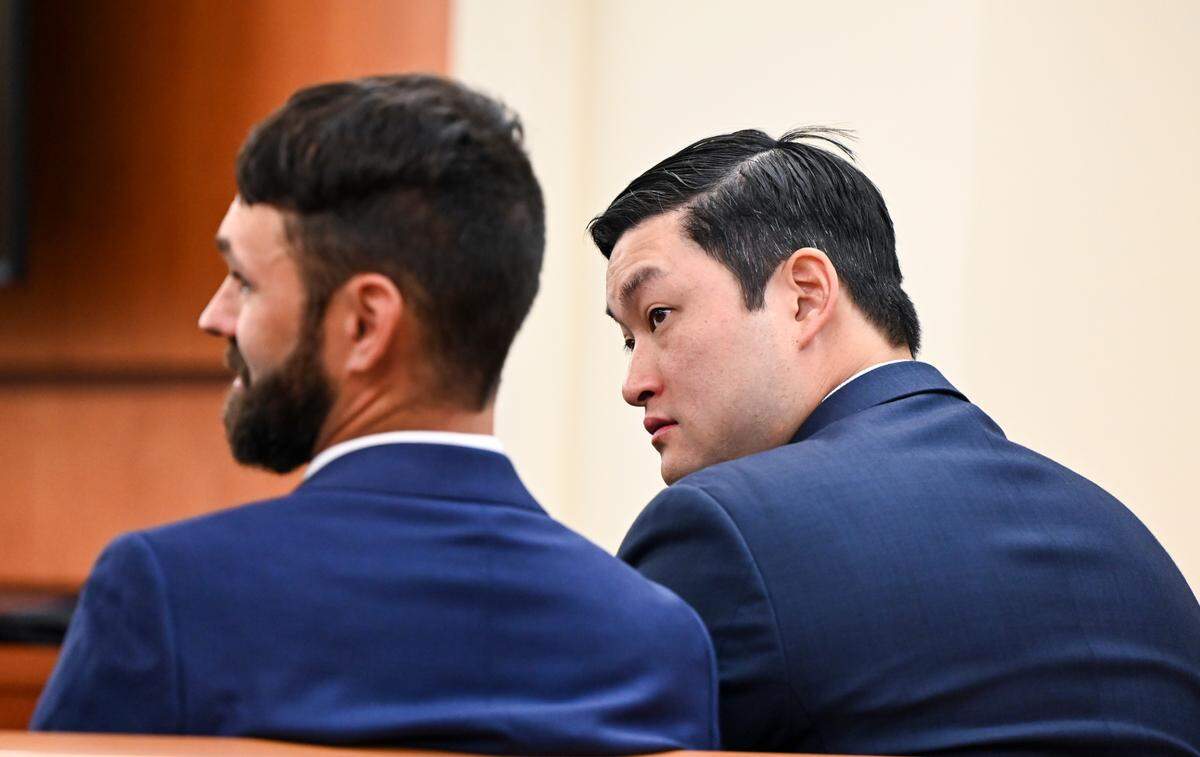
Police officers Christopher Burbank and Matthew Collins are accused of second-degree murder and first-degree manslaughter in Pierce County Superior Court for the March 3, 2020, death of Ellis, who was shocked with a Taser, beaten, hogtied and had a spit hood put over his head after he encountered the defendants’ patrol car on a South End street corner while walking home from a convenience store.
Ellis was captured saying, “Can’t breathe,” on a home’s doorbell security camera, according to prosecutors’ criminal complaint, while several officers sat on his back at different times. Rankine, who responded to the scene as backup and allegedly knelt on Ellis, is charged with second-degree manslaughter.
The defendants have been quiet throughout jury selection, occasionally conferring with their attorneys, pouring coffee or lingering in the gallery to speak with friends or family who have come to support them. The three have mostly worn suits to court each day.
The 12 people chosen to judge them include a Black man and woman and another person of color who appears to be Asian American. The exact racial diversity of the jury is unclear because other jurors did not discuss their race.
Burbank and Collins are white, and they had been with the Tacoma Police Department for four-and-a-half years and five years, respectively, when Ellis died. Timothy Rankine, who is Asian American, had been with the department for a year and 10 months at the time.
The Black man chosen for the jury has said he watches the BBC and worked as a loss-prevention officer for seven years. Asked if racial profiling exists, he admitted he has used it to do his job. Less is known about the Black woman, who grew up in Pierce County and said the neighborhood where Ellis died, at the corner of 96th Street and Ainsworth Avenue, wasn’t the friendliest area.
The Asian American man was previously questioned privately about media he consumed about this case after he said he listened to a podcast he thought was about it. The man said he wouldn’t decide the case based on what he remembered from the podcast.
Other jurors include a former Navy serviceman who has worked as an animal control officer; a former U.S. Army scout; a woman who indicated she knows someone close to her who has struggled with methamphetamine; a man who works as a teacher in a small, private elementary school; a woman who works for MultiCare; and a man who said he wants to be on the jury for the life experience and to be more involved in Tacoma. Little is known about the three others on the panel.
Four alternates were chosen in case a juror on the panel becomes ill or otherwise cannot complete their duties. They include a pastor from Graham; a woman who said a guilty verdict could cause the government to look more closely at policing; a person who said their brother has struggled with his mental health; and a physician.
Jury selection lasted eight days, most of which were taken up by attorneys for both sides questioning prospective jurors about their backgrounds and biases. Two groups of 60-some Pierce County residents were asked about views on law enforcement, movements such as Black Lives Matter and Blue Lives Matter, the presumption of innocence and the state’s burden of proof as well as experiences with loved ones who have struggled with substance abuse or mental health.
Asking such questions gives lawyers clues about the lives of the people tasked with coming to a unanimous verdict on the guilt of the three officers, Bill Bailey, a professor at the University of Washington School of Law, told The News Tribune. Jurors are instructed to be impartial and only consider evidence presented at trial, but everyone comes to court with different experiences, and Bailey said the attorneys’ goals are to get a jury as slanted in their direction as possible.
“Since most jurors will not come right out and admit something like I don’t like Black people or I don’t like police officers, you just have to sort of do a profile,” Bailey said. “Is this person one of my nightmare jurors?”
Attorneys for the officers are expected to argue that the encounter began when Ellis attacked Collins’ and Burbank’s patrol vehicle after he was seen trying the door of a vehicle at the intersection and the officers asked if he was OK. Burbank hit Ellis with his door to try to stop the attack, defense attorneys wrote, and, when Collins got out to restrain the man, Ellis tossed the officer in front of the patrol car. Burbank got out, and the officers reported that Ellis fought them with “superhuman strength.”
Monday morning’s action was focused on arguments about the state and defense attorneys’ use of peremptory challenges, which empower them to remove jurors without reason. Prosecutors and the defense had nine strikes to use in choosing the 12 jurors, and an additional seven strikes for the four alternates.
Three strikes were used in regard to the 12 jurors, but Judge Bryan Chushcoff only upheld one. Chushcoff denied a defense strike to juror 8, the Black man who ended up on the jury. The state objected to the strike, arguing it violated General Rule 37, which protects prospective jurors from being removed by a peremptory challenge on the basis of race alone.
Chushcoff later allowed the defense to strike juror 44. The state had objected, stating he answered on his questionnaire that he would find the testimony of police officers more credible because of the hiring and screening process.
The last failed strike came from the state, who wanted to remove juror 55 because she doesn’t believe in Black Lives Matter and when asked if she would find officer testimony more credible, she said officers take an oath to protect and serve and want to get home to their families. Mark Conrad, an attorney for Rankine, argued the state didn’t want her pro-police views on the jury because her multi-racial identity would make her more persuasive than white jurors with the same view.
This story was originally published October 2, 2023 at 3:32 PM.