Tacoma man convicted in 2 fatal shootings a month apart sentenced to prison
A man found responsible for two fatal shootings in Tacoma in 2021 and 2022 pleaded guilty to manslaughter and has been sentenced to 18 years in prison.
Keon Eugene Simms was arrested after 56-year-old Victor Scott was fatally shot during a road-rage shooting in January 2022 in South Tacoma. Simms was driving a rental car occupied by several other men, according to court documents, when they were cut off by another driver.
Simms, 29, later told police the other men became upset and pulled out guns. The driver of the other vehicle reported that she had inadvertently cut them off, and, when she tried to get away, the armed men followed. Simms’ struck the back of her car before the men started shooting.
Simms’ defense attorneys wrote in a sentencing memorandum that to the best of any witnesses’ knowledge, their client did not fire a shot, and Simms denied shooting at the victims. Charging documents show investigators used shell casings found at the scene, among other evidence, to tie him to a homicide that occurred about a month earlier outside a South End apartment complex.
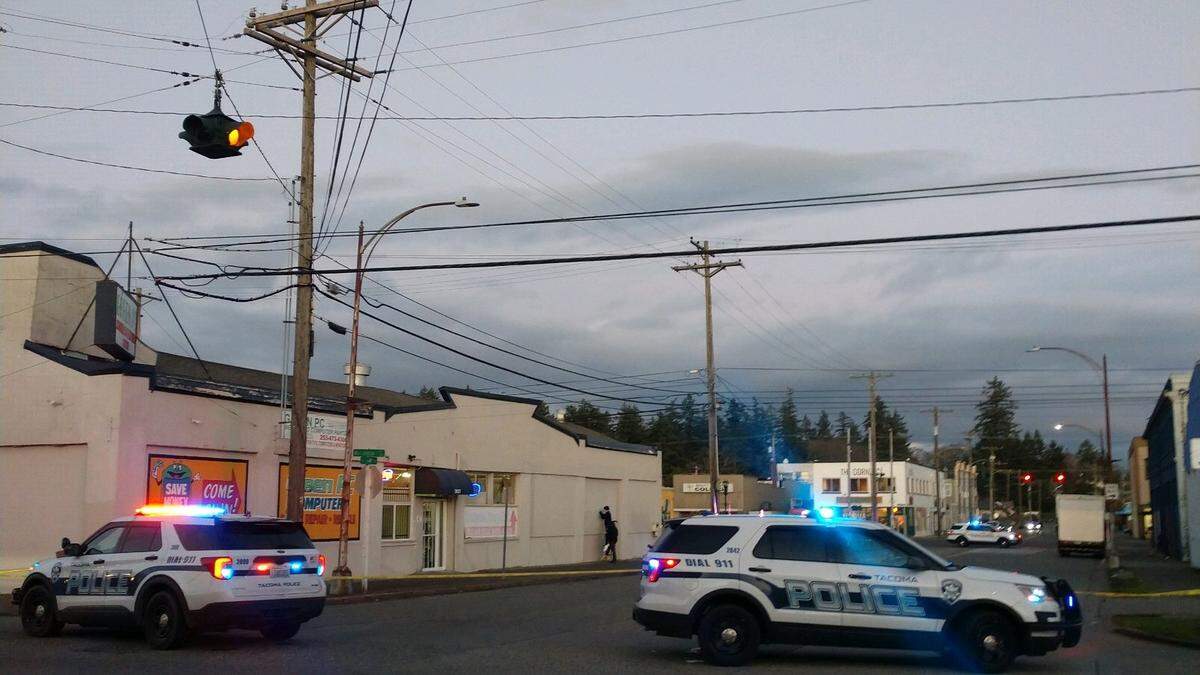
The person killed in that shooting was 46-year-old Jason Arkell. A man who was with him that night, Dec. 20, 2021, told police they were gathering tools to work on a car. According to the probable cause document, the man said he was rummaging through a vehicle for his tools when he heard what sounded like firecrackers. He saw a vehicle speed through the parking lot, then noticed Arkell’s Honda was steaming.
The Honda had 17-20 bullet holes in it, according to the probable cause document. Arkell, who was in the driver’s seat, was struck under the arm. He died at the scene.
Surveillance video captured the shooting, which helped detectives determine the suspect vehicle was a 2015-2016 Mercedes-Benz CL250.
Further investigation found that one of their suspects, Kenneth Lamar Jr., owned such a vehicle, and photos on social media showed him and Simms standing in front of what appeared to be the car used in the shooting. Charging documents also said Lamar and Simms’ phones were pinging off the same cell-phone towers in the area of the homicide before, during and after it occurred.
According to the probable cause document, detectives believed Lamar and Simms killed Arkell in a case of mistaken identity, targeting him because they believed he was responsible for shooting a member of a gang Lamar and Simms were thought to be part of.
How did detectives begin investigating Simms and Lamar in the first place? Charging documents say an anonymous caller who “refused to give their information” reported that the suspect vehicle belonged to Lamar, and that the shooter was Simms.
In the years after Arkell’s death, an attorney for Lamar conducted an investigation that allegedly found missteps and evidence of dishonesty in the police’s investigation. Emily Gause said she found evidence that the “anonymous caller” was a fabrication by police, and that in fact detectives knew their identity and that she was a “known liar.”
Gause also said she found police misidentified the suspect vehicle, misinterpreted cell-tower data and disregarded credible alternate suspect evidence, including information that Arkell was involved in a drug dispute with another person shortly before his death.
Her findings forced prosecutors to acknowledge there were “proof problems” related to Lamar. His first-degree murder charge was reduced to second-degree manslaughter, and he was sentenced to time served.
Simms defense attorneys from the Department of Assigned Counsel, Travis Currie and Andrew Ricci, said in a footnote of their sentencing memorandum that they were not prepared to adopt each of Gause’s contentions, which were outlined in her own sentencing memorandum.
“Independent investigation of that case was in a somewhat more nascent stage upon case resolution,” the attorneys wrote.
“The Court may wish to consider the facts as set out therein as those which might have been presented by Mr. Simms as well,” they added.
Simms pleaded guilty to second-degree manslaughter in Arkell’s death Jan. 15, admitting to causing the man’s death by acting with criminal negligence. In his guilty-plea statement, Simms wrote that he did not admit he was guilty of this crime, but that he was pleading guilty to take advantage of prosecutors’ sentencing recommendation.
He pleaded guilty to first-degree manslaughter for Scott’s killing, also on Jan. 15, admitting to recklessly causing his death. No one else was arrested or charged in connection to the shooting. In that case, Simms took responsibility for Scott’s death in his guilty-plea statement.
Prosecutors originally charged Simms with first-degree murder and second-degree unlawful possession of a firearm for Arkell’s killing. They charged Simms with second-degree murder, two counts of first-degree assault and other offenses for the road-rage shooting.
In a court filing explaining the amended charges, deputy prosecuting attorney Scott Harlass said the resolution acknowledged potentially dispositive pre-trial motions, particularly in the Arkell homicide case, as well as potential evidence issues the state could face at trial.
“This represents a global resolution of all of the defendant’s pending criminal cases which has been heavily negotiated between the parties to take into account the serious nature of the offenses with the consideration of the factual risks to the State’s cases should the charges proceed to trial,” Harlass wrote.
Pierce County Superior Court Judge Joseph Evans sentenced Simms in the two cases on Feb. 27, handing him a midrange sentence in the road-rage shooting, 18 years, and a high-end sentence in the apartment shooting of nine years, eight months. According to court records, Simms will serve the sentences at the same time, rather than consecutively.
As part of a plea agreement, prosecutors agreed to move to dismiss four other felony cases brought against Simms between 2019 and 2025. Those cases included charges of felony harassment, second-degree assault, unlawful possession of a firearm and unlawfully possessing a weapon as a prisoner.
Simms was previously convicted as an adult of possessing drugs as a prisoner in a state institution in 2017 in Lewis County and delivering firearms to an ineligible person in 2018 in Pierce County.
In other news out of Superior Court
Pierce County man gets 12 years for running over neighbor, killing him
A 27-year-old man who pleaded guilty to intentionally driving over his neighbor during an argument has been sentenced to 12 years, three months in prison.
Keaton Scott Ross pleaded guilty in January to first-degree manslaughter and two counts of second-degree assault for the March 12, 2025 incident that left 41-year-old Joshua Clemens dead of multiple blunt-force injuries in the 300 block of 384th Street, southeast of Roy.
According to charging documents, Ross told a Sheriff’s Office detective that Clemens knocked down security cameras he had mounted on poles at the end of his driveway. He then got in his Ford F-150 to confront the man.
Ross said he started recording the confrontation on his phone, and Clemens knocked it out of his hands. While he picked up the phone, Ross reportedly told detectives, Clemens pulled out a folding knife and allegedly raised it above his head as if he was going to assault Ross.
Ross told the detective he got back in his truck and put it in reverse to leave, but Clemens approached the front of the vehicle, so he put the vehicle in drive and accelerated toward the man. Clemens was reportedly knocked to the ground. When he got back up, Ross struck him a second time, and this time Clemens went under the truck.
Then Ross hit the man a third time. According to the probable cause document, Ross told the detective he pinned Clemens against a fence along the driveway, and the man stopped moving. Ross then drove the short distance home and called 911.
Deputies responded and first spoke to Ross about what happened, then found Clemens on his property lying next to a pickup with its door open. Emergency responders later declared him dead at the scene.
While waiting for medical aid to arrive, deputies detained Ross at his residence. According to the probable cause document, a black folding knife that was partially open was found along the driveway.
In nearly a dozen victim-impact statements submitted to the court ahead of sentencing Feb. 27, family and friends of Clemens described him as a kind and loving soul who cared for his family and enjoyed fishing and woodworking.
Clemens’ grandmother wrote that her grandson’s death left an irreparable void in the lives of his family members. His brother wrote that the loss was “immeasurable,” and his mother said the brutality of his death left scars on her soul.
“Joshua’s assailant, Keaton, will eventually face justice, but his sentence, whatever its length, cannot compare to the life sentence of grief and suffering imposed upon my family,” the mother wrote.
Judge Thomas Quinlan sentenced Ross, giving him a punishment at the high end of the standard sentencing range of about nine to 12 years. Court records show Ross had no prior criminal convictions.
Prosecutors originally charged Ross with two counts of second-degree murder under two different theories of the offense. In a court filing about the amended charges, deputy prosecuting attorney Michele Ann Taylor wrote that the change was part of plea negotiations.