County’s homeless heat wave response lacked leadership. ‘You can’t survive without water.’
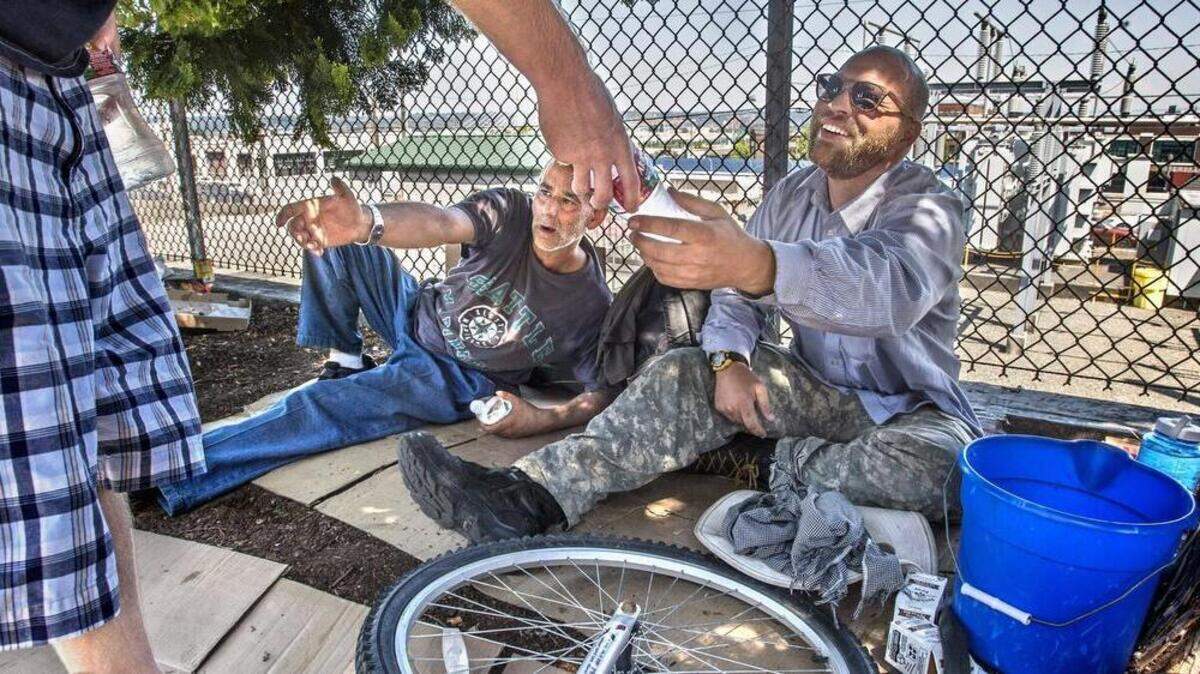
When last month’s dangerous heat wave hit, Pierce County was ill-prepared to care for its most vulnerable residents — those experiencing homelessness.
With temperatures in the triple digits, distributing water to people living in area homeless encampments quickly became a life-and-death necessity. But according to local advocates and volunteers who took on the lion’s share of that work, what was sorely lacking was a cohesive plan from the county for how, exactly, that was supposed to happen.
Given the reality of man-made climate change — and the knowledge that the heat wave we just endured won’t be our last — it’s a performance that can’t be repeated.
How frantic was it? Just ask Maureen Howard, who serves as a spokesperson and policy analysis for the Tacoma Pierce County Coalition to End Homelessness.
By the afternoon of Saturday, June 26 — a day when temperatures reached 102 degrees at Seattle-Tacoma International Airport — Howard says she was desperately calling anyone who would listen, including Tacoma Mayor Victoria Woodards, begging for more pallets of water to be delivered to the Dome District stability site. In what she describes as a leadership void, Howard and other volunteers took on the task of coordinating water deliveries to roughly 60 known encampments, she said, and the stability site became the last-minute hub for water distribution throughout the county.
“I was saying, ‘This is not my job,’” a still-irritated Howard told The News Tribune of her search for water.
Three weeks removed from the historic heat wave that claimed the lives of 24 in Pierce County, some things have become more clear than they were in the thick of the crisis. By the time temperatures subsided, nearly 40 pallets of water had been collected for homeless distribution efforts, including 22 from the city of Tacoma and Tacoma Public Utilities, which was a minor miracle, according to Howard and Coalition to End Homelessness director of operations Gerrit Nyland. That’s the good news.
The tragic news? We already know at least one person believed to be experiencing homelessness — 47-year-old Jason Nixon — died during the heat wave, according to the Pierce County Medical Examiner.
While it’s unclear if a lack of water contributed to Nixon’s death, Howard, Nyland and local elected officials like Pierce County Council chair Derek Young are deeply concerned by the systemic flaws the heat wave exposed, they said.
“I will put it this way: If there is (a county plan for responding to extreme heat situations), it’s not adequate,” Young said, arguing that it’s a task the county’s Department of Emergency Management is best suited to take on.
“This really is a county function, and it’s important for the county to step up and take responsibility,” Young continued. “The water situation really caught me by surprise, because you can survive that level of heat. You can’t survive without water.”
Although Pierce County officials largely defended their handling of the heat wave this week — and the support role the county took in the distribution of water — they acknowledged there’s room for improvement.
According to Pierce County director of Human Services Heather Moss and Department of Emergency Management director Jody Ferguson, the county’s response to inclement weather is currently dictated by warnings from the National Weather Service. When extreme heat or extreme cold is in the forecast, it kicks into gear, and the county responds by working with its contracted service providers to make sure they have what they need to meet people’s needs, including access to water.
That’s precisely what happened, they told The News Tribune. In addition to helping to open more than 20 cooling centers on the heat wave’s hottest day, the county Department of Emergency Management contributed two and half pallets of water to the Dome District stockpile, and roughly six pallets spread elsewhere across the county, including in Puyallup at Lakewood, they said.
There were nearly 1,500 individuals experiencing homelessness in Pierce County, according to the most recent count, and each pallet contained 2,000 bottles, county spokesperson Libby Catalinich said.
For the county, according to Moss, it raises the question: “How much is enough?”
“I think there’s a little bit of misinformation about what was available or how dire the situation was,” Moss said, indicating that a lack of communication was one of the biggest problems exposed during the heat wave.
Maybe that’s true, but even if a sufficient stock of water did eventually materialize, the root of the criticism the county is now facing centers on a lack of planning and leadership — and it’s a challenge Moss and her county colleagues must meet head on. We got lucky this time, in large part because volunteers and area service providers stepped up during moments of uncertainty, but luck isn’t something a county can bank on.
Asked about how the county can improve, Moss said her office would soon be revisiting its contracts with providers to include provisions for the purchase of water during extreme weather events — with reimbursement from the county.
The county is also preparing an after-action report detailing what worked and what didn’t, which is expected by next month, Moss said.
“Every emergency is different, and we learn from every emergency response that we are involved in,” Moss said. “I would say we did an adequate job responding to this episode, and we’ll do a better job next time.”
For those experiencing homelessness in Pierce County, adequate isn’t good enough, Nyland argued.
Nothing will change until the county takes ownership of the problem, he believes.
“The question is: What should the response be?” Nyland offered.
The obvious answer:
Much, much better than it was.
This story was originally published July 22, 2021 at 5:00 AM.