White House announces $46 million in climate resilience funding for Tribal communities
Tribal communities will soon receive $46 million in funding to address climate change, the Department of the Interior announced Monday, April 11.
The funding is made available from President Biden’s Bipartisan Infrastructure Law and 2022 appropriations for projects and initiatives that address and strengthen climate resilience and adaptation; ocean and coastal management; community-driven relocation and protect-in-place activities; as well as internships and youth engagement.
“As the effects of climate change continue to intensify, Indigenous communities are facing unique climate-related challenges that pose existential threats to Tribal economies, infrastructure, lives and livelihoods,” Interior Secretary Deb Haaland said in a release Monday. “Coastal communities are facing flooding, erosion, permafrost subsidence, sea level rise, and storm surges, while inland communities are facing worsening drought and extreme heat.”
The Interior Department will support collaborative and community-led planning, relocation expenses, infrastructure investments and other forms of assistance to Tribal communities. The Bipartisan Infrastructure Law investments also will advance the Biden-Harris administration’s equity and environmental justice goals, according to the release.
“Funding in the Bipartisan Infrastructure Law is essential to advancing the all-of-government approach to supporting and empowering Tribal communities as they simultaneously face environmental impacts to physical, cultural and subsistence-based infrastructure,” Assistant Secretary for Indian Affairs Bryan Newland said in the release.

Last year, Haaland highlighted the infrastructure deal when she traveled with U.S. Rep. Derek Kilmer to Taholah — located on the Quinault Indian Reservation in Grays Harbor County — to see first-hand the challenges of coastal Tribal communities feeling the effects of climate change.
Like many other coastal Tribal communities, Quinault is faced with abandoning traditional homelands and important community infrastructure for higher ground due to rising sea levels.
“It is truly a historic moment for our Tribes to know that the administration in Washington, D.C., cares enough about Tribes to send their delegation here to talk with us and hear our concerns, to hear what matters to Tribes,” Quinault Indian Nation President Guy Capoeman said at the meeting with Haaland. “And that’s our people, our safety, our health, our environment, our homes.”
The Tribe, which sees about 110 inches of rain annually, last year began construction on a new housing development for approximately 70 families out of the tsunami zone.
“When we see that ocean breach up to our only store, our community center, our jailhouse, our courthouse — every one of these is a reminder that we are in harm’s way… We have a duty to protect our community,” said Fawn Sharp, vice president of the Quinault Indian Nation and president of the National Congress of American Indians.
In her first Tribal consultations as Chair of the White House Council on Environmental Quality, Brenda Mallory sat down with Washington state Tribal leaders in October.
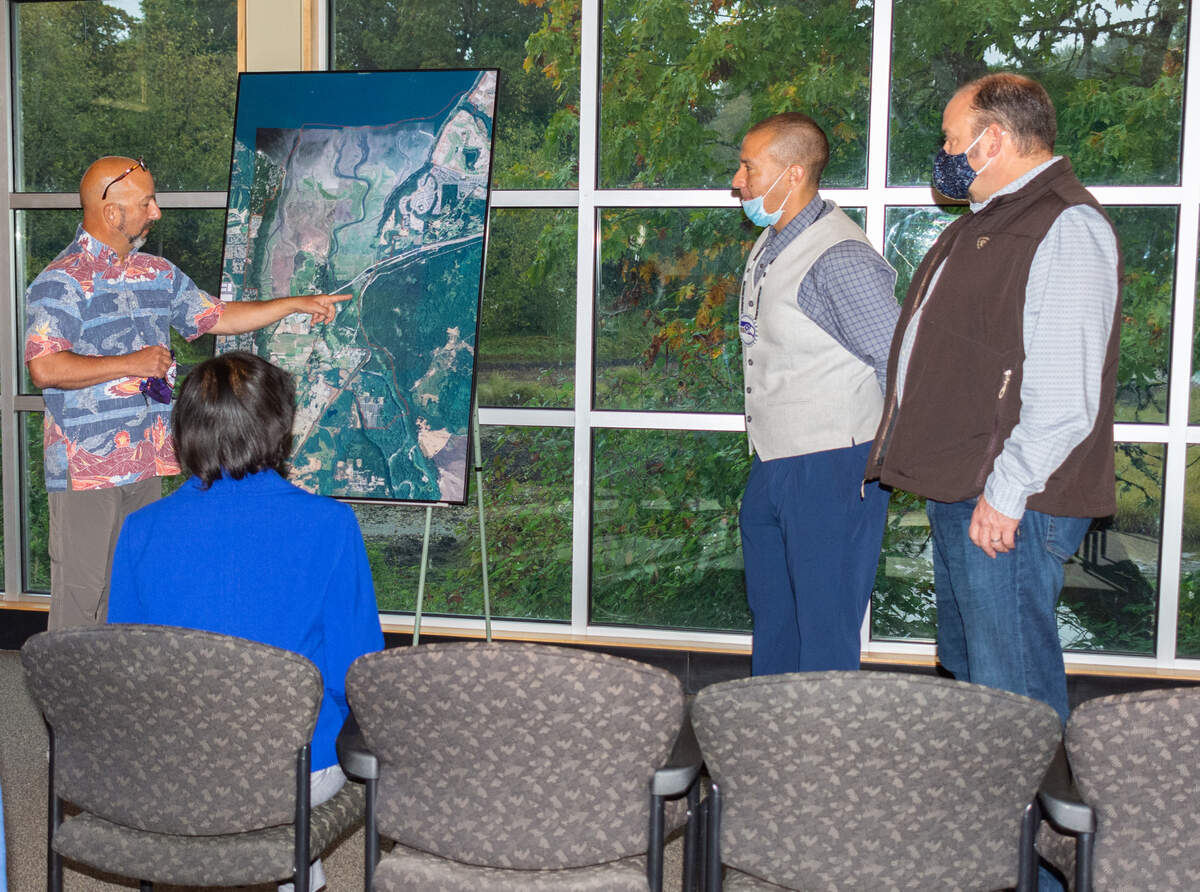
“In Washington, we’re about ground zero for the impacts of climate change. Our Tribes don’t want to just have meetings, we want action — to move the dial, ” Northwest Indian Fisheries Commission Chairman Ed Johnstone, then the fisheries policy spokesperson for Quinault Indian Nation, said at the meeting.
Mallory discussed federal investments in Tribal communities and conservation efforts, like the infrastructure deal, with Tribal leaders across the state, the Northwest Indian Fisheries Commission and U.S. Reps. Derek Kilmer and Marilyn Strickland.
“Because climate change disproportionately affects Native communities, it is now more important than ever to assure that the federal government collaborates with Tribal nations and Native communities...,” Mallory said shortly after her Washington state tour at the White House’s Tribal Nations Summit in November.
The Bipartisan Infrastructure Law provides a total of $466 million to the Bureau of Indian Affairs over five years, including $216 million for climate resilience programs.
Of that funding, $130 million is provided for community relocation, $86 million is provided for Tribal climate resilience and adaptation projects, and $43.2 million will be available to spend annually for five years.
Monday’s announcement is supported by $21.7 million from Bipartisan Infrastructure Law funding and $24.5 million from fiscal year 2022 annual appropriations.
An informational webinar hosted by the Institute for Tribal Environmental Professionals Tribes and Climate Change Program on the funding opportunity is scheduled for April 25, at 2:30 p.m. Registration is available online. The Department is now accepting proposals for the 13 funding categories from Tribes and Tribal organizations as part of the Bureau of Indian Affairs Tribal Climate Resilience Program.
This story was originally published April 11, 2022 at 12:35 PM.