
National lab in WA has key role in Trump AI mission to transform science
AI-generated summary reviewed by our newsroom.
- PNNL to be core contributor on AI projects for grid, materials, security.
- Genesis Mission unites 17 national labs to double U.S. R&D productivity.
- AI workflows aim to speed experiments and support grid operators; may aid jobs.
The national laboratory in Richland is being tapped to work on three key research challenges for the Trump administration’s Genesis Mission, an ambitious project to dramatically increase the pace of scientific discovery, Pacific Northwest National Laboratory announced Tuesday.
The Genesis Mission, led by the Department of Energy, is bringing together all 17 of the U.S. national laboratories to use artificial intelligence systems, in combination with supercomputers and emerging quantum technologies, to transform how science is done.
Scientists at national labs like PNNL in Richland will focus on energy, discovery science and national security research.
“The Genesis Mission represents a pivotal moment of profound national purpose, where the brightest minds across DOE’s national labs, industry and academia are coming together to redefine the boundaries of scientific discovery,” said PNNL Director Deb Gracio. “At PNNL, we are seizing this opportunity to shape the future of science with urgency and determination.”
Energy Secretary Chris Wright has compared the initiative to the Manhattan Project.
Then workers at the Hanford nuclear site raced to create plutonium for an atomic bomb, helping end World War II, and launching the atomic age.
Now the challenge is to “unleash the full power of our national laboratories, supercomputers and data resources to ensure that America is the global leader in artificial intelligence and usher in a new golden era of American discovery,” he said.
The Genesis Mission could also provide a path for the national lab based in Richland, the Tri-Cities largest single employer, to restore some of the jobs it lost in the last full fiscal year.
Its employment fell by almost 400 employees from the 6,440 in fiscal year 2024, amid uncertain federal funding outlooks, including for clean energy and climate research that were not priorities for the Trump administration.
Under the Genesis Mission, Pacific Northwest National Laboratory will be collaborating in efforts to strengthen the nation’s electric grid, analyze nuclear materials related to national security and helping integrate artificial intelligence workflows to improve experiments.
“The Genesis Mission is giving us a once-in-a-generation opportunity to build the word’s greatest scientific instrument and collaborative infrastructure for discovery science, energy and national security,” said Court Corley, chief scientist for artificial intelligence at PNNL.
The national project is not intended to replace scientists, but to enable them, according to DOE.
“Genesis Mission has the goal of doubling the productivity and impact of U.S. research and development by pairing scientists with intelligent systems that reason, simulate and experiment at extraordinary speed,” DOE said in a Q and A guide to the program.
Here’s what’s planned at PNNL:
U.S. power grid
The nation’s electric grid, sometimes called the world’s largest machine, has the complexity that makes it an almost perfect test case for taking advantage of the power of AI to provide immediate data and analysis, says PNNL.
It’s also among the Genesis Mission projects most closely tied to “boots-on-the-ground commercial operators” who must constantly manage power on the nation’s grid now using firsthand experience and limited data, according to PNNL.
PNNL will be the core technical contributor among nine national laboratories for a proposed national AI platform designed to evolve continuously and support operators in real time with reliable intelligence.
.jpg "unnamed (1).jpg")
The model will be trained on grid control data, past events that disrupted the grid and stress testing. Then grid operators will test its ability to support planning, forecast and decision-making on grid operations.
“When operators often work with tight deadlines to complete tasks such as reviewing data as part of market operations, they can have as little as three hours to make important decisions,” said Marcelo Elizondo, a technical lead for the PNNL team.
“We’re hoping that AI models can be useful to support operators for those tasks, as well as to derive important information to help operator’s decisions regarding power system reliability,” he said.
Analyzing nuclear materials
PNNL can trace its role analyzing the properties of uranium and plutonium back to the Manhattan Project.
Now the lab will use its decades of expertise to deploy artificial intelligence to create new ways to analyze nuclear materials in support of the nation’s nuclear weapons stockpile.
Replacement parts made with new production approaches must produce materials that behave the same way as in the original parts.
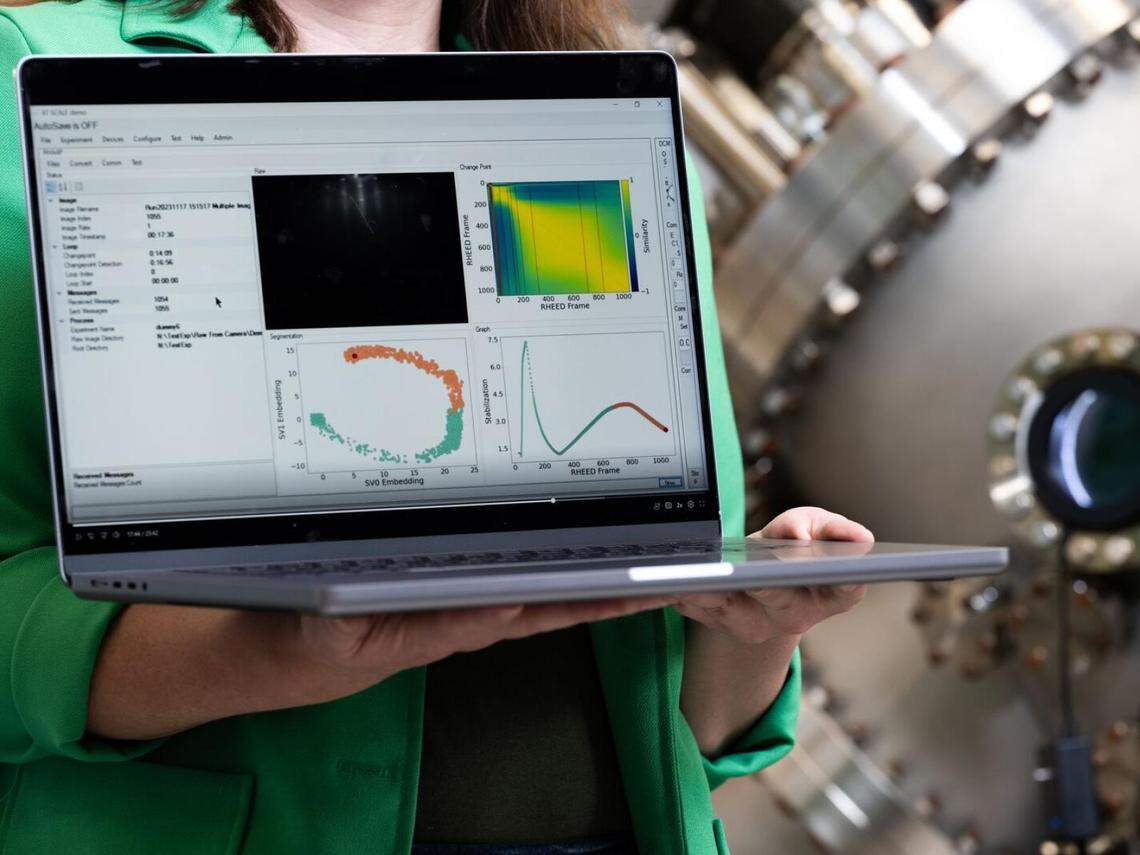
The PNNL team is using artificial intelligence with scanning electron microscopes to image nuclear material samples, analyze the data and then determine what to try next with little-to-no human intervention.
That frees up researchers from tedious data collection tasks to focus on the fundamental science of material performance.
“Over the last three years, we’ve had the opportunity to process fewer than 10 samples of our most important uranium alloys,” said Aaron Luttman, senior adviser to the Mission Genesis project, called Autonomous Characterization of Materials Across Scales.
“At the end of the project, we will be analyzing 10 samples every three months,” he said.
The data should provide the National Nuclear Security Administration, its design laboratories and its production plants options for materials and manufacturing at a pace not seen before, he said.
Optimizing AI research
In early December, the nation’s energy secretary visited PNNL for the first time and commissioned a first-of-a-kind prototype system using artificial intelligence to accelerate the speed at which biological science is done.
The system, the Anaerobic Microbial Phenotyping Platform, or AMP2, combines robotics and artificial intelligence to conduct research using microbes, such as bacteria and fungi.
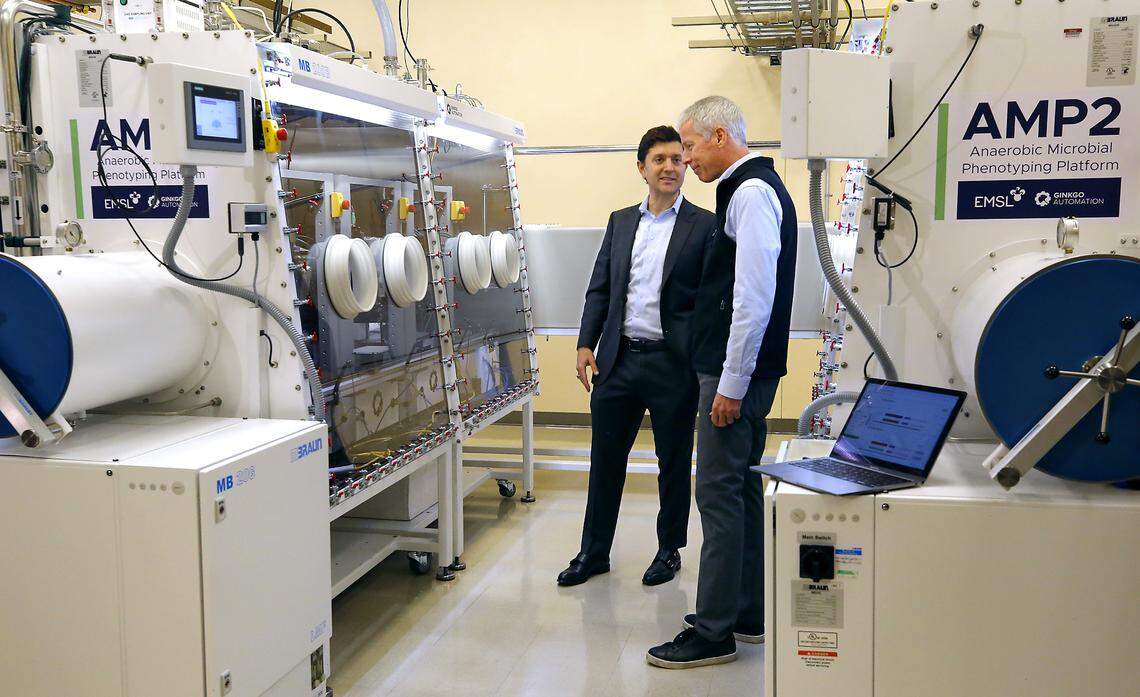
Construction is planned to start this year on an addition to the Environmental Molecular Sciences Laboratory on the PNNL campus to house a similar but much larger system to explore questions about microorganisms that can play important toles in industrial processes to make chemicals, fuels and biomaterials.
AMP2 will be used in collaboration with other labs, combine resources that combine automation, robotics and data analysis.
PNNL researchers will work on what they are calling a translation system to help instruments and data sources speak the same language.
“What that means is we can ask a question, for example, in the language of a mass spectrometer instrument and get an answer in the language of genes,” said Chris Oehmen, a technical lead for the project. “The goal is to have a platform that can speak multiple data languages, integrate those data and tell us which experiments to do next.”
The point is to do better experiments by using AI and do more experiments by using automation, he said.
For example, if he is doing an experiment by himself and needs a microbe to grow faster, he can optimize for that condition. But an AI system that has access to multiple conditions and datasets can find an optimal growth condition that could not only get the microbe to grow faster but also be robust.
This is going to change the way scientists think about their work, he predicted.
This story was originally published February 23, 2026 at 5:00 AM with the headline "National lab in WA has key role in Trump AI mission to transform science."