Earth recorded its hottest-ever month in July. But how hot did it get in Western WA?
The World Meteorological Organization has declared that July 2023 was officially the hottest month on record.
The first three weeks of the month were the hottest three-week period on record, and July 6 was officially the hottest day on record, with an average worldwide temperature of 63 degrees, according to the WMO. The average worldwide temperature includes the frigid cold of the poles and the searing heat around the equator.
July 5 and 7 measured slightly cooler than July 6, according to WMO, making up the top three hottest days in recorded history.
How hot was July in the Puget Sound?
Interestingly, Western Washington was one of the only regions in the country that didn’t get blasted by heat throughout July. The Puget Sound area stayed at an average high of about 80 degrees during the mid-July “heat dome” that cooked most of the U.S. west of the Rocky Mountains.
Western Washington escaped the heat thanks in part to a low-pressure system sitting off the coast providing the region with cooler air, National Weather Service meteorologist Carly Kovacik told McClatchy News.
Using data recorded in the Seattle-Tacoma area, temperatures peaked at 91 degrees on two occasions but otherwise stayed in the 70s and 80s.
Overall during July, the Puget Sound area had 15 days that reached at least 80 degrees and had an average high of 80.1 degrees.
As heat waves blasted North America, Europe and Asia, weather in Western Washington was much easier to endure. As Phoenix set the hottest month on record for a U.S. city, Washington’s July only ranked as its 6th hottest in history.
Was this Puget Sound’s hottest July on record?
Since records began in 1945, a typical July in Puget Sound sees an average high temperature of 77.4 degrees and an average low of 56.8 degrees for an average 24-hour temperature of 67.1 degrees.
But a new normal in hot temperatures is emerging for Washington state. As Benjamin Hatchett, a research assistant professor with the Desert Research Institute, previously told McClatchy News: “This summer will now be the coolest summer we experience.”
This past July when the average high was 80.1 degrees, and the average low was 57 degrees, it also made the 24-hour average for the month 68.5 degrees.
Here’s how this past July stacks up against other toasty summers in the Puget Sound region. Each month is measured by the average 24-hour temperature:
2009 - 69.5 degrees
2014 - 69.2 degrees
2022 - 68.8 degrees
1958 - 68.6 degrees
1985 - 68.6 degrees
2023 - 68.5 degrees
Notably, four of the top six have occurred since the turn of the 21st century. United Nations Secretary-General António Guterres publicly said that he believes it could have been avoided.
“For vast parts of North America, Asia, Africa and Europe, it is a cruel summer. For the entire planet, it is a disaster,” Guterres stated in a news release. “And for scientists, it is unequivocal – humans are to blame. All this is entirely consistent with predictions and repeated warnings. The only surprise is the speed of the change.”
Korri Anderson, a meteorologist with the National Weather Service, agrees that human-caused climate change is a significant factor for soaring temperatures.
“There’s more blacktop and cement around these areas that are contributing to (increasing temperatures) as well, as the cities get bigger,” Anderson said.
Upcoming weather for Puget Sound
After a month of going against the grain when compared with the rest of the county, August will finally be Puget Sound’s turn to warm up. The National Weather Service is forecasting temperatures up north around Bellingham to hit 80 degrees, while areas farther south, such as Olympia, are expected to reach 87 degrees.
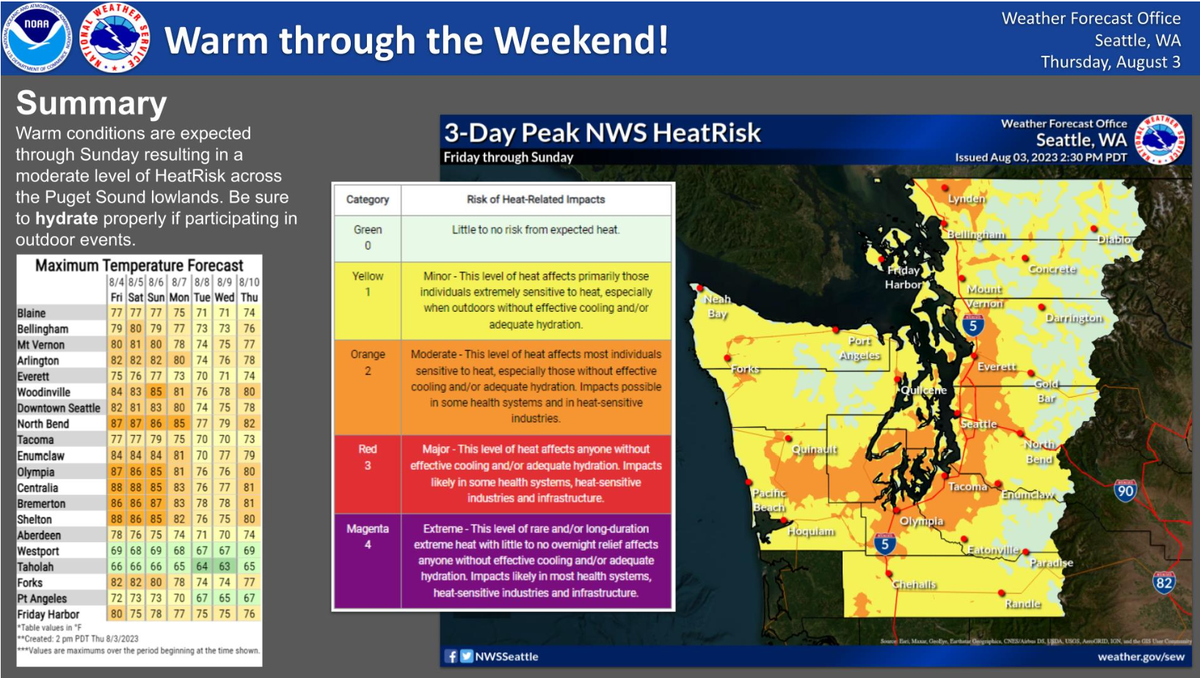
The Climate Prediction Center, an extension of the National Oceanic and Atmospheric Administration, has the Puget Sound region in a narrow corridor of seeing a 40-50% chance of above-average temperatures through Aug. 13.
The average high temperature for Puget Sound from 1990 to now during August is 77.6 degrees, meaning Washingtonians can expect temperatures to peak closer to 80 degrees as we head deeper into the month.
This story was originally published August 4, 2023 at 12:01 PM.