The Pierce County Council wants to debate the future of Canyon Road. They’re too late
The damage has been done. The monster has been created.
That’s why it’s so maddening now — many years later — to listen to the Pierce County Council debate the future of Canyon Road East, yet again.
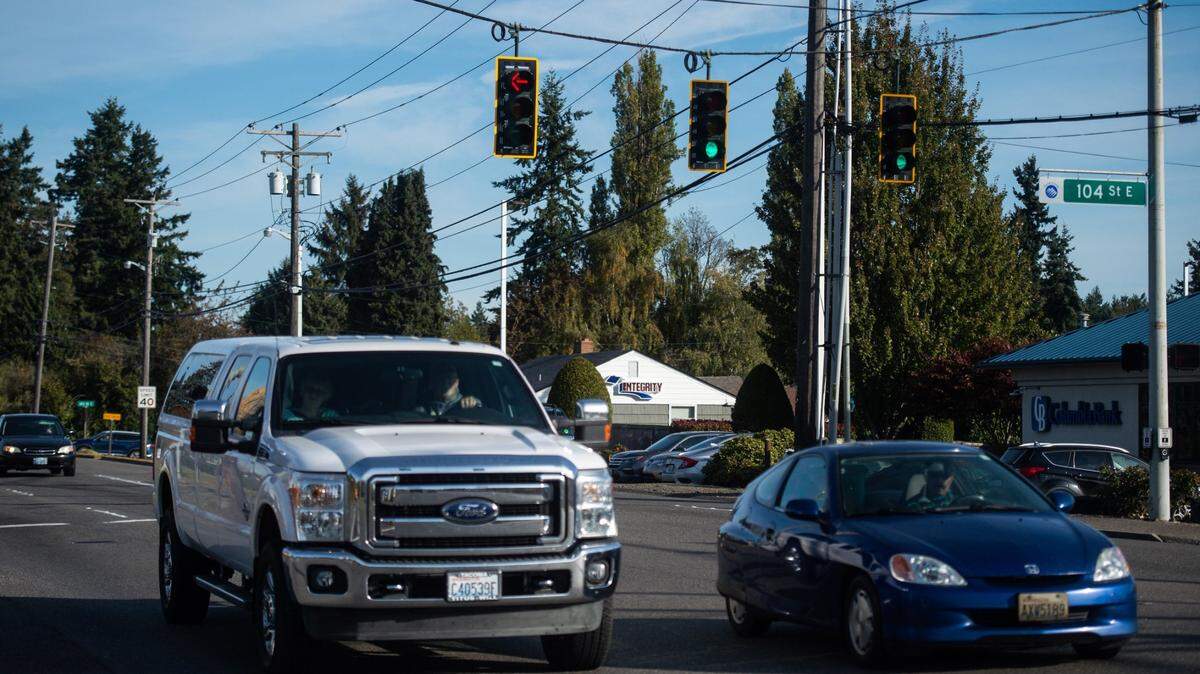
Drive the straight-shot corridor, from East Pioneer on the outskirts of Puyallup all the way up to 200th Street East near Frederickson, and you’ll be bombarded by signs of change and so-called progress. As you cross 72nd Street, straw lines the torn-up side of the road, signaling a coming expansion from three lanes to five. At points, you’ll contend with as many as seven lanes of traffic. By the time Canyon meets its terminus outside Graham and Elk Plain, you will have navigated congestion and large intersections while passing strip malls, weed shops, fast food joints, single-family housing developments and several chain auto parts stores.
In short, it’s a burgeoning version of Meridian on South Hill, one of the most egregious examples of poor planning and wasteland sprawl Pierce County has to offer.
It’s also exactly what the original proponents of the Canyon Road Regional Connection Project — which dates back decades and envisioned protecting Frederickson as a hub for family-wage industrial jobs connected to the Port of Tacoma via an expanded Canyon Road freight corridor — promised we wouldn’t get.
Why am I rehashing this now? In early October, the County Council voted against pursuing a $30 million grant that could be a small part of the funding puzzle to finally completing the long-envisioned Canyon Road corridor, extending it over the Puyallup River and into Fife, where industrial freight could easily make its way to the port. On a council with a progressive Democratic majority, the vote was along party lines.
Ignoring the history for a moment, the skepticism voiced by current liberal council members like Derek Young and Ryan Mello is reasonable enough. Should Pierce County really tie up millions more dollars in scarce transportation money on a five-lane highway across the Puyallup Valley, given the county’s other transportation needs and deficiencies? Do massive road projects like this align with the county’s other goals, including reducing carbon emissions? Should the project be smaller? With the construction of the state Route 167 extension making it easier for freight cargo to reach the Port of Tacoma, is it still necessary? Even if we wanted to, do we have the money to finish the Canyon Road project as originally envisioned?
They’re all fair questions to ask, and all of them should be asked, even if it’s sure to strike conservatives as righteous liberal posturing.
But here’s the thing: It’s too late. For anyone with roots in this area, it’s impossible to view the potential final piece of the Canyon Road project in a singular vacuum, nor should we expect anyone to try. Talk of Canyon Road will always come back to what’s already been built, and the damage that’s been done. Regardless of what happens from here, Canyon Road has become exactly what previous leaders pledged to prevent, a repeat of the same land-use mistakes Pierce County has made so many times before.
For newcomers, it’s important to grasp what the Canyon Road project was supposed to deliver, which can easily be lost in the sense of inevitably that comes with growth and slow change. The vision was to establish Frederickson as an industrial center and economic driver, while utilizing expanded Canyon Road primarily as a commerce corridor — and not simply another massive sprawl creator slicing into the hinterlands. In other words, it was about jobs — good jobs — and connecting Frederickson to the port.
So how did it go wrong? The same way it always goes wrong in unincorporated Pierce County, through lax zoning, a scarcity of foresight and the same lack of critical questioning from leaders that have doomed so many high-profile projects (the Joint Base Highway comes to mind). For the original vision to materialize, leaders over the last three decades would have had to do something unheard of in these parts: Say no to developers and put strict limits on what can be built. They would have had to curtail the vast expansion of never-ending tract housing, and eschewed automobile-centric strip-mall designs.
They did none of that and said yes to all of it. What Pierce County residents are left with is yet another example of how not to grow.
Today, after you travel all eight miles of Canyon Road, you end up in Frederickson. There, the Frederickson Town Center commercial development continues to expand. There’s industry, sure, but lately it’s been mostly warehouses and Amazon distribution centers being built, which are a far cry from the family-wage jobs that were supposed to arrive. Mostly it looks and feels a whole lot like another ill-placed, contiguous ‘burb in the making. Twenty years ago, Frederickson was home to just under 6,000 people. As of the 2020 Census, it was home to nearly 25,000, and it’s expected to keep growing.
All of this brings us full circle, back to the County Council’s fresh misgivings over the final piece of the Canyon Road Regional Connection Project. Is it complicated? Sure. Is hindsight 20/20? I guess.
Should our current elected leaders evaluate the envisioned completion of Canyon Road using everything we know today? They’d be negligent not to.
Still, there was a time to get this right and deliver on the full promise of good-paying industrial jobs Pierce County desperately needs while preventing unrepentant sprawl.
That time has passed. It was a long time ago.
Now, debating the future of Canyon Road mostly feels like an attempt to add a footnote to history that’s already been written.
This story was originally published December 3, 2022 at 5:00 AM.