Republicans are right: Solving homelessness in WA requires more than housing | Opinion
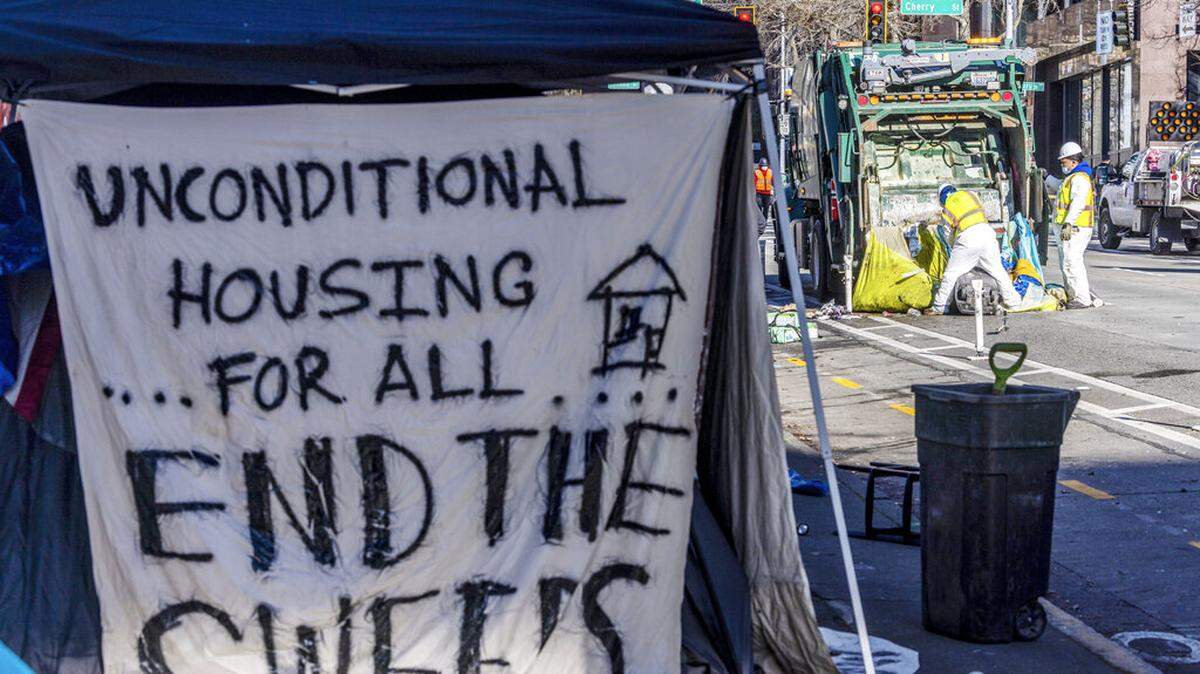
Common ground. It’s what we’re always searching for. In a partisan world, it’s what so often eludes us. It’s a magical place where divergent sides can, in theory, come together to find a starting point — a place where compromise and good-faith problem-solving can begin.
Increasingly, identifying common ground is easier said than done. Or at least that’s how it feels. We often live a siloed existence, inhabiting social and political bubbles. And most of us are righteous in our own way, intentional or not. The others — those we disagree with, regardless of why — quickly become bad guys and monsters. It’s not hard to see how this happens, particularly given the perception that the stakes have never been higher.
Our dysfunctional politics, a media landscape that feeds off the fury and our tendency to yell and scream on social media drive a daily wedge between us.
Amid all of this, homelessness is just one of many issues that sharply divide us — not that you need a reminder. Venture into the realm of talk radio, your neighborhood’s Nextdoor group or just about any online comments section and the venom is real.
But here’s the thing: What if we’re not as fractured as it so often feels?
What if there’s a chance for middle ground — right in front of us, and we’re just too frothing and broken to realize it?
That was one of many reactions I had while reading Bill Bryant’s latest column for The News Tribune, published this week. On the surface (and perhaps even the first few layers) the former Republican gubernatorial candidate staunchly disagrees with me.
Bryant thinks Washington Governor Jay Inslee’s proposal to borrow $4 billion to quickly build thousands of units of affordable housing and shelter space across the state is “doomed to fail.” I do not.
To make his case, Bryant offers two main points. First, he argues that solving homelessness requires addressing behavioral health and chemical addiction issues in Washington’s unhoused population. He also believes that current regulations and red tape make building the low and middle-income housing we desperately need more difficult and costly than it should be.
So, are you sitting down?
Because what if I told you that I agree with both of those sentiments — wholeheartedly?
Shocking, right?
Before we go too much further, it’s worth pointing out the places where I believe Bryant’s argument falters.
Most notably, Bryant’s underlying assertion, which seems to be shared by a number of his conservative contemporaries, fails to acknowledge the full scope of the crisis. It’s easy to think about homelessness and picture what Bryant describes as “those living in tents and boxes,” and perhaps that’s only natural. For most, the crisis of homelessness is personified by the people we see along the side of the road or huddling beneath overpasses — truly, individuals with the most barriers to being housed.
The actual breadth of Washington’s homelessness crisis, however, is more complicated. The real faces of homelessness are all those we don’t see. Of the estimated 25,000 people experiencing homelessness in Washington according to the U.S. Department of Housing and Urban Development’s annual homelessness assessment, last year less than a third were classified as “chronically homelessness” — meaning they have experienced prolonged or repeated episodes of homelessness and have a disability. Not every person who falls into chronic homelessness faces mental health or addiction challenges of course, but the prevalence is impossible (and foolish) to ignore.
In short, Bryant is exactly right: Many of the people we see as homeless — the visible faces we’ve associated with the problem — require much more than cheap housing. To lift them out of crisis, they need housing and a whole host of services, in many cases for the rest of their lives. It’s what’s known as permanent supportive housing, and it’s exactly what Pierce County’s proposed micro-home village for the chronically homeless would provide. If we fail to deliver solutions like these, we’ll never fully address the problem.
It’s just that we also need good old-fashioned affordable housing, and a lot of it. There’s no way around that.
We need places where people of all incomes can afford to live, to help them escape homelessness.
Equally important, we need affordable housing across the state that will prevent people from becoming homeless in the first place — and there’s simply no way that local cities, counties, housing authorities and the private market can do it alone, let alone with the speed and urgency the moment requires.
“A substantial part of the population needs an affordable place to live. … They don’t need a lot of services. They just need places they can afford on social security, or SSI, or a minimum wage job. That’s not a question of mental health or addiction or behavioral health,” explained former Tacoma Housing Authority Executive Director Michael Mirra.
“Naked children need clothing. Starving children need food. Homeless children need housing,” Mirra continued.
“As complicated as this whole topic is, that’s the peasant’s truth.”
So where do we go from here? I’d suggest we spend more time focusing on the things we agree on and less on our perceived differences.
We need an answer for all those living without shelter while battling mental health or addiction issues. Any Democrat that’s not saying it plainly enough should be.
We need to make it more feasible and less cost-prohibitive for affordable housing to be built.
We need thousands and thousands of units for people who just need a place to live.
And we need it quickly — because there’s no time to spare.
The merits and potential shortcomings of Inslee’s $4 billion plan deserve to be debated, and surely will be.
But when the dust settles, here’s the realization we should rally around:
We have to do something.
And we have to do it now.
This story was originally published February 19, 2023 at 5:00 AM.