
Tacoma, don’t plant the wrong trees. Our canopy must face a new climate | Opinion
Trees are more important than ever to Tacomans’ health, shielding us from historic heat waves and filtering pollution. So it was a step in the right direction when Tacoma’s city council passed a resolution May 13 that aims to protect and grow the city’s tree canopy while still promoting housing development.
I applaud the city for considering trees while grappling with Tacoma’s growing housing affordability crisis, and for expanding this approach beyond the Home in Tacoma plan, where the idea originated.
But for Tacoma to grow its tree canopy, we have to have a conversation about which tree species to prioritize.
To be clear, Tacoma’s urban forestry program has lots of helpful information on how to pick a good tree. It has a list of trees it’s approved or banned for planting in rights of way, and tolerance of extremes is a factor in vetting those trees. And it provides funding to the Tacoma Tree Foundation, which has multiple programs to help residents pick the right tree for a specific location.
The problem we all face is that the climate is changing, and some trees that have done well in the Tacoma area historically are less suited to surviving in the future. Regions around the world are tackling this issue by searching for trees that will survive in the climate they expect to live in 20 to 30 years on, when trees planted today have grown to maturity.
Sydney, for example, has identified an Australian city closer to the equator with trees that might do well in the Sydney of 2050. The research informs which trees the city puts on its recommended tree list. Scientists in London have traveled to the steppes of Romania to find tree species that tolerate the drier springs expected to become commonplace in the UK (and that are threatening its namesake tree, the London Plane).
Closer to home, Portland has reconsidered its tree list in light of which plants might have more staying power in a changing climate. Tacoma has much of the information we need to focus on climate resilient trees, too. Boosting that knowledge would fix what I see as a gap between what the city knows about trees and what it highlights to the public.
The city’s urban forestry program has access to guidance on which trees can tolerate a wide range of extremes, from heat waves to freezes, and from drought to flood. The city also partners with the Tacoma Tree Foundation to train tree stewards and present free workshops to give people tools for picking good trees. That means there are avenues for getting the message out.
But Tacoma also leaves developers who are required to plant trees to research for themselves which plants from its list are suited to a particular site. Whether they do it is up to them. And the city doesn’t put the need to pick trees that can weather the extremes of climate change front and center.
A community conversation
It’s also important for the public to get invested in this issue. We can contribute to a resilient urban forest by getting involved in the tree programs already available and sharing what we learn with our neighbors. If you plant a tree using the city’s tree coupons or the Grit City street tree program, you can also access city-funded programs to learn how to pick a good tree for your site, and how to get a young tree get established in its vulnerable early years.
This conversation also needs to acknowledge the unfortunate downside inherent to shifting toward new species. Cities that look for climate resilient trees will need to de-emphasize some beloved native species. Sadly, we can already see that that’s necessary in Tacoma.
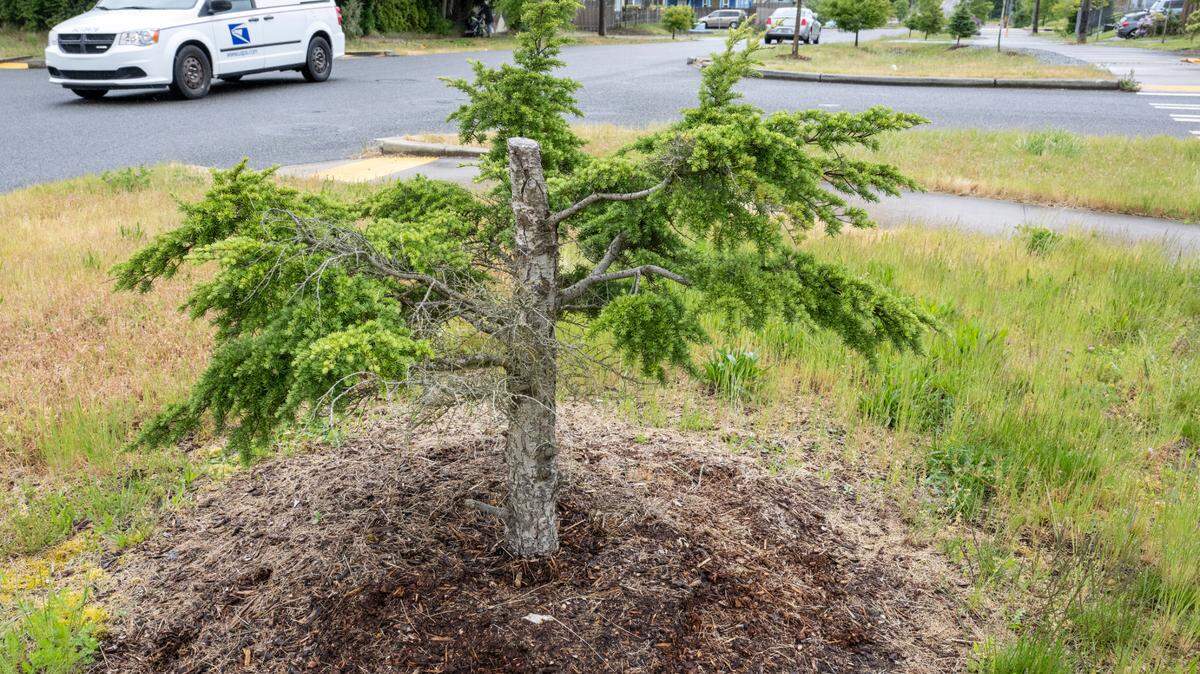
Mature native trees here already show signs of major distress, brought on by cycles of increasingly dry springs and hot summers. Skeletal evergreens haunt the region from roadsides, and maples display partially dead crowns.
That’s depressing to look at, but the city can’t save established trees in public rights of way with watering. Those areas represent 26% of the city’s surface. The cost of watering mature trees deeply in that much space would be astronomical. That just makes it even more important to choose trees that will survive the temperatures and moisture levels climate change will bring.
A home for our neighbors’ native species
There’s also hope for natives. Firstly, tree experts can identify areas where native trees still thrive (typically parks or other areas with ready access to water), and prioritize maintaining those plants. Secondly, we can become a home to our close neighbors’ native plants that are threatened in nearby regions.
One research effort in Washington examines this exact approach. A multi-city program in Tacoma, Seattle and Renton is growing saplings to see which location might be an ideal home for western redcedars grown from seeds collected in Oregon. Redcedars are culturally significant for indigenous tribes throughout the region, and cultivars from drier parts of Oregon may now do better here.
If we can’t regularly plant or maintain all of our native species, we can still help other species survive. And those survivors will help us, too. In addition to providing shade, trees cool the air around them by letting off water vapor. Unlike traditional air conditioning (which we will also need more of), trees don’t put more greenhouse gas emissions into the atmosphere.
We can’t let climate change kill trees when we need them the most. But that’s exactly what could happen if we aren’t strategic about planting and preservation efforts.
This story was originally published May 22, 2025 at 5:00 AM.