Frank Clark’s in another Super Bowl. He got what Chad Wheeler won’t: a Seahawks 2nd chance
Frank Clark got the second chance Chad Wheeler won’t get.
The second chances Ben Roethlisberger, Tyreek Hill and Antonio Brown got.
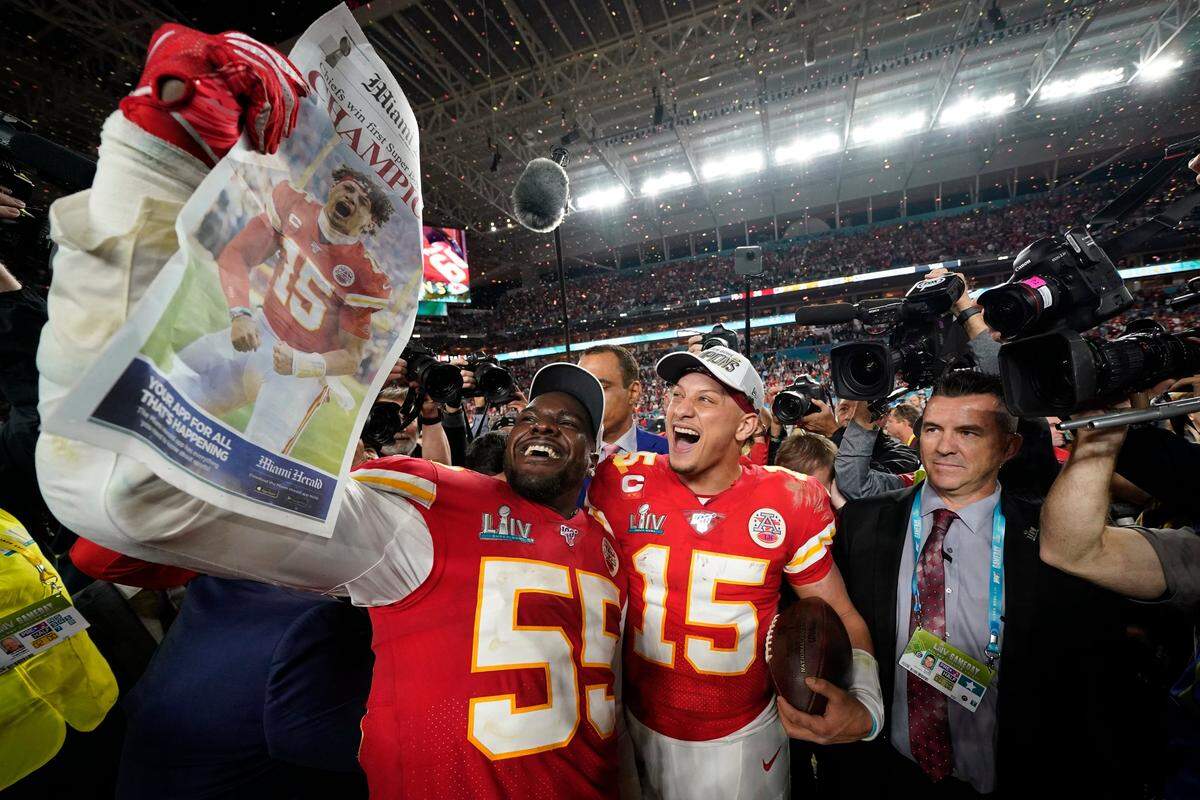
Clark, the former Seahawks pass rusher, has turned his football re-do following an alleged domestic-violence incident while in college into $104 million. He has a Super Bowl ring he earned last year with Kansas City. He’s got a shot at a second one in two seasons Sunday when his Chiefs play Tom Brady and the Tampa Bay Buccaneers in Super Bowl 55.
He’s playing with NFL MVP Patrick Mahomes against Tom Brady, the six-time Super Bowl winner starting his 10th Super Bowl.
“It’s just a pleasure to share the field with these guys, to have these moments, to get to go out there and compete against him,” Clark said.
More of a pleasure than meets the eye.
Clark is 27 now. He’s wealthy beyond what anyone from his notoriously tough area of Los Angeles, Baldwin Village, expects from life. Clark’s old neighborhood was the quasi-fictional backdrop for actor Denzel Washington’s Oscar-winning portrayal of a crooked cop immersed in the street drug trade in the movie “Training Day.”
“They call it ‘The Jungle,’” Clark told The News Tribune in 2016, describing the area bordering the Crenshaw district, southwest of downtown Los Angeles. “Basically, I mean, there aren’t too much I want to talk about, you know what I mean, about that. It’s a rough area.
“It’s hard making it out of that city. It’s a city within the city of Los Angeles. Anybody who knows LA knows that’s one of the roughest parts of the city.”
He made it out, and way up, thanks to Pete Carroll. Back when he was coaching at USC, Carroll used to walk Baldwin Village’s streets at night to help the community while working for A Better L.A., his nonprofit organization. Carroll drafted Clark into the NFL in 2015.
Now, on the eve of playing in his second consecutive Super Bowl for Kansas City, Clark remembers Carroll and Seattle with supreme appreciation.
“I look back that it was a good time,” he said, smiling after taking off sunglasses, dancing to music on his mobile phone then speaking via an online Zoom call from the Chiefs’ facility in Kansas City this week.
“I mean, Seattle, that’s where I got my start, my first taste of the NFL.
“I always say, hats off to Pete Carroll, his staff up there, (general manager) John Schneider...going ahead and drafting me. Gave me my first shot in the league, man. And I can be nothing but thankful for that.”
A second chance
Before the 2012 NFL draft, Schneider drew a line against domestic violence for his Seahawks.
“We would never take a player that struck a female or had a domestic-violence dispute like that,” Schneider said then.
Three years later, he did.
He drafted Clark.
Clark had made it out of “The Jungle,” to Cleveland, to live with relatives and go to high school. He excelled at Glenville High, in the class of 2011. He earned a football scholarship to the University of Michigan.
But in November of 2014 Michigan kicked him out of its program, following his arrest and brief jailing for domestic violence in Ohio.
A police report stated that that he reportedly struck his girlfriend during an incident at a hotel outside Sandusky, Ohio. Witnesses told police the 20-year-old woman appeared to be unconscious. After an investigation, a local prosecutor determined Clark did not strike her.
The prosecutor agreed to a plea bargain with Clark and reduced the charge to disorderly conduct, a fourth-degree misdemeanor. Clark paid $350 in fines and court costs, plus an undisclosed probation fee.
For months, Clark worked out alone at a gym, with no trainers or the specialty draft-preparation academies top prospects use. Then the Seahawks made Clark their top pick in the 2015 draft.
“Believe in me,” Clark said the night Seattle picked him.
Carroll and Schneider did, though many NFL teams took Clark off their draft boards.
Clark told the Seahawks he didn’t hit the woman. On the night the Seahawks drafted Clark, GM Schneider said he believed Clark never struck his girlfriend.
That night he got drafted, Clark said he was still in court-mandated counseling.
“I mean, they questioned me about the incident. They went through every single detail,” Clark said of the Seahawks in May 2015.
“I simply kept it real with them. I don’t pride myself on lying.”
Nearly six years later, people still criticize the Seahawks for having Clark on their team. For many, anyone charged with domestic violence deserves no second chance.
Carroll and Schneider didn’t give Wheeler one.
Wheeler’s end
The reserve offensive tackle who played in five games this past season was arrested and jailed in King County for investigation of felony domestic-assault violence against his girlfriend in an apartment in Kent on Jan. 22. Charging documents allege the 6-foot-7, 310-pound Wheeler attacked, beat and strangled a 5-9, 145-pound woman to the point that she lost consciousness twice, and sustained a broken arm and bruised, bloodied face.
Wheeler was released from the King County Jail on $400,000 bond Jan. 26. On Monday he pleaded not guilty to felony charges of domestic-violence assault and domestic-violence unlawful imprisonment, plus a misdemeanor charge of resisting arrest.
His trial is scheduled to begin April 6.
The Seahawks issued an extraordinary statement Jan. 27, condemning Wheeler and emphasizing that his contract—and likely his NFL career—was ending.
“The Seahawks are saddened by the details emerging against Chad Wheeler and strongly condemn this act of domestic violence,” the team said. “Our thoughts and support are with the victim. Chad is a free agent and no longer with the team.”
The statement urged anyone experiencing domestic assault to call the National Domestic Violence Hotline at 1-800-799-7233 or to go online to thehotline.org. All calls are free and confidential. The team noted the hotline is available all day, every day, in more than 170 languages.
To reinforce they were done with him, the Seahawks waived Wheeler. That absolves the team of even the option to not tender a restricted free-agent contract offer to him, which Seattle wasn’t going to do, anyway.
Wheeler went unclaimed on waivers. He is an unrestricted free agent, out of the league at least for now. The NFL has the right to suspend him under its personal-conduct policy and will investigate whether to do so.
“We encourage Chad to get the help he needs,” the Seahawks’ statement said in conclusion. “If you are experiencing mental health issues, please reach out for help. For immediate help with a mental health crisis or thoughts of suicide, contact the National Suicide Prevention Lifeline at 1-800-273-8255 (TRS: 1-800-799-4889).”
Why Clark?
Wheeler and Clark are the same age: 27.
Why did the Seahawks stick with Clark yet quickly cut ties with Wheeler?
First, there is no denying Clark is better at football than Wheeler. He is more valued by coaches and decison-makers in the sport. That’s cold. But that’s fact.
At Michigan, Clark showed the speed, size and potential to be what he’s become: a star edge rusher. His is a premium skill in the pass-and-sack-the-passer NFL. It’s why Seattle used its first pick in a draft on him. He was the first of three pass rushers the Seahawks drafted with their first pick from 2015-19. Now he’s a $104 million, Super Bowl-champion defensive end.
Wheeler was a fourth-string offensive tackle. He only played for the Seahawks when three others in front of him got hurt.
Another fact: Clark was still in college, at age 20, at the time of his alleged assault in Ohio. That’s seven years and multiple professional seasons behind where Wheeler is as he awaits his trial.
The NFL has had multiple, horrid, high-profile cases related to domestic violence in the last 10-15 years.
Pittsburgh Steelers two-time Super Bowl-winning quarterback Ben Roethlisberger has been accused of sexual assault twice. He was accused of rape in 2008 in a civil suit brought against him the following year by a former employee of a hotel-casino in Lake Tahoe, Nevada. The case was settled out of court in 2012. After the woman and alleged victim filed a civil suit, the NFL took no action.
In 2010, Roethlisberger was accused by a college student in a Georgia police report of raping her in a bar bathroom. Three friends backed the woman’s allegations. The woman then requested the local district attorney not pursue the charges because of the intense attention a trial would bring to her and her family. The NFL and commissioner Roger Goodell suspended Roethlisberger for six games for violating its personal-conduct policy. Goodell eventually reduced the suspension to four games. Roethlisberger started that season’s Super Bowl.
The year before the Seahawks drafted Clark, wide receiver Tyreek Hill was arrested for alleged domestic violence while attending Oklahoma State University. Oklahoma State kicked him out of its program. Hill pleaded guilty to domestic abuse and received three years’ probation.
The Chiefs drafting of Hill in 2016, and the Seahawks selection of Clark the year before, suggest NFL teams have looked differently at domestic-violence allegations involving players while they were in college, before they became paid professionals and true adults.
Hill’s example illustrates is another cold NFL truth: better players get more chances.
Even with domestic violence.
Twice in 2019, while Hill was earning his fourth Pro Bowl selection in four years with the Chiefs, police responded to his home, investigating him for alleged abuse or neglect of his 3-year-old son. The Johnson County (Kansas) district attorney decided not to press charges, lacking sufficiently clear evidence to determine who committed the crime. The NFL investigated for four months, then decided not to discipline Hill.
This season he was an All-Pro selection for the third time. He tied his career high with 87 receptions and had a career-best 15 touchdown catches. Hill is one of the key reasons the Chiefs are back in the Super Bowl.
A turning point
In 2014, the year before the Seahawks drafted Clark, Pro Bowl running back Ray Rice was filmed on a casino surveillance camera knocking out his fiancee with a punch in an elevator.Goodell initially suspended Rice for two games. Upon his indictment, the Baltimore Ravens released Rice. Goodell suspended him indefinitely. The league eventually reinstated Rice after he appealed, but his career was essentially over.
What made Rice’s case different than Clark’s, than Hill’s, than Roethlisberger’s, than anyone’s before in the NFL? Video. Inarguable. Undeniable. Viewable around the world. It captured the running back punching a woman and knocking her out.
Because of that, Rice became the league’s ugly symbol for our nation’s problem of domestic violence. The league increased its punishments for it. It changed its training of players and all NFL personnel in attempts to prevent it.
Yet statistically, as a part of society, it’s chilling to consider how many incidents happened before and after the Rice case that haven’t been filmed or reported. It’s not as if domestic violence, committed by NFL players or anyone else, suddenly stopped.
According to the National Coalition Against Domestic Violence, on average nearly 20 people per minute are physically abused by an intimate partner in the United States. During one year, that’s more than 10 million women and men. One in four women and one in nine men experience severe intimate partner physical violence, intimate partner contact sexual violence, and/or intimate partner stalking, according to the NCADV.
Clark and Hill aren’t the only players in Sunday’s Super Bowl with a history involving domestic violence.
Buccaneers wide receiver Antonio Brown has been sued by a former trainer who alleges Brown sexually assaulted and raped her. After an NFL investigation of a separate alleged sexual assault of a second woman, marked by Brown sending his accuser threatening text messages, the league suspended Brown for the first eight games of this season.
Russell Wilson worked out with Brown last summer. Seattle’s franchise quarterback said he wanted him on the Seahawks—because he is a former perennial All-Pro receiver with 100-plus catches over consecutive seasons with the Steelers.
“Nobody’s perfect,” Wilson said of Brown last year.
As his suspension was ending this midseason, Brown signed with Tampa Bay.
Carroll’s approach
Hill and Brown show this weekend’s Super Bowl coaches, the Chiefs’ Andy Reid and the Bucs’ Bruce Arians, take an approach similar to Carroll—though Brown’s cases have happened after he entered the NFL.
It’s like the league’s: a nuanced approach, without an absolute that they will never add a player with incidents allegedly related to domestic violence in his past.
The Seahawks said they personally investigated Clark. They talked to people on the Michigan campus about him, in the football program and outside it. They talked to those familiar with his domestic-violence case in Ohio. They became convinced Clark deserved a second chance in spite of his conduct in college.
“Our organization has an in-depth understanding of Frank Clark’s situation and background,” Schneider said upon drafting him in 2015. “We have done a ton of research on this young man. There hasn’t been one player in this draft that we have spent more time researching and scrutinizing more than Frank. That’s why we have provided Frank with this opportunity and are looking forward to him succeeding in our culture here in Seattle.”
The Seahawks later acknowledged they did not interview witnesses who said they saw the incident between Clark and the woman in the Ohio hotel. They didn’t talk to Clark’s girlfriend, the alleged victim. The 20-year-old woman told police at the scene that night Clark had punched her in the face, according to a police report as reported by mlive.com in Michigan. The responding police officer reported a large welt on the left side of the woman’s cheek, and blood near her left temple.
Carroll made a judgment call about a 21-year-old man, and acknowledged the risk.
“I think it’s more the philosophical outlook, and also the confidence that you can help guys,” Carroll said in December 2018. “If you can sense that they’ve got the stuff that it takes, then, obviously, you take risks sometime on young guys because of their background.
“But because a guy is a young guy and he has some challenges or some concerns or whatever doesn’t mean that’s who he is or that’s what his life is going to be.”
Carroll said that while Clark was flourishing in his final Seahawks season. From 2016-18, he tallied 32 sacks with the Seahawks, ending with a career-high 13 in 2018.
In that time, Clark had a daughter. She was born in Bellevue. Clark doted and smiled upon her and talked about her often.
“It’s been marvelous to watch him grow,” Carroll said in December ‘18. “He’s acting like it. He’s embraced the opportunity and the role. He’s grown to it. ...He’s just grown right before our eyes...
“It’s just marvelous to see.”
He made the absolute most of his second chance.
Sent to K.C.
Clark wanted to stay in Seattle. He said in late 2018 he thought the Seahawks would get a deal done to keep him. He wanted a top-of-the-market contract in excess of $20 million per year.
The Seahawks didn’t want to pay him that. They gave Clark a franchise tag in the spring of 2019. It would have guaranteed him $17.1 million for that year. Entering the ‘19 draft Schneider advertised he was fielding trade offers for Clark, hoping to lure a team with pass-rushing needs.
The Chiefs bit. They sent Seattle their first-round choice in 2019, plus a second-round pick in 2020. The two teams also exchanged third-round selections.
Immediately after the trade, Kansas City GM Brett Veatch gave Clark the deal the Seahawks and Schneider wouldn’t: four years, $104 million, with $62.3 million guaranteed.
The first-round pick in 2019 the Seahawks got for Clark became L.J. Collier. Collier was the third of those three first-pick pass rushers in five years for Seattle. In 2020, the Seahawks traded that second-round pick from Kansas City to Carolina. The Panthers used it to select safety Jeremy Chinn. The Seahawks ultimately traded up with the New York Jets in the second round last year and drafted yet another high-pick pass rusher, Darrell Taylor.
Chinn made the Pro Football Writer’s Association’s NFL all-rookie team with Carolina.
Taylor didn’t play a game in his rookie season with Seattle because of leg surgery and his delayed recovery from it.
This week, before flying to Tampa for another Super Bowl with the Chiefs, Clark was philosophical about his trade from Seattle to K.C.
Two more years—and more than $100 million—have softened the emotional jolt of being traded by the team and coach that drafted him and believed in him.
“I have no feelings toward the trade. It’s a business, man,” Clark said. “You’ve got to understand that. The older you get, the more you start to understand this stuff. When you are younger and you come into the league, things are unclear. They are supposed to be unclear. That’s how it is—until you get some experience, you learn, you talk to some vets, you see how it happens. Then you get a feel for it yourself, eventually, if you stay around long enough.
“But myself, so fortunate for me that I was blessed to have Andy Reid and Brett Veatch come together and bring me in and help this team win football games.”
Clark had eight sacks his first season with the Chiefs and six this season. That’s fewer than he had in any season with the Seahawks—except his rookie year. In 2015 he was a part-time player for Seattle behind Pro Bowl defensive ends Michael Bennett and Cliff Avril.
“My time in Seattle was (in) a different type of scheme, just how the defense was set up and the different types of calls and stuff like that,” Clark said this week.
Kansas City just played in its third consecutive AFC championship game. The Chiefs are trying to become the ninth team in NFL history to win consecutive Super Bowls, and the first in 17 years—since Brady’s 2003 and ‘04 New England Patriots.
Asked what it would mean to him to win a second ring in a row, Clark paused. He smiled.
“It would be mean, we’ve got to go win a third,” he said.
“Go back to back to back.”