
Hooker chemical cleanup planning a messy process
For decades, the Hooker Chemical Corp. on the Tacoma Tideflats was a prime economic driver of the city. Chemical innovation meant industrial jobs and city prosperity, especially in an era before strong environmental protection.
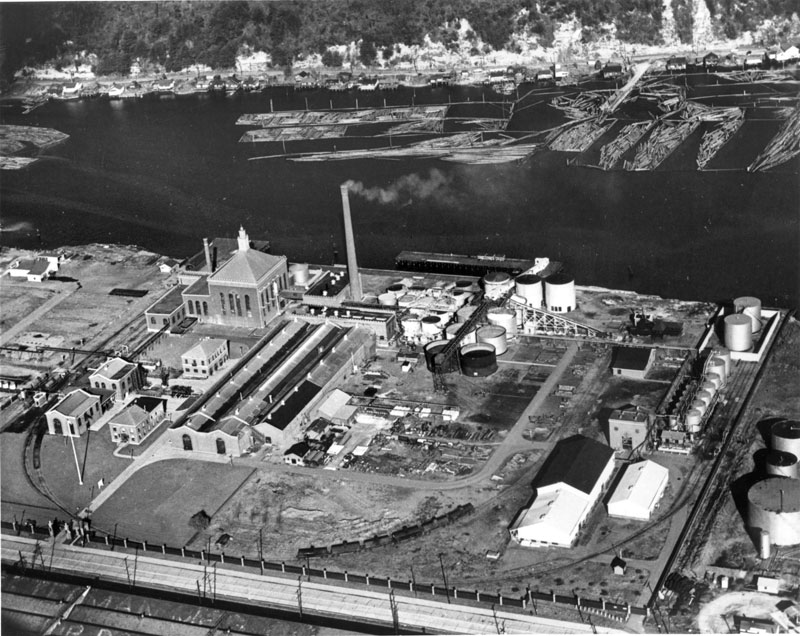
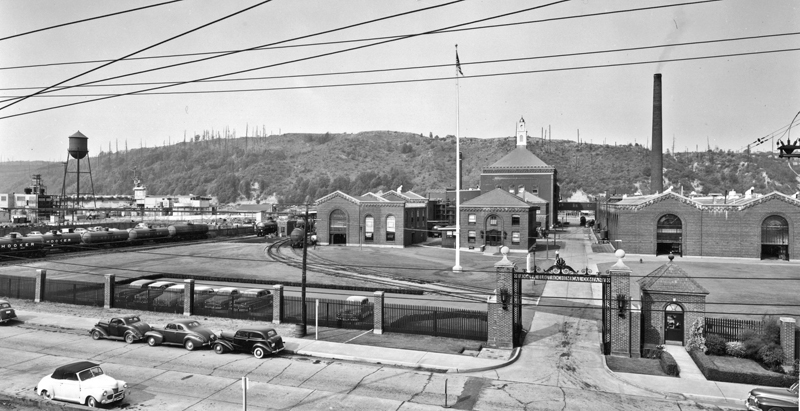
Architecture legend Stanford White’s firm designed some of the proud brick buildings on its 30-acre campus on the Hylebos Waterway. Hundreds worked there. Albert H. Hooker Jr., son of a founder, sat on the City Council.
The plant bought tens of millions of dollars of Tacoma Public Utilities electricity, formulated hundreds of tons a day of chlorine for pulp mills and perchlorethylene for dry cleaners and ramped up production exponentially over nearly eight decades.
It all went away. The plant changed ownership a couple of times, then shut down for good in 2002, blaming high power costs and low product prices. Even its buildings are gone.
Today, what it left has become a topic of fervent debate.
The state Department of Ecology is weighing pollution cleanup possibilities that could cost Occidental, which acquired Hooker (and responsibility for its sites) in 1968, hundreds of millions of dollars.
Decisions made in the coming months will dictate decades of work.
An estimated 1 million pounds of toxic chemicals, dumped by accidents and routine disposal, sit stewing in the soils and groundwater under the land the company still owns. The nonprofit Citizens for a Healthy Bay calls it “by far the worst unaddressed contamination in Commencement Bay.”
Asked recently, a former Hooker worker said contemplating the company gave him “mixed emotions” over his, and his father’s, time there.
“We worked with quote-unquote hazardous stuff and didn’t think a thing about it,” said Scott Candler, 64, who worked summers at Hooker and whose father was a chemist there. “It’s really sad. They did a lot of things that were bad, but they didn’t know any better. I’m really sorry. That’s just the way it was.”
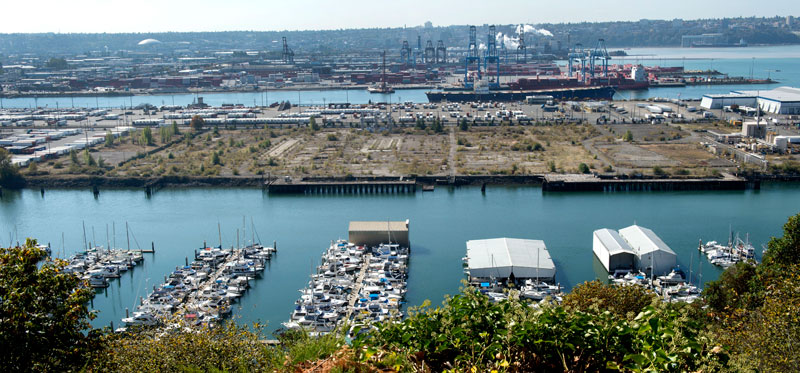
On Alexander Avenue East one afternoon this spring, Noah Davis looked through a gapped brick-and-iron fence at the flat, weedy lot that is all that now shows of this legacy. He and his wife have two young children and a home in Northeast Tacoma, up the bluff from the old chemical site.
Davis is a lawyer. He has read with alarm some of the state-issued reports that the pollution in the ground — which includes chemicals linked to cancer and other serious health problems — is moving around, possibly into Puget Sound, via the Hylebos.
Options for the cleanup, which Ecology will pick from and which Occidental must pay for, range from about $110 million over several decades to more than $440 million.
Occidental has pushed to use one of the lowest-cost cleanup plans, arguing it is the most cost-efficient and that trying to get all the pollution out is impractical at best.
Davis and others have criticized this as falling far short of what should be required.
“What Occidental did was criminal,” Davis said. “Even if there wasn’t a law specifically forbidding it, it was morally wrong.”
The power to force a cleanup
State law gives the Ecology Department the power to set rigid requirements for how a polluter has to clean up what it left. Sometimes it requires monitoring that can last for years or decades.
To get there, the agency must consider the company’s preferred course of action, which Occidental filed in a 394-page feasibility study in January, and then take public feedback on the menu of options.
A March 8 community meeting showed the difficulty that high public interest and the vast sums at stake have brought to this situation. An Ecology Department official said the audience of more than 80 people was more than any cleanup meeting has drawn in memory.
Audience members engaged in none of the chanting, songs or coordinated attire activist groups have used to protest new industrial plants at other civic meetings. But they were nonetheless engaged. The state officials in charge of the meeting, scheduled to be taking official public comments for two hours, spent almost 90 minutes answering questions that won’t become part of the official record.
Most questions focused on the scale of the mess and the difficult-to-understand range of cleanup possibilities in Occidental’s report. State officials conceded it lacks clarity.
“We’ll be assembling what we think is probably a better comparison,” Ecology Department project manager Kerry Graber said afterward.
The public comment period runs until April 27 and can be joined via the Ecology Department’s project website. As of March 22, Graber had received 41 comments.
Where the pollution came from
From the time the Hooker Electrochemical Co. set up shop on the Hylebos in 1929, its enterprise was industrial chemicals. These included ammonia, chlorine and “caustic soda” — sodium hydroxide — for pulp and paper mills of the Northwest.
The company had looked since 1914 for a site to build its western center of operations and decided on the Port of Tacoma because of its access to cheap electric power and ship-delivered salt, according to a 1954 News Tribune story.
That story noted the plant, at 25 years old, was producing 25 times its original output. Seven years later, it added a perchlorethylene line, becoming the first Northwestern maker of the chemical solvent widely used by dry cleaners and as an engine degreaser. Clair Candler, Scott Candler’s father, worked as a Hooker chemist who tested the new product for purity.
Today, “perc” is tightly regulated and has been found to cause cancer, brain and organ damage. Hooker, in 1980, hauled away 2,000 cubic yards of soil laden with it and other chemicals under an EPA agreement. The soil had been noted as leaking into Commencement Bay.
Scott Candler said he watched other plant leavings pollute the waters, by routine practice, during his time as a Hooker worker in the early 1970s. Just as his father had started off, Candler worked in building chemical cells with molten lead and graphite slabs to process chemicals with saltwater brine. Asbestos rope and copper diodes were involved. The process left scraps, which went into a dumpster hooked to a backhoe.
“I hate to tell you this,” Candler said, “but we’d take it down to the Hylebos and just dump it right in the water every day. Every day. In that went asbestos and other crappy stuff. That’s the way it had been done, and that’s the way it was done.”
State regulators believe accidental spills were responsible for only some of the chemical pollution now detected in enormous plumes beneath the plant site.
“Most of it was intentional discharge,” said Graber of the Ecology Department. “They started out just piping it out to the waterway off of the process, and at some point they moved to putting the waste — it was kind of a sludgy waste — onto barges where the liquids were allowed to drain and fall into the waterway. The solids would be barged out to a disposal site.”
The danger of letting it sit
No one lives there, or could. The site where Hooker Chemical stood remains zoned for port industry, and the entire area appears unlikely to host any other use in the foreseeable future.
Occidental still owns part of the site and pays $34,000 a year in property taxes on it. Another Texas company is listed as owning the rest.
Next door, Puget Sound Energy is doing site work in preparation for its $310 million liquid natural gas plant, which is to include an 8 million gallon storage tank nearly as tall as the Tacoma Dome.
Underground around the former Hooker site, the toxic mix of solvents left behind by Hooker is deeper than the Dome is tall and stretches beneath the Hylebos nearly to busy Marine View Drive. It has two main components: chlorine-rich volatile chemicals and a high-pH mix of heavy metals and other materials potent enough to dissolve the rock aquifer.

State officials’ best guess is that while 57 million pounds of solvents were produced by the Hooker plant, about 1 million pounds of solvent pollution went into the dirt.
Investigators have prodded the acreage with enough testing holes to accumulate 40,000 data points. They revealed that the pollution is moving down through the aquifer, despite efforts to contain it that include a 20-year-old groundwater pumping-and-treatment operation.
One danger is that the contaminants can get into Puget Sound via the Hylebos. There, the toxic materials can kill endangered wildlife or enter the food chain. Another danger is that the perchlorethylene and a related chemical, tetrachloroethylene, found in the underground pollution, degrade into vinyl chloride, a gas that causes cancer.
“You have to think of this site as similar to a landfill,” Graber said. “There are materials that have been placed decade after decade and are going to be persistent in the environment no matter what technical option that we choose.”
What could be done
The possibilities for cleanup and containment are complicated.
In the feasibility study, Occidental listed a complex menu of options. They include extracting some polluted groundwater for treatment, using underground barrier walls to limit seepage into the Hylebos, and removal plans for groundwater and polluted soils.
Occidental’s preferred path includes building nine groundwater extraction wells to remove pollutants, a treatment system and the barrier wall along the Hylebos and doing nothing to reduce or contain high-pH groundwater and soil.
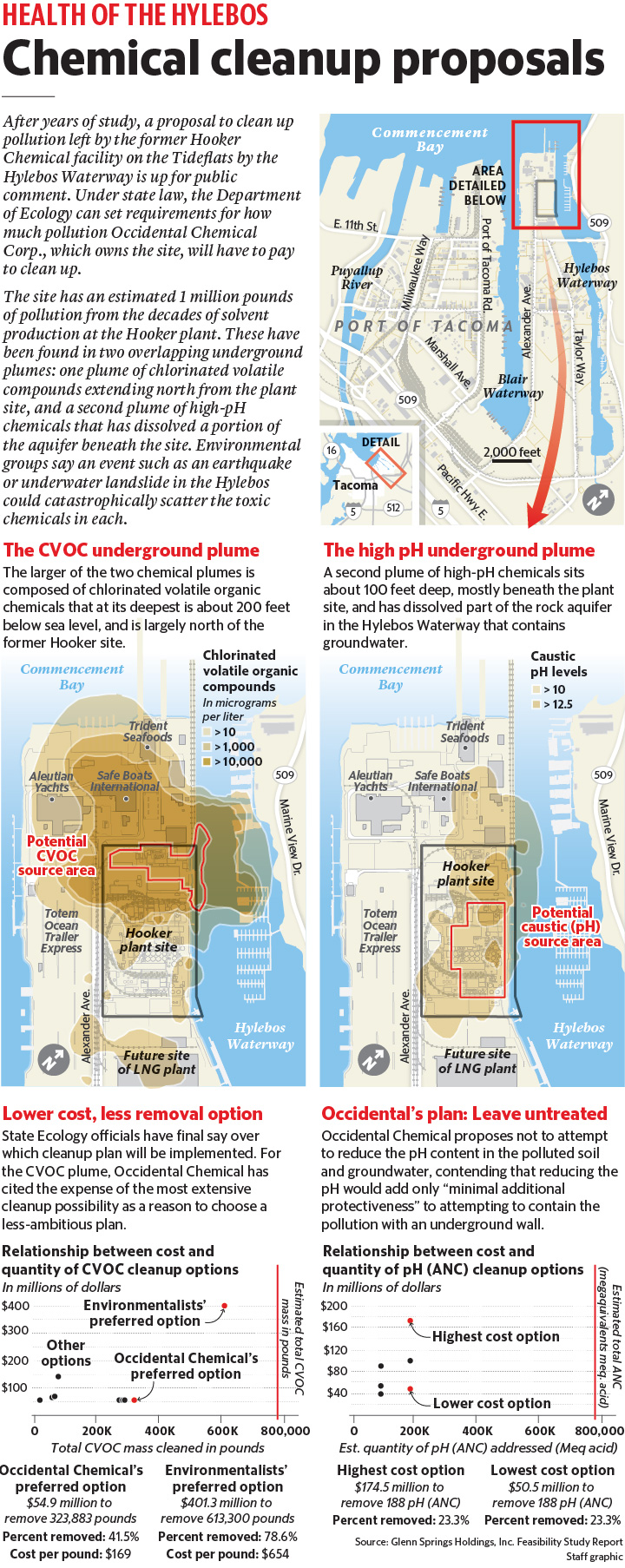
The piece of the company’s plan to reduce pollution from volatile chlorinated compounds would cost about $54 million and deal with about 330,000 pounds of pollution.
The most extensive option listed for that would treat 600,000 pounds of those pollutants and cost about $400 million over 30 years, according to the report.
Graber said the law allows regulators to make accommodations for “sites that are technically impractical to clean up to a pristine level.”
Several observers have objected to the possibility regulators might sign off on that option.
“It seems like (Occidental Chemical) is throwing up their hands, saying they’ve dumped too much pollution, so they should be able to do something minimal and walk away,” Melissa Malott, executive director of Citizens for a Healthy Bay, said at the Ecology Department community hearing. “This is not acceptable for our community and our waters. … This is not a valid argument when dealing with environmental pollution.”
She added the report is “misleading” in its discussion of other cleanup possibilities. Her organization will stage its own forum on the cleanup proposal Monday evening on the University of Washington Tacoma campus.
Malott said her ideal resolution would be for Occidental, voluntarily or under an Ecology mandate, to agree to perform the maximum cleanup possible with current technology and research remedies for the toxic mess that shovels and machines can’t get to.
“I’m sure that they have ways to figure out how to clean this stuff up,” Malott said. “They’re the fourth-largest petrochemical company in the country.”
Dean Burke, a board member of the group, said he got some clarity from seeing that Occidental’s proposal would fix only about 41 percent of the estimated pollution.
“If I paid 41 percent of my mortgage, they would repossess 100 percent of my house,” he said. “So I want to see that pressed to a higher standard.”
Graber said the Ecology Department hopes to present the cleanup options in an easy-to-comprehend fashion before the public-comment window closes April 27.
The complexity of the cleanup, she said, means several sets of cleanup options might be combined to produce one plan to work with.
“We have to come up with a better way to compare the effectiveness of the alternatives,” Graber said, “because what was presented isn’t very helpful from Occidental. … Their comparison isn’t a real comparison because the remedies were stacked one on the other.”
Candler, the former Hooker worker, recalled seeing a port street with a series of chemical businesses. None of their founders, he noted, survived to a time when they’d be held to account for their legacies.
“All these guys abused the environment,” he said. “They abused it because they didn’t know any better. And they’re all gone. They’re all gone.”
Derrick Nunnally: 253-597-8693, @dcnunnally
This story was originally published April 1, 2017 at 11:00 AM with the headline "Hooker chemical cleanup planning a messy process."