Tacoma police disproportionately use force against people of color, TNT analysis shows
READ MORE
Use of Force
Last summer, Tacoma raised its voice about police brutality and demanded to be heard. The death of Manuel Ellis started a conversation about how people of color are policed in the city. This series is the result of months of investigation trying to answer the questions at the foundation of that conversation: How often do Tacoma police use force? What type of force do officers use? Whom do they use it on? And what discipline do they face?
Expand All
Tacoma police use force against Black people at roughly five times the rate they do against white people, according to department statistics.
The News Tribune analyzed 657 reported incidents of police force between 2015 and 2019 and found officers most use force against white men, but disproportionately against Black men.
In that five-year span, force was used about 22.56 times per every 10,000 Black Tacoma residents. In the same time frame, force was used about 4.5 times per every 10,000 white Tacoma residents.
Black residents make up 11 percent of the city’s 217,000 population, according to Census data, but 38 percent of the use of force encounters in that five-year span were with Black people. Comparatively, white people make up 65 percent of Tacoma’s population, but accounted for 48 percent of total use of force encounters.
Black people also are arrested at a higher rate than white people in Tacoma, based on their percentage of the population. In 2019, Black people made up more than 30 percent of the arrests in the city of Tacoma, according to a report by Pierce County.
“It is deeply disappointing that African-Americans and Native Americans have sometimes been in a place in Tacoma where those that are expected to protect and serve them have sometimes caused the greatest harm,” said defense attorney James Bible, who is representing family of Manuel Ellis, a Black man killed by police. “It’s something that should give every person pause in the city of Tacoma and the state of Washington itself.”
Native Americans were another group that experienced the disparity in police force, making up 1.6 percent of the city’s population but receiving 2.7 percent of police force.
Hispanic and Latinx residents, the second largest demographic in Tacoma, make up 12 percent of the city’s population but only 4.4 percent of use of force incidents. Asian residents make up 8 percent of the population, but only 1.82 percent of use of force incidents.
Interim Police Chief Mike Ake, who is Asian-American, said department leaders regularly review use-of-force incidents to see if they are within policy, but had never considered the racial breakdown.
“What we didn’t do is take a step back and look at this problem from an equity lens. Upon looking at this, we realized the disproportionate numbers of those contacts that we’ve had,” Ake said. “It disproportionately involved Black residents. We need to do a deep dive into this problematic issue to determine root causes and figure out is it our policy, practices, our culture, or a combination of multiple practices?”
The chief said he is talking to police and city officials about how to address the problem.
Chris Tracy, president of the Tacoma Police Union Local 6, which represents sworn officers, declined to address the use-of-force numbers in Tacoma but said context of the incidents is as important as the statistics.
Racial disparity not a surprise
The numbers showing a racial disparity did not come as a surprise to city leaders.
“I don’t need a data point to let me know that African-Americans are disproportionately affected by the criminal justice system and by police … (but) it’s always different when you get those stats about your own community,” said Mayor Victoria Woodards, a Black woman.
She said the city is working toward systemic change, including launching body cameras for all police officers, banning chokeholds, and starting Heal the Heart of Tacoma, a community-led anti racist team.
The city also hired a private firm to review its police practices and in January released a report with 64 recommendations, many focused on use-of-force.
Council member Chris Beale, who is white, also said he’s disturbed by the numbers showing police disproportionately use force against Black people.
“I join the Tacoma Community in deep feelings of grief, sadness and anger that Black people are disproportionately represented in all aspects of the criminal justice system, both locally and nationally,” he said. “The way that systemic racism and other injustices have impacted Black lives for generations, and can so easily still impact their lives today, is gut-wrenching and it is heartbreaking.”
Beale pointed out that the City Council passed a Transforming Tacoma initiative for systemic change in June. The resolution directed the city manager to prioritize anti‐racism in the evaluation of new and existing policies and services, with initial priority being given to policing.
“I unequivocally believe that Black Lives Matter. Systems of racism create disproportionate outcomes for Tacoma’s Black residents, and the community is demanding we look at other models of community safety. To that, I want to say, I hear you and honor your demands for Black justice,” he said.
Other changes are coming, too.
City officials are looking into new programs like CAHOOTS (Crisis Assistance Helping Out On The Streets), which was launched in Oregon to provide an alternative mental health response rather than relying on police.
In November, the Council passed a resolution directing the city manager to start collecting race data on traffic stops by the end of March 2021. That information will be provided to the Community Police Advisory Committee, the public body that reviews use of force data and provides recommendations on Tacoma police policy.
Woodards said that collecting traffic stop information will help the city better understand use of force data.
“We don’t know if that data comes from calls for service or comes from traffic stops,” Woodards said.
Council member Kristina Walker, who is white, said finding the disparities in Tacoma police’s use-of-force and identifying the root causes are important and what is driving programs like Heal the Heart and the Transforming Tacoma initiative.
“Our Black community members face extreme disparate systemic barriers in policing, and in all institutions and systems both locally and nationally,” Walker said. “The impact of racism is acutely felt when police interact with people at disproportionate rates.”
When asked why the city hasn’t acted sooner if aware of a racial discrepancy in police force, the mayor said the impact of the COVID-19 pandemic on people of color, coupled with the death of Manuel Ellis, has brought disparities further into the spotlight.
“It just exacerbated what we already knew,” said Woodards, who was first elected to City Council in 2009 and then mayor in 2017. “I want to work on this and make things better in Tacoma as its mayor, but also as a Black woman,” she said.
‘Little to no accountability’
The racial disparity can be seen in complaints filed with the Police Department accusing officers of discriminating against them or using excessive force.
Out of 62 complaints filed from 2015 through 2019, 51 percent were from Black residents. Nearly 10 percent of those complaints were sustained by police officials, meaning it resulted in disciplinary action of some kind.
Defense attorneys and city activists say many people don’t bother to report what they believe to be misconduct because they don’t think police will believe them or do not think law enforcement is willing to police itself.
“We’re driven by what we see. What we’ve seen has confirmed what we’ve known. And what we’ve known is that there’s disproportionate force against people of color,” Bible said. “But there’s been little to no accountability across this nation, and state, for police misconduct.”
The most common type of complaint filed against Tacoma officers was for discrimination.
From 2015 to 2019, 34 people complained that officers had discriminated against them and 61 percent of them were Black, records say.
In one 2015 complaint, an officer observed a Black driver suddenly change lanes in front of him, causing the officer to break hard and nearly strike the complainant, according to records. The officer stopped the man and cited him for failure to use a turn signal. The driver later made a complaint against the officer, claiming the officer “racially profiled me while driving black.” The complaint was determined to be unfounded by police.
In 2016, a Black man filed a complaint that said he was pulled over by an officer who said, “It’s you kind of people,” to him during a stop and found it offensive. Department records say the officer was responding to a dispatched call of a stolen car and observed the driver driving erratically and “saw at least one subject running from it.” After the initial stop, it was determined the driver was delivering papers and was cited for the erratic driving. The officer denied using the phrase, “It’s you kind of people,” during the stop, according to documents, and the case was also determined to be unfounded.
Internal affairs and police officials looked into the complaints and determined five were true but thought the officer acted appropriately, 11 of the allegations did not happen and they did not have enough facts to rule on 17 of them. One incident was resolved after an officer explained to the complainant why they were contacted, and the complainant was satisfied.
The numbers were similar for those who complained that officers used excessive or inappropriate force against them.
Out of 28 use-of-force complaints in that five-year span, Tacoma police sustained five complaints, found seven to not be true, eight happened but the officer acted appropriately and eight could not be determined.
Those complaining were almost evenly split by race with 12 being white and 11 being Black. Police statistics did not list race for the other five.
Union head: Context is important
Tracy, the police union president, who is white, cautioned against using only use of force rates and census data when drawing correlations between police force and race.
“That’s an overly simple analysis,” Tracy said in an email to The News Tribune. “What’s missing is context.”
He said context includes, but is not limited, to the following:
Has the person committed a crime? If so, what kind of crime?
Was the person armed? With what kind of weapon? Has the person used the weapon?
What is the person’s criminal record?
What are the person’s actions and behavior? What is he/she saying? What is he/she doing?
Are others at risk? Are there multiple people who pose a risk?
Is this an area prone to violent crime?
What were the staffing levels? Did the officer have additional units available?
Are there less-than-lethal options available to the officer?
What are the environmental conditions (e.g., lighting, weather)?
Can the officer safely de-escalate the encounter?
“Without context, it would be possible to make any number of inaccurate or misleading conclusions,” Tracy said. “It’s that kind of misunderstanding that could in turn artificially diminish the community’s trust in legitimate police authority and undermine efforts to improve public safety and perceptions of personal safety in a city that is currently experiencing a surge in violent crime.”
Tracy said TPD officers work every day to protect diverse communities in the city.
“We are proud of the service and sacrifice that our members (current and retired) make, and have made, as police officers in the City of Tacoma,” he said.
Members of Tacoma’s Community Police Advisory Committee said the data is valuable to spot trends even without the context.
“The point isn’t to look at every single incident, it’s to look at themes that we’re seeing,” said CPAC member Shayna Raphael, who is white. “If you’re seeing a big amount of data being skewed one way, data doesn’t lie.”
Louis Cooper, another CPAC member, agreed.
“Context or not, something’s wrong with this picture,” said Cooper, who is Black. “I mean, it can’t just be all Black men or Black people that are doing this in their context.”
Community pressure increases
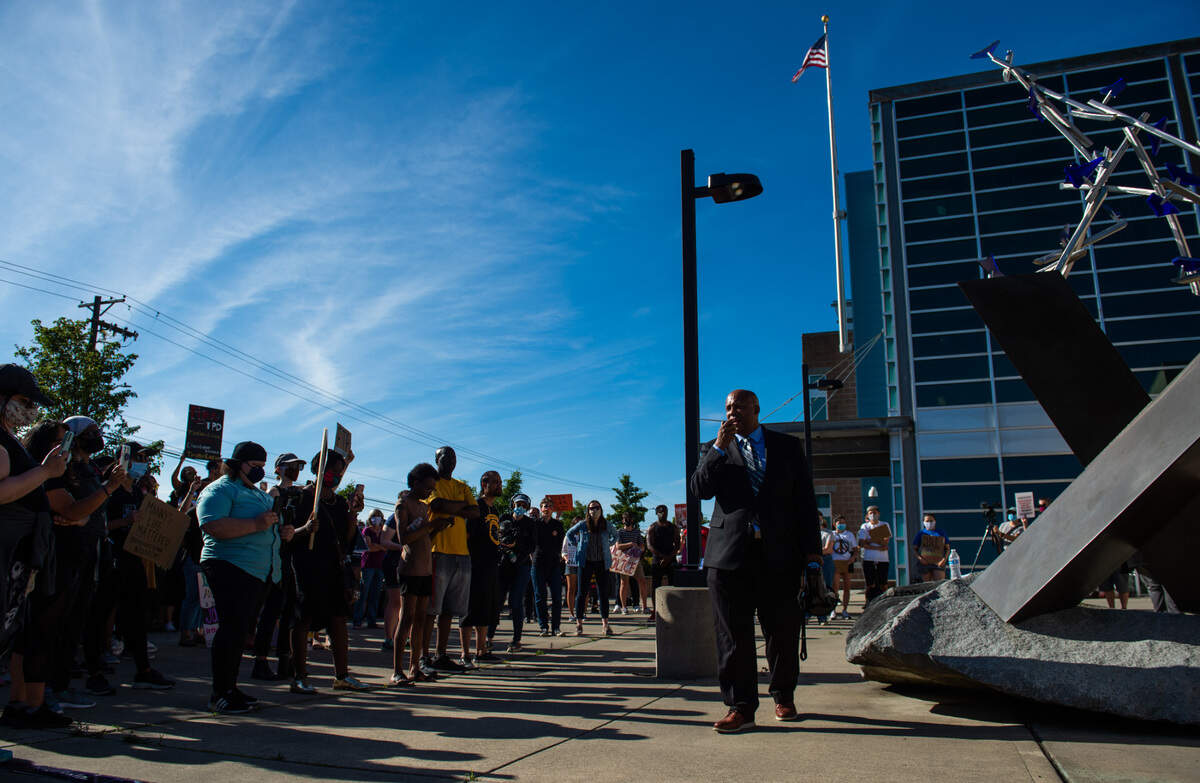
The city of Tacoma has been under increased pressure by activists and the community to address racial disparities in its policing.
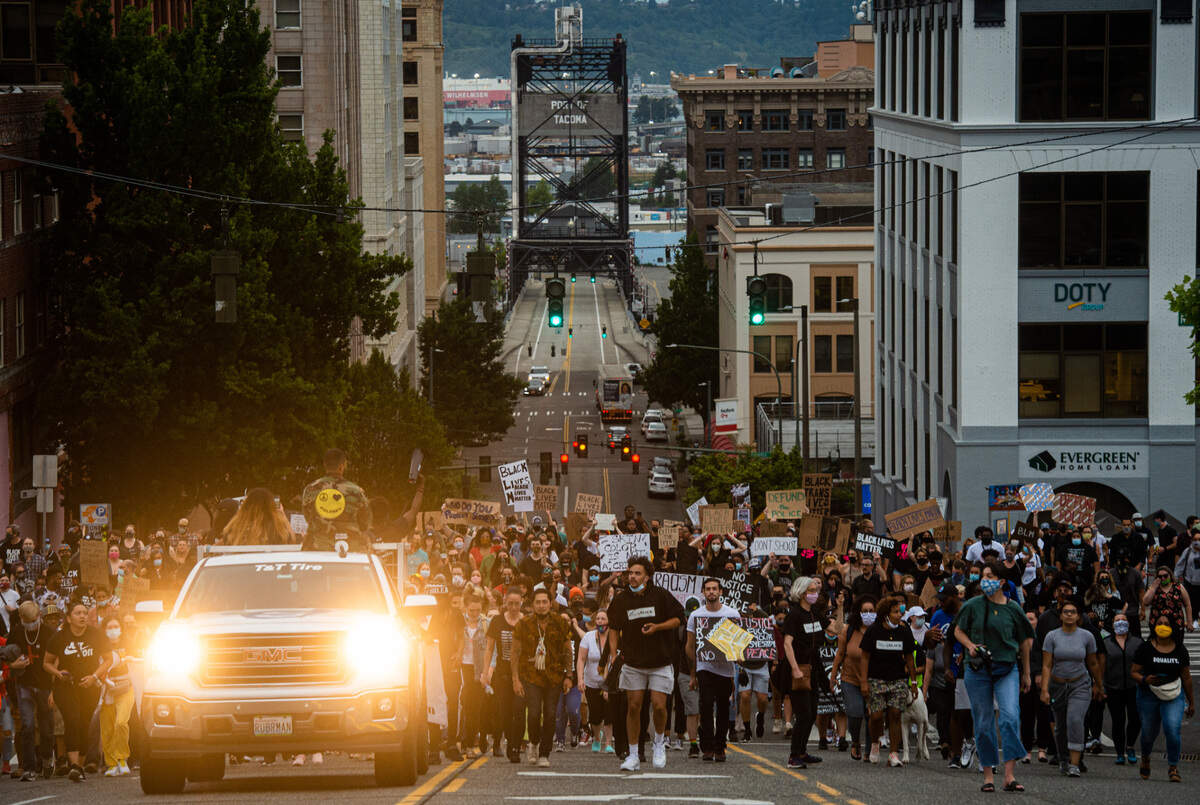
Thousands took to the streets last year to protest, carrying signs with the names of people killed by Tacoma police and chanting “No justice, no peace.” Members of CPAC said they have noticed more people attending their meetings.
Chris Jordan, a Black community organizer, said he and his family members have been profiled by police but never had force used on them. He thinks that’s likely because he goes out of his way to limit the possibility of police encounters.
“I don’t call the cops. And I don’t really communicate with them. I avoid as much as possible having any interaction with the police,” Jordan said.
He already knew police disproportionately use force against people of color and believes it’s in part because police disproportionately patrol neighborhoods where people of color live.
“Different stages of subjection to violence at the hands of police from the beginning comes from over-policing in Black and brown communities,” Jordan said. “It creates the conditions already, and this goes back centuries. It’s really about at an existential level, someone having the belief that any kind of self-determination that you have is a reason for violence. That (Black people are) seen as uppity, as insubordinate, that you’re seen as a criminal and someone that needs to be taught a lesson. It’s deep and ingrained in policing.”
His theory is backed up by a 2017 study completed at the University of California, Los Angeles titled “Predatory Policing.” The authors explored how social, economic and legal forces incentivized law enforcement to target African-Americans and how criminalizing behaviors like loitering, sleeping in public and panhandling allows police to selectively target groups like people of color and the unhoused.
“It provides police officers with a kind of perpetual probable cause that they can use to justify arresting African-Americans for a wide range of non-serious activities,” author Devon Carbado wrote.
Over the summer, in the wake of George Floyd dying after a white Minneapolis police officer kneeled on his neck for nearly nine minutes, a Black community group in Tacoma started a list outlining four major changes they’d like to see in the Police Department.
The Black Collective is a volunteer leadership organization created 50 years ago dedicated to addressing issues that affect the Black community in Tacoma and Pierce County. Their list included implementing body and dashboard cameras, requiring independent investigations of police misconduct, adding accountability measures in the hiring process and engaging the city manager and police unions around contract negotiations.
Lyle Quasim, a Black member of the Tacoma-Pierce County Black Collective and longtime Tacoma resident, said COVID-19 and policing were the most prominent issues on the group’s weekly agenda in 2020. Unlike COVID-19, discussions around policing have been around for much longer.
Despite changes Tacoma police and city officials say are being implemented in the Police Department, Quasim said Black communities haven’t changed their feelings since he arrived in the city in the 1960s.
“Does the Black community feel safer today with the police department than they did in 1967? And I would say no. I know I don’t,” Quasim said.
Some of the changes underway, including body cameras for officers and starting a race database, should have happened sooner but weren’t prioritized, Quasim said.
Tacoma began researching the purchase of body cameras in 2016, but the project stalled. City Council fast-tracked the project in the summer of 2020 following Floyd’s death, which was caught on camera.
“This should be at the top of the list, and to say, ‘Oh, we need more time to do this’ — Time’s up,” Quasim said.
Quasim said he wants TPD’s chain of command to be held accountable for the disparities in use of force data and any lack of effort to change them.
“Whenever you have data like this … ask yourself, ‘Who’s been fired? … What methods of administration have been changed? What priorities have been restructured? What number these issues are on the agenda for bargaining with Local 6 and Local 26?”
Qusaim called for specific accountability measures to be outlined in its contract with the police union, adding that Tacoma’s people of color shouldn’t bear the weight of change.
“It’s not up to the Black community to say, ‘Oh, we need to change it.’ It’s up to the people who are in charge of the system,” he said. “… If I am the person who has to construct those, then you should leave your job, I will take your job, and I will be compensated for that. And you go someplace else. Don’t ask me to do your job.”
When asked about the future of policing in Tacoma, Quasim was blunt.
“I think racism is fairly well entrenched, baked into how the system operates,” he said. “And unless I see a level of courage that I haven’t seen … I don’t see how we would change it.”
Can it be fixed?
Alicia Klein is a member of the Tacoma Urban League, an organization that’s been around for 53 years that works to help people of color who have been disenfranchised.
Like city officials, Klein, who is Black, said she was “not at all surprised” by the use of force numbers.
“It was very disturbing to see those numbers supporting the feelings I’d already had — all the feelings we’ve had as an organization knowing the things that have happened in this community and what’s happened to our community members. To see it on paper, in black and white, is disturbing,” she said.
Klein said the number one thing that needs to happen is police reform.
“I think we really need to really evaluate who’s responding to calls, what calls they’re responding to, what neighborhoods they’re going to,” she said.
The fact that Tacoma is talking about the issues is a good start, said Klein but that those conversations need to be happening on a county-wide and statewide level.
“If you’re not trying to find the place where you’re not doing well, then you’re failing,” she said.
The interim police chief said the department already has policies dealing with biased-free policing, discrimination, harassment, equal employment opportunity and hate crimes, but he’s committed to bringing more change.
“When we talk about use of force and use of force disproportionately against African-Americans, there are two separate topics but it becomes worse when they’re combined. We need to look at this process, re-examine ourselves, make sure we’re following best practices and best policies practices and learn throughout this process,” Ake said.
“Every growing organization has to be a learning organization. We have to be very open and take a look at changes on how we can make our department better.”
This story was originally published March 4, 2021 at 5:05 AM.