With 8 dead and hundreds injured, Tacoma grapples with how much police force is too much
READ MORE
Use of Force
Last summer, Tacoma raised its voice about police brutality and demanded to be heard. The death of Manuel Ellis started a conversation about how people of color are policed in the city. This series is the result of months of investigation trying to answer the questions at the foundation of that conversation: How often do Tacoma police use force? What type of force do officers use? Whom do they use it on? And what discipline do they face?
Expand All
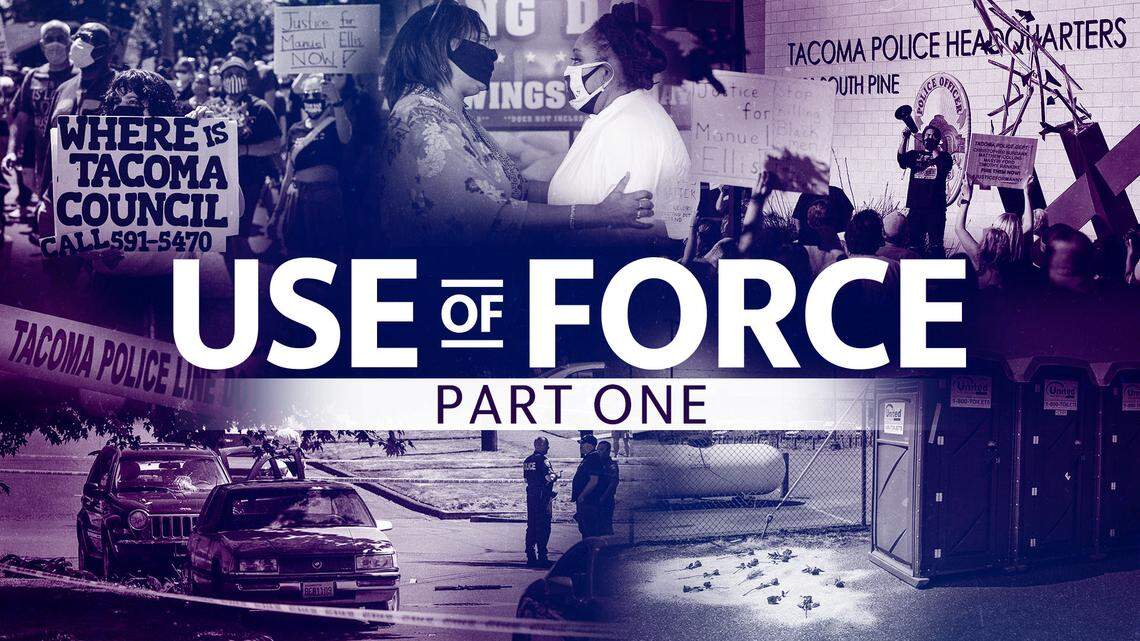
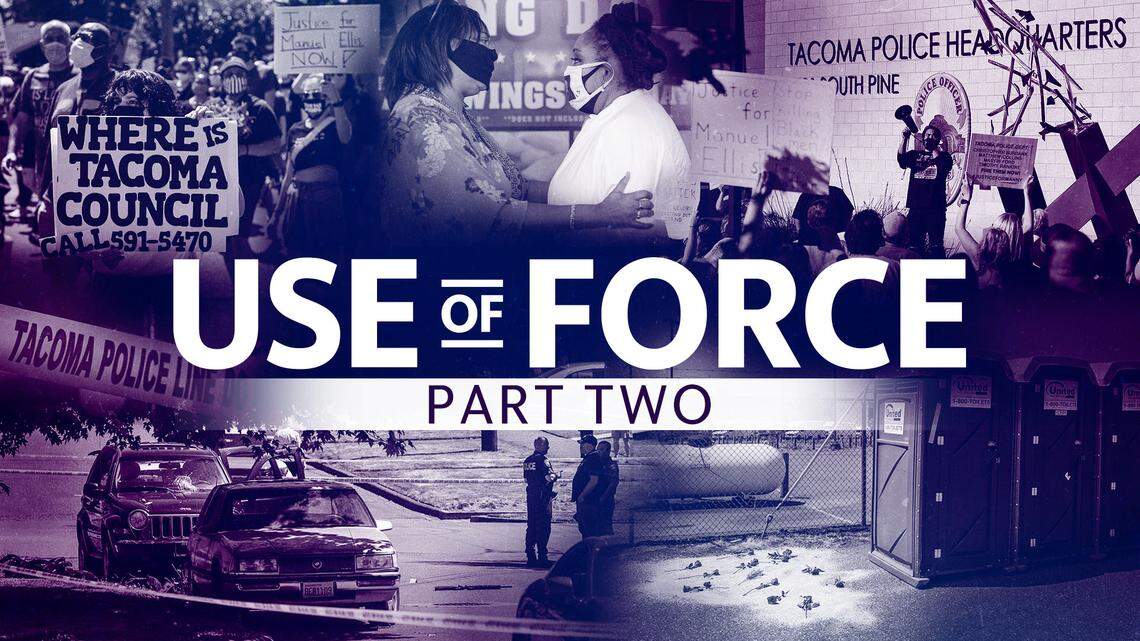
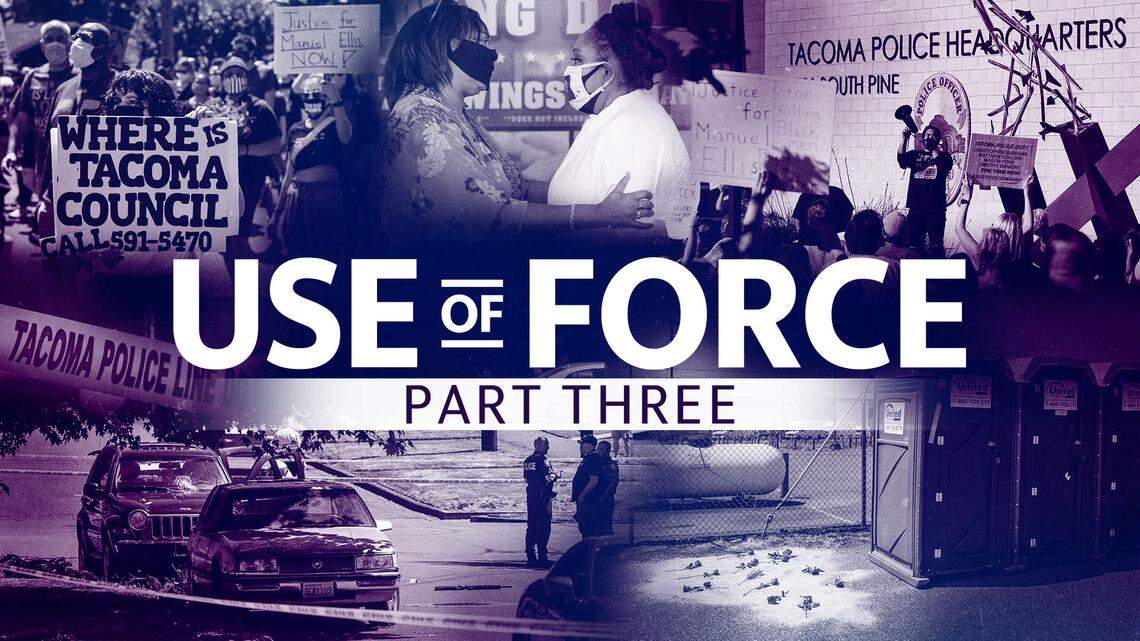
Tacoma police used force against 657 people in a five-year span, killing eight and injuring 203.
Records and department statistics from 2015 to 2019 show a majority of officers used force, primarily against people of color, and few officers were disciplined.
Police say the overall amount of force used isn’t much compared to the number of calls to which officers responded, but community organizers say it paints an unsettling picture of the relationship between police and the people they are sworn to serve.
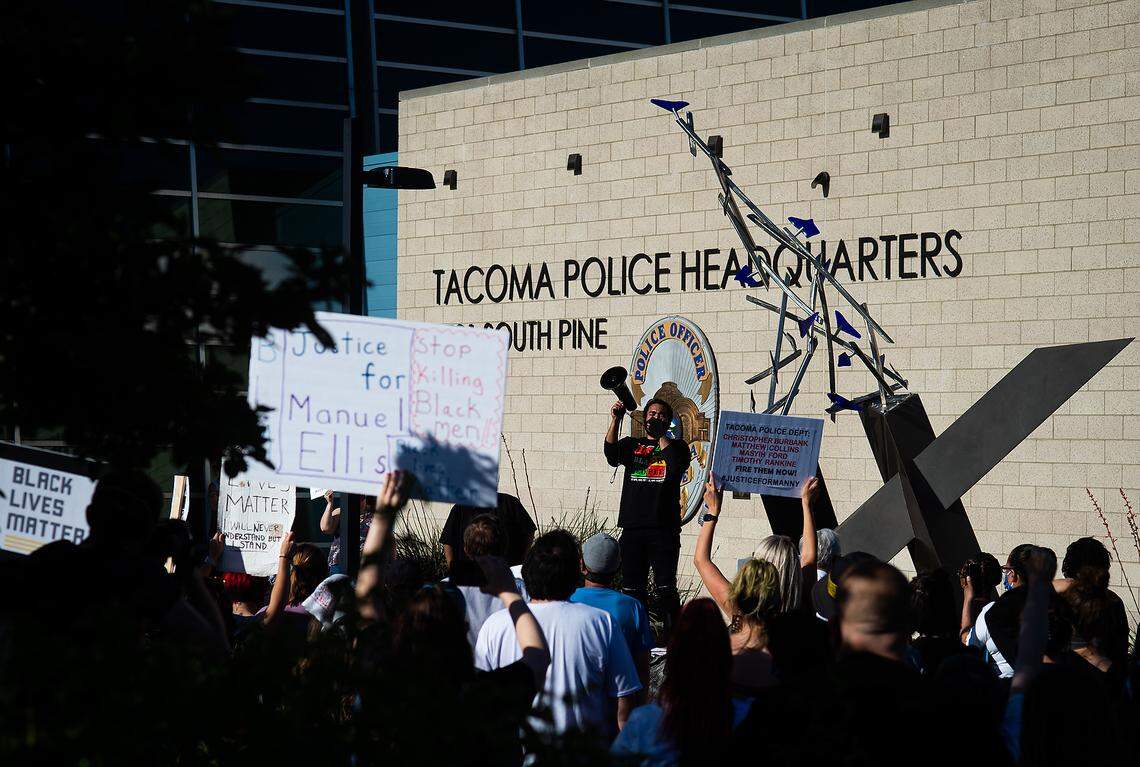
Shayna Raphael, a member of the Community Police Advisory Committee, said the relationship is strained, especially after Manuel Ellis was killed by police restraining him and an officer drove through a crowd of people after being surrounded by a group that had gathered to watch cars do doughnuts in a downtown intersection.
“I can’t think of another profession where people are so afraid of the person in that profession,” Raphael said.
Interim Police Chief Mike Ake acknowledged that fear and said the department would continue to build trust “through our actions and words.”
Use of force by police garnered national attention last year after George Floyd, a Black man, died May 25 when a white Minneapolis police officer placed a knee on his neck for nearly nine minutes. His death ignited protests across the country, including in Tacoma, against police brutality.
Shortly after Floyd’s death, Pierce County medical examiners ruled that Ellis died of oxygen deprivation after Tacoma police restrained him with hobbles and a spit mask even after he told officers, “I can’t breathe, sir, I can’t breathe.”
Ellis’ death is not counted in the statistics of this story because The News Tribune was only able to get data through 2019.
A defense attorney representing Ellis’ family said police brutality is a major problem in Tacoma, and he believes it is under-reported because many people are too afraid to come forward or don’t believe law enforcement will properly police themselves.
“Ultimately, force is used far more frequently than it actually needs to be used,” said defense attorney James Bible. “I feel like force is often used out of anger by law enforcement, out of an ‘I want to control you and make you do what I tell you to do,’ as opposed to when it’s authentically needed.”
About 78 percent of Tacoma’s officers used some type of force over those five years. Out of 1,452 uses of force, 14 were found to be outside of department policy. One lieutenant was fired; the other four officers who acted outside of policy were disciplined and often given additional training.
How do the numbers of uses of force in Tacoma compare with other cities of similar size? For the year 2019, there were 119 total use-of-force incidents in Tacoma. In Modesto, California, with a population of roughly 212,000 people compared to Tacoma’s 217,000, there were 232 use of force incidents in 2019. In Boise, Idaho, population 226,000, there were 111 use of force incidents in 2019.
Ake said he thinks the use-of-force numbers in Tacoma are low compared to the number of calls officers respond to but that the department needs to be more transparent.
The Police Department has a database where it stores information on all reportable uses of force, but it is not available to the public unless the data is requested. The FBI launched a voluntary data collection for use-of-force in 2019. Tacoma is in the process of signing up to participate.
In Pierce County, only police in Puyallup, Lakewood, Fife and Bonney Lake report use-of-force to the FBI.
In Tacoma, each use of force is reviewed by the officer’s superiors to determine whether it was within policy. A deadly force review board, which includes two citizens, makes a decision on more serious cases. If force was used outside of policy, Internal Affairs investigates and sends its findings to the chief, who decides discipline.
Police said they responded to more than 536,000 calls for service from 2016 to 2019. Data was not available for 2015 because they changed systems.
“That means that 99.9 percent of the time our police officers are handling these calls without any uses of force,” Ake said. “We attribute this success by consistently staying up to date in case laws and best practices as identified by industry standards. But we also understand the need for better accountability and transparency in our use-of-force incidents. But overall, our officers in regards to our use-of-force applications, have done a fantastic job.”
Police officials are reviewing use-of-force policies to see if any should be revised and will work with city officials, advisory boards and police unions to make any necessary changes, Ake said.
Union says context important
The Police Department has 11 pages of policies related to use of force, outlining when and how it can be used.
They keep track of all reportable uses of force, including canine contact, pepper spray, when an officer points a gun at someone, electronic control tools like Tasers, when an officer fires his or her gun, impact tools like batons or flashlights, physical controls like arm bars, PIT maneuvers used in pursuits to stop a fleeing car and restraint devices like hobbles or a spit mask.
Physical controls are by far the most common, used nearly three times as much as any other use-of-force. Tacoma police employed them 905 times from 2015 to 2019, followed by 340 uses of a Taser. Officers fired their department-issued guns 29 times and used restraint devices 88 times.
Using force was mostly effective in subduing people, according to department statistics, working 64 to 78 percent of the time every year.
Lewis “Von” Kliem, spokesman for the Minnesota-based Force Science Institute, which does research on police force and offers training to law enforcement, said statistics don’t tell the full story.
“It doesn’t tell you about the reasonability of an individual use of force,” Kliem said. “As a cop on the street, you’re looking at behavior. Officers don’t shoot everybody who reaches behind their back to grab their wallet. But there might be an instance where somebody reaches behind their back and he’s shot. What made that case different for the officer? You can only make decisions based on the information you perceived at the time, which is incomplete and uncertain.”
Chris Tracy, the president of Local Union 6, which represents sworn officers, echoed that sentiment and said context is critical when assessing whether an officer’s actions were justified.
That context includes how officers arrived at the situation, whether the subject has committed a crime or has a criminal background, whether others were at risk and even the environmental conditions of the scene, Tracy said in an email to The News Tribune.
“It’s vital that any analysis of TPD policing practices paints a fair and accurate portrayal — with context — of the service we are providing,” Tracy said.
Continuous training essential
Training is a critical component to reducing police uses of force, and academy instructors say not enough time or money is dedicated to it.
In Washington, all officers attending the Basic Law Enforcement Academy must receive 720 hours of training. That includes six hours of classroom instruction on use of force, learning everything from case law to participating in mock scenarios with hired actors playing suspects.
There’s also 12 hours practicing Taser use, six hours handling pepper spray and 12 hours with impact weapons like batons and flashlights.
“Physical controls is the bulk of our training. It’s the first step and the most frequent step they’ll be using in the field,” said Sean Hendrickson, de-escalation program manager for the Law Enforcement Training and Community Safety Act who has worked as an academy trainer since 2004.
After the basic academy, law enforcement officers are required to undergo 24 hours of annual training but each department gets to choose what its officers brush up on. In Tacoma, it varies from session to session.
Use-of-force experts say there needs to be more frequent training so police remember how to properly employ the methods they’re taught.
“These are extremely perishable skills,” Hendrickson said. “Even with the amount of time we spend on them at the academy, within months of leaving the academy, those skills are starting to deteriorate.”
About 15 minutes a week would be the minimum amount of training to keep use-of-force skills fresh, he said. Ideally, law enforcement officers would brush up on the tactics 15 minutes a day, three times a week.
Officers in Washington typically receive eight to 10 hours of training several times a year.
“The recommendation would be to take the annual hours allotted for training and spread them out over the year into these ‘micro-trainings,’” Hendrickson said.
Initiative 940, which went into effect January 2020, requires every law enforcement officer in the state (there are 10,871) to receive 40 hours of de-escalation training by 2028. After that, the training is required every three years.
Jack Connelly, a defense attorney who has represented many use-of-force or wrongful death lawsuits against law enforcement agencies in Pierce County, said he noticed police brutality in the South Sound ratchet up about a decade ago and has become increasingly worried. He began keeping a file last year with complaints about police brutality because his office was getting dozens of calls.
“My biggest concern at this point is the police are not first moving to tactics to try to de-escalate cases,” Connelly said. “What we’re seeing is police are very quickly moving to use of deadly force when they don’t need to do it.”
He pointed to the June 28, 2013, Tacoma police shooting of Cesar Beltran-Serrano, who is mentally ill and speaks limited English.
Officer Michel Volk approached Beltran-Serrano after receiving complaints about panhandlers, but Beltran-Serrano laid on his stomach and started digging a hole. Volk called for backup after realizing Beltran-Serrano did not speak English, but she shot him in the back with a stun gun when he ran away 37 seconds later.
Beltran-Serrano kept running so the officer fired multiple shots from her service weapon, injuring him.
Witnesses said Beltran-Serrano did not appear to be acting aggressively. Charging papers filed against him say he hit Volk with a piece of metal when she approached and refused to drop it. He was found incompetent to stand trial, and the police department found Volk acted within department policy.
“The purpose of the police is to protect and serve, not to go out and shoot people or beat them up,” said Connelly, who is representing Beltran-Serrano in a lawsuit against the city.
Killings by Tacoma police since 2015
Tacoma police killed eight people from 2015 to 2019, and one in 2020.
All of them were shootings except Ellis, who died of oxygen deprivation March 3, 2020, while being restrained by officers.
The Attorney General’s Office is reviewing the Ellis case and deciding whether to criminally charge the involved officers. They are expected to make a ruling by April.
Tacoma police have not turned over two cases from 2017 and 2018, but the other six were found to be justified homicides by the Pierce County Prosecutor’s Office.
Those killed by police were:
▪ Stephen Cunningham, 48, fatally shot May 10, 2015, by officer Jimmy Welsh after he allegedly grabbed a gun when police responded to a North End home for a noise complaint.
▪ Jason Galaviz, 40, fatally shot Aug. 5, 2015, by off-duty officer Dwain Dakari after allegedly robbing a woman and pointing a gun at the officer during a chase.
▪ Jacqueline Salyers, 32, fatally shot Jan. 28, 2016, by officer Scott Campbell after she allegedly drove toward him when police came to arrest her longtime boyfriend on felony warrants.
▪ Franky Santos, 58, fatally shot on Sept. 10, 2017, by officers William Johnson, Matthew Watters and Jeffrey Robillard after Santos allegedly fired a gun at police.
▪ Michael Bender, 27, fatally shot Jan. 7, 2018, by seven officers after allegedly walking out of a burning garage, crawling across the lawn with a rifle and exchanging gunfire with police.
▪ Willem Van Spronsen, 69, fatally shot July 13, 2019, by four officers outside the ICE Processing Center after throwing incendiary devices at cars and outbuildings while pointing a rifle at a sergeant.
▪ Hashim Wilson, 28, fatally shot July 21, 2019, by officer Christopher Bain after allegedly pointing a shotgun at police.
▪ Bennie Branch, 24, fatally shot Sept. 8, 2019, by officer Ryan Bradley after allegedly reaching for an Airsoft gun while struggling with officers during a traffic stop.
Salyers was the only one of the eight not armed when police shot and killed her.
She was frightened by officers yelling outside of the car she and her boyfriend lived in, so she put the car in gear and tried to drive away, according to investigators.
Her boyfriend later said Salyers steered right to avoid hitting the patrol car and was not aiming for the officer.
Campbell said he tried to backpedal out of the path of Salyers’ vehicle but the tires stayed pointed at him “in an obvious and blatant, intentional attempt to run me over.”
Campbell fired seven rounds, striking Salyers four times in her right arm, abdomen, left wrist and side of the head. She was pronounced dead at the scene.
Her mother and uncle later formed Justice for Jackie, which started as a group that met once a week to talk about how police had hurt them or a family member. The group then organized to speak to the Tacoma City Council and seek answers about the police shooting.
James Rideout, Salyers’ uncle and a Puyallup Tribal Council member, said he began focusing on law enforcement accountability after Salyers was killed in part because it was so difficult to get information.
“There’s nothing that’s going to bring the loved one back, ever, no matter what we do. It will never make a difference,” Rideout told The News Tribune. “All you have is what you do at this present time to change the things and the process of what’s happened, how it’s happened and how you’re being policed here in the communities and really prevent people from losing their life, including law enforcement. It’s critical to say that it’s not about just Jackie. It’s about justice for all walks of life, including law enforcement.”
He helped work on I-940, the statewide police accountability initiative now known as the Law Enforcement Training and Community Safety Act.
Now, independent investigations are required in incidents where police use of force results in death or serious injury. Washington State Criminal Justice Training Commission also developed new rules for de-escalation and mental health training.
Officials have acknowledged there is no oversight body making sure law enforcement is complying with LETCSA, something Attorney General Bob Ferguson said needs to be addressed.
Ferguson directed his office in June to look at 30 statewide use-of-force cases — 21 fatal, seven injury and three unknown — to determine whether police agencies have been complying with the new law. Ferguson also recommended to the state Legislature that law enforcement be required to report deadly force and the incidents should be gathered in a statewide database accessible by the public.
In January, a hearing was held on a police accountability bill that would require jurisdictions to establish community oversight boards. The bill has passed out of committee but is not yet on the floor calendar.
A bill that establishes a state Office of Independent Investigations was passed by the House on Wednesday. The office would investigate deadly force incidents involving peace officers.
5 use-of-force violations in 5 years
In a five-year span, Tacoma police found that five officers acted outside of department policy when they used force.
Most officers received written or oral reprimands and were re-trained on the policy they violated. The most severe punishment was being fired.
That incident took place Aug. 6, 2016, after a driver became angry that police did not write a report for a near collision. The driver pulled into a parking lot, took pictures of a patrol car and backed his vehicle into the patrol car while smiling, according to police reports.
When the officer tried to speak with the driver, the driver started rummaging through the car’s center console so the officer retreated and requested backup.
Lt. David O’Dea and others responded to the scene.
The driver was on the phone with 911 dispatchers but refused to get out of the car, driving forward over a curb until an officer shattered the car window with a baton. The driver backed up and struck another vehicle, then drove through the parking lot toward the lieutenant. O’Dea fired several shots at the car. The driver, who was not shot, later pleaded guilty to third-degree assault.
After a 10-month investigation, police determined O’Dea acted inappropriately and fired him in June 2017.
“He was fired because he did not have probable cause to believe that Mendoza Davalos presented an imminent threat and consequently, he never should have fired his weapon at all,” the city stated in court documents.
O’Dea filed a lawsuit against the city in 2018 claiming he was fired because he did not shoot to kill. After a judge dismissed his case, O’Dea filed an appeal, which is pending.
Another use of force deemed outside of policy occurred Jan. 8, 2016, at North Shore Golf Course after officer Gary Keefer tried to arrest a 47-year-old man who set off a burglary alarm, refused to turn off his truck and told the officer he did not recognize the authority of police because he is a “sovereign citizen/constitutionalist practicing subject,” according to police reports.
Keefer warned the man he would shoot him with a stun gun if he didn’t cooperate, then he did. When an officer reached in to turn off the truck, the man allegedly reached into his backseat so Keefer stunned him again.
Police officials found the first use of a stun gun was outside policy and gave him a verbal warning and re-training.
On Sept. 14, 2016, officer Sylvester Weaver was working off-duty at a grocery store when he tried to approach a man accused of stealing items from the store and the man tried to drive off, injuring the officer’s arm. Weaver said he saw the passenger fumbling at his feet so he pointed his gun low at the car. When the driver started to leave, Weaver said the vehicle “brushed against me” so he shattered the car window with the butt of his gun.
Using his service weapon as an impact tool was deemed outside of policy, so Weaver was given a verbal warning and re-training.
On July 30, 2018, officer Philip Amici was chasing a man suspected of assaulting his ex-girlfriend through blackberry brambles and thorny weeds behind a church. When the man refused to come out and kept crawling away, Amici grabbed his legs and struck him twice in the upper back with a flashlight, records say.
Amici was given counseling and re-training for hitting someone with a flashlight just because they weren’t obeying his commands.
In the most recent use of force deemed inappropriate on Feb. 7, 2019, officer Justin Tables responded to a car prowl and found a man slumped in the driver’s seat of a vehicle.
The officer unlocked the passenger door and removed the keys from the ignition, then ordered the man to take off his seat belt. The man refused so Tables grabbed his right wrist and when the man tried to pull away, Tables said it looked “like he was getting ready to strike me” so he punched him in the eye, according to police reports.
Using a “profanity-laced threat” during the incident was deemed outside of department policy, so Tables was given a written reprimand and re-training.
Kliem, with the Force Science Institute, said it’s difficult to judge officers’ actions because they have to make snap judgments in seconds.
“We hold them accountable for the level of prediction they can engage in as a human in those conditions. We want cops to be right, but the law doesn’t require right, it requires reasonable,” Kliem told The News Tribune. “The environment they’re operating in almost never offers them sufficient time to determine what is right.”
Reform efforts underway in Tacoma
Police and city officials acknowledge there are improvements to be made in policies and how they interact with the public and say they are working on it.
Tacoma City Council launched an effort in June 2020 to transform the city into an antiracist organization following the deaths of Floyd and Ellis and protests renewed over police brutality and use of force.
“We’ve already done some things that will immediately get at this,” Mayor Victoria Woodards said.
The city jump-started its implementation of police body cameras and equipped all officers with cameras at the end of February, costing the city about $1.2 million in the first year and $800,000 for each consecutive year.
Ake and Woodards also pointed to the implementation of the initiatives with “8 Can’t Wait,” a national campaign aimed at police reform. It included banning chokeholds and strangleholds, requiring de-escalation and a warning before shooting, exhausting all other means before shooting, requiring duty to intervene when an officer observes a use of excessive force by another officer, banning shooting at moving vehicles and requiring comprehensive reporting of uses of force by police.
The city also spent $75,000 to assemble a committee to aid in the city’s transformation that will include police reform and paid an outside firm, 21st Century Policing Solutions, $250,000 to conduct an assessment of the Police Department and provide recommendations for policy changes.
That initial 10-page report, released in January, consists of 64 recommendations for TPD, most focusing on the department’s use-of-force policies. The report indicated police should “revise its use of force policies to make clearer to officers when force is and is not authorized” and prohibit “various problematic” uses of force, such as shooting from moving vehicles and prohibiting techniques and/or modes of transport that run a risk of positional asphyxia.
Tacoma City Manager Elizabeth Pauli said the next step is to prioritize the recommendations and develop a timeline for implementation.
City Council members say they’re committed to better tracking use-of-force information, identifying any disparities and funding solutions.
“I am proud to lead with the transformation of policing, and as part of this work, I anticipate that data and review of statistics will become part of a regular report the City Council receives,” Council member Kristina Walker told The News Tribune.
City officials said a long-term transformation of the Police Department will take time.
“It took a long time to get here,” Woodards said. “We’re not going to get out of here overnight.”
In its police reform efforts, the city is enlisting the help of its Community Police Advisory Committee, which reviews police policies and policy complaints on behalf of the community.
The committee had a hand in developing TPD’s body camera policy and now is looking over the department’s use-of-force policy.
CPAC member Louis Cooper said he is interested in looking at specific language in Tacoma’s policing policies, such as the Controlled Superiority Principle, in which an officer must “always maintain balanced, controlled superiority over a subject’s level of non-compliance.”
“If you think about that wording, and if that’s what they’re teaching, it doesn’t leave a lot of room for de-escalation,” Cooper said.
Raphael said she reviewed a TPD use-of-force complaint from 2015 in which a man at a bus stop was asked to put out his cigarette, and when he threw it in the roadway, was shocked with a stun gun and arrested by an officer.
Police records say the officer told the man to retrieve the cigarette and the man refused. The officer told him he was under arrest for unlawful bus conduct and “while being arrested, the citizen began resisting,” reports say. The case against the officer was exonerated.
“It’s like, ‘OK, this is over a cigarette. We need to pick our battles,’” Raphael said.
CPAC members said police are good about providing them with records if they ask for them, but committee members are bothered there’s not a statewide database that collects use-of-force information. A bill introduced to the Legislature would create a centralized, publicly accessible database containing all incidents of law enforcement use of deadly force in Washington state. Currently, there is no single location where the public can obtain this information.
Raphael said there are systems that could give early warning signs if, for example, an officer is having many negative interactions with a certain demographic.
“Here you have a way to be proactive and implement additional training before something horrible happens that we can’t take back,” she said.
Chris Jordan, a Black community organizer, said the most important things to focus on are why these encounters happen and what can be done to change things for the better. Jordan said he’s in favor of diverting police funds to things that will directly improve the lives of people, especially communities of color, like housing, poverty and economic mobility.
“If you can be killed by an officer of the state with impunity for any reason, you effectively have no rights,” Jordan said. “It’s crucial for everyone to understand: while police have a monopoly on what justice looks like against harm of a civilian, you don’t have rights as a civilian.”
This story was originally published March 4, 2021 at 5:05 AM.