Decision is in on controversial Tacoma mega-warehouse. Here’s what hearing examiner said
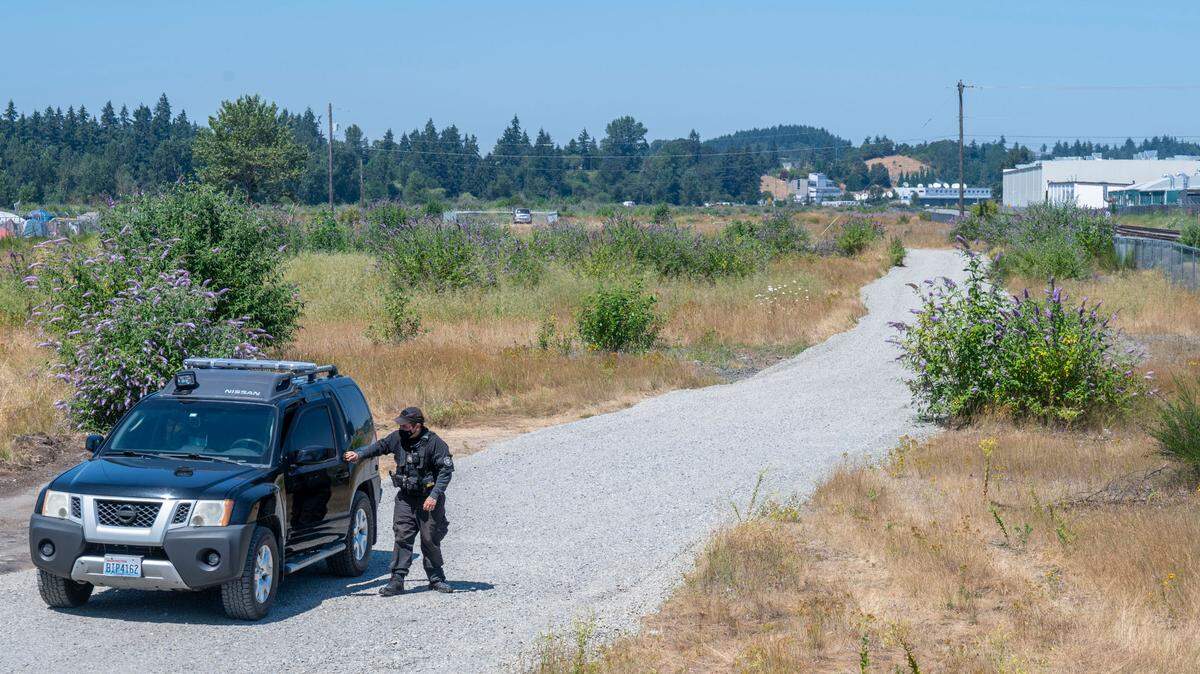
The city’s approval of a controversial mega-warehouse in South Tacoma is valid, a city hearing examiner has ruled.
Hearing examiner Jeff Capell issued his 90-page ruling Thursday.
Capell denied an appeal filed in May by a nonprofit providing legal representation to two local groups and upheld the city’s issuance of both a Mitigated Determination of Nonsignificance (MDNS) and a Critical Areas Development permit to applicant Bridge Point Tacoma, LLC.
In May, attorneys with nonprofit Earthjustice of Seattle, representing environmental group 350 Tacoma and the South Tacoma Neighborhood Council, filed an appeal against the City of Tacoma and the LLC. A multi-day hearing was held in July.
“The appellants showed that more could have been done, and/or that things could have been done differently, but that is not the same as showing clear error in what was done or that a different conclusion should have been reached under the law,” Capell wrote in the concluding portion of the decision.
On Friday, Earthjustice attorney Molly Tack-Hooper said in a statement: “Under Washington’s State Environmental Policy Act, projects that are likely to have significant impacts on climate, air, water and other aspects of the environment require an Environmental Impact Statement. This facility will attract thousands more polluting vehicles to an already overburdened area, and clearly meets that threshold.”
Earthjustice noted that it, 350 Tacoma and the South Tacoma Neighborhood Council were all “deeply disappointed in this decision.”
Tack-Hooper added that Earthjustice disagreed with the ruling and is “proud to stand by our clients and other South Tacoma residents who are tirelessly demanding transparency, environmental justice and public involvement in decisions that directly affect them.”
The project
Bridge Point Tacoma LLC, connected with Chicago-based Bridge Industrial, gained conditional approval in April from the city’s director of Planning and Development Services to redevelop the approximately 150-acre property, 5024 S. Madison St., with a four-building warehouse-distribution site, totaling about 2.5 million square feet, with parking for approximately 1,242 vehicles.
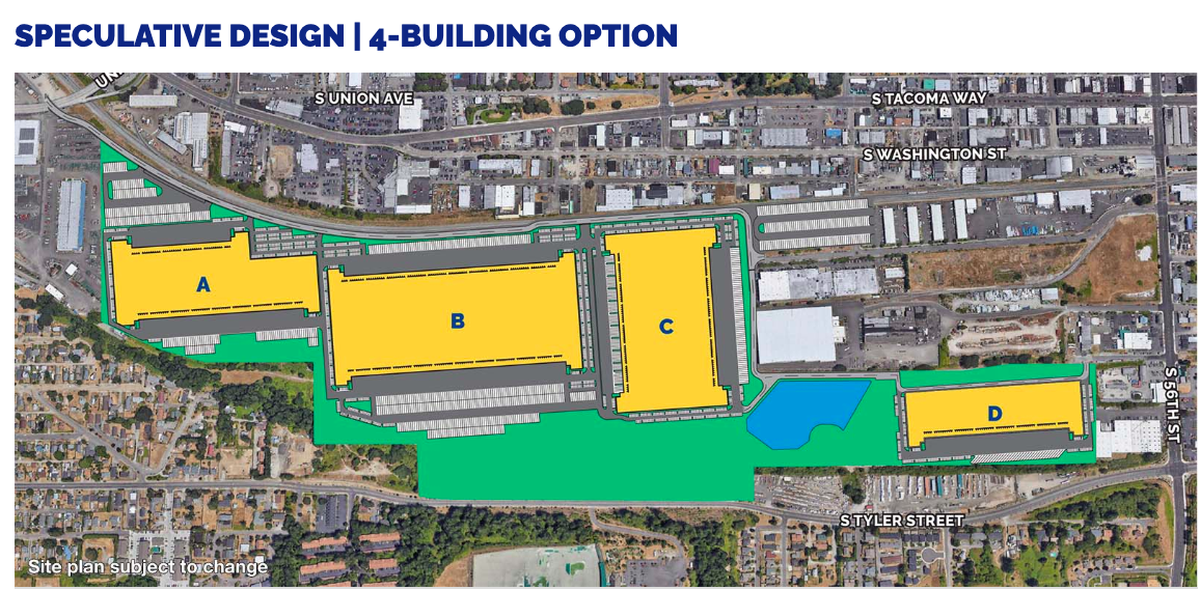
As described in Capell’s decision, the project also proposes “private access roads, pedestrian walkways, landscaping, stormwater infrastructure, public sanitary sewer and water main extensions, as well as modifications to, and enhancements of the critical area buffers,” and other enhancements.
The Bridge LLC purchased the site from BNSF Railway in September 2021 for $158.3 million.
The city, on its project page, touches on the site’s history, noting, “A portion of the site has been remediated” through a Superfund process “and contaminants have been located on a capped portion on the north of the site. This portion of the site is also proposed for redevelopment. As part of the cleanup, the owners (and subsequent owners) are party to an agreed order and institutional controls for the site and will continue or complete remediation as part of redevelopment.”
The appeal contended the permitting decision violated the State Environmental Policy Act. It sought a reversal of the SEPA determination and land-use permit issuance, and an order for the city to do a full review of the project’s environmental and health impacts.
Capell wrote, “As currently proposed, the project appears to be able to, and intends to comply with all applicable regulations, including (without limitation necessarily) the International Building Code, as adopted and amended by the City,” as well as city regulations under zoning, critical areas, stormwater “and the accompanying Stormwater Management Manual ...”
He cited the city’s requirement of Bridge to “either to achieve 30 percent tree canopy coverage within the Developed Area of the Site ... or to provide for an equivalent amount of tree planting within one half-mile of the Site if the final approved landscape plan cannot accommodate 30 percent coverage on-site.”
Capell further wrote, “Mitigation for the Project relevant to the (Critical Areas Development Permit) will include wetland and stream buffer restoration and enhancement, the re-establishment of historic wetlands, FEMA floodplain compensation areas within the wetland buffer areas to achieve the required ‘no net rise’ criteria for floodplain development.”
“During the hearing, and in all filings on the record, the applicant made no objection to the City’s imposition of the MDNS Mitigation Measures,” he wrote.
He noted that the site is zoned industrial and the covenants and restrictions remaining from the Superfund cleanup “limit the subject property to industrial uses. The project is just such an industrial use.”
He added that as examiner, he had “no authority to block a project that complies with the extant zoning, and has complied with the requirements for environmental review sufficient to obtain an MDNS.”
Examiner parses credibility accusations
Capell dedicated a portion of the decision to what was labeled “Witness Testimony and Credibility.”
He wrote that “the examiner found both sides’ witnesses to be essentially credible,” also adding, “Much of the hearing testimony was opinion.”
“The relevance and weight of any given opinion depends on how that opinion lines up with the actual facts found as part of this decision and how those facts align with the laws and regulations applicable to this appeal,” he wrote.
Capell wrote, “Both sides ... have an agenda in this appeal. The applicant wants its project to be constructed and then operated successfully. Without mincing words or attempting to be overly politically correct, the appellants would like to prevent the Project from being built and operated. ...”
Capell further explained how that mattered in the decision, since “in large part on these competing agendas, there was at least some testimony from the parties that appeared to question the other side’s credibility or veracity.”
For example, he wrote that he “found nothing untoward in the recalculation” of a traffic impact analysis, which project opponents had pushed back on.
“The insinuation, without saying so expressly,” he wrote, “was that the applicant had electively changed its methodology in order to artificially minimize trips generated by the project, which then would artificially minimize the environmental impacts of the project.”
“An example from the other side” he wrote, occurred when a Bridge pointed out in cross-examination that an appellant witness providing testimony “had worked for several years exclusively as an expert witness for appellants’ attorneys EarthJustice, the unspoken insinuation being that she is clearly biased for the appellants.”
He noted the biggest “example of an insinuation of a credibility problem” came from the opponents’ “foundational allegation of error — the disagreement over the land use designation” used in the Traffic Impact Analysis by professional services firm Transportation Engineering NorthWest.
He wrote that in the hearing, “there was a pervasive insinuation that the applicant’s consultant TENW had duplicitously, or at least in an intentionally erroneous manner, chosen the Industrial Park land use designation in order to artificially minimize the number of projected trips generated by the project and thereby erroneously underestimate potential impacts to traffic, air and noise, as well as water and wildlife.”
He added, “Despite these insinuations, the examiner finds no reason to determine the applicant’s testimony on this issue ... to lack credibility.”
EIS, SEPA and MDNS
Capell then offered his review of details presented from the two sides regarding transportation/traffic, air quality, greenhouse gas emissions, truck/trip lengths, environmental health, stormwater and groundwater/aquifer, animals/salmon, soils, the city’s review and own determination.
In the end, he wrote that “the Appellants did not meet their burden of proof to show that the (Critical Areas Development permit) was approved in error.”
As for the Mitigatated Determination of Nonsignficance on the project, he wrote that “there is nothing substantively or procedurally inferior about an MDNS in comparison to an EIS, and in many cases the public policy and environmental values of SEPA, which the reviewing agency is required to consider ... come out ahead in the MDNS process because of the mitigation measures that are imposed.”
He added that “it is notable that the City spent approximately the same amount of time reviewing the project proposal that SEPA sets as a goal for EIS completion. As already stated above, the City’s review was thorough and extensive, and not just because it took nearly two years.”
“Giving the City’s decision ... and then weighing the evidence on appeal against that deference, the examiner was not left with the definite and firm conviction that a mistake has been committed,” he wrote.
Reaction and reconsideration process
Reaction came early Friday from the groups represented by Earthjustice in the appeal.
South Tacoma Neighborhood Council said in a statement: “People of color and low-income people will be affected the most if this project is built. Our community takes pride in South Tacoma. We continue to be frustrated in the lack of investment by the City of Tacoma in South Tacoma, and the City’s willingness to greenlight industrial projects in an area already overburdened with environmental problems. We will continue working to protect the people of South Tacoma.”
350 Tacoma said that the project “is incompatible with the progress that the state, county, and city need to make on climate – and would also be devastating to South Tacoma residents. We’re deeply disappointed that the City of Tacoma has approved this project and is unwilling to take a comprehensive look at the project’s environmental, climate and health harms.”
Tacoma resident Michelle Mood has actively followed the permitting process and spoken at several council meetings with concerns over the project and approval process. She told The News Tribune via email in response to questions that the examiner’s “agenda” comments were what stood out to her after reading the decision.
“I am puzzled, saddened and disappointed that the hearing examiner states in his decision that the appellants, represented by EarthJustice, had an agenda that biased their work, and that that agenda was to stop the construction,” she wrote.
“Our community’s interest from the start simply was to have a full Environmental Impact Statement and Health Impact Statement if the proposed project were to be permitted. This has been our most basic ‘ask’ all along.”
Climate Alliance of South Sound representatives, a local environmental organization, also issued a statement Friday on the decision, stating that “An EIS is crucial to fulfilling the city’s promises of building a more equitable Tacoma.”
Aife Pasquale from CASS said in a statement, “CASS is ready to continue this battle. We refuse to stand silently by as (Bridge Industrial) and the city continue to use our communities as sacrifice zones for their pollution. We are coming together as a community to say ‘No!’ to these warehouses, and to protect our communities from environmental injustice like this.”
A representative for Bridge Industrial did not respond to requests for comment following the decision, and the City of Tacoma did not issue any official statement regarding the decision.
Maria Lee, media representative for the City of Tacoma, referred The News Tribune to the city’s FAQ page about the project in response to request for comment.
A motion for reconsideration can be filed with the hearing examiner within 14 calendar days of the decision, according to the examiner’s filing, in which “after a review of the matter, shall take such further action as (the examiner) deems appropriate, which may include the issuance of a revised decision/recommendation.”
The decision also could be appealed to Pierce County Superior Court. “Any court action to set aside, enjoin, review, or otherwise challenge the decision ... shall likely have to be commenced within 21 days of the entering of the decision by the hearing examiner, unless otherwise provided by statute.”
Asked whether further action for reconsideration/appeal would be forthcoming, Earthjustice media representative Elizabeth Manning told The News Tribune that “The Earthjustice attorneys and appellants are weighing next steps.”