From house posts to hockey sticks, Squaxin artist Andrea Wilbur-Sigo carves her way
READ MORE
Indigenous peoples profiles
Indigenous Affairs Reporter Natasha Brennan profiles the contributions, cultural knowledge and strength of Washington state’s Indigenous peoples.
Expand All
This profile is one of a series on the contributions, cultural knowledge and strength of Native peoples in celebration of November’s Native American Heritage Month.
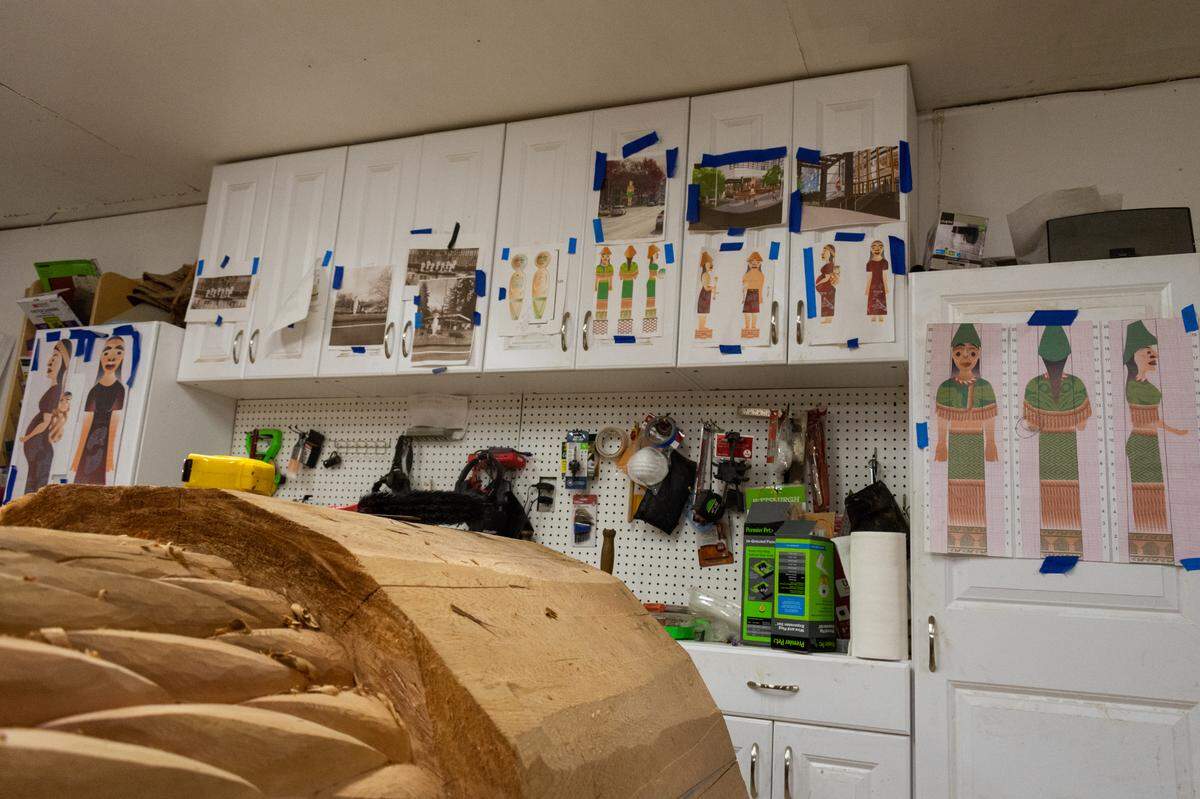
“It all starts with a circle,” Andrea Wilbur-Sigo said, pointing to the printed mock-ups of welcome figures — tall, carved figures that greeted guests on Coast Salish lands — hanging on the walls of her workshop in Shelton, Wash.
Wilbur-Sigo uses a vector program called CorelDraw to first create her large public art pieces in digital form by starting with a circle and building out her vision from there. Once the piece is designed, she superimposes the digital figure onto an image of the site where it will be installed and scales it to size to give her clients a realistic look at her vision.
Though she’s made a name for herself as a master carver of massive welcome figures, house posts and spindle whorls that can be seen from the Suquamish reservation to Seattle, Wilbur-Sigo began as a beader at the age of 3. By the time she was 8, she was showing off her beadwork at Evergreen College and shipping worldwide.
She took up making welcome figures and other large carving projects almost 20 years ago, but throughout her journey as an artist has also learned weaving and still receives orders for button blankets that are given to Coast Salish high school students for graduation. She has a tradition of making them for her children and is excited to start on her youngest daughter’s button blanket for graduation in June.
“But I always knew I wanted to be a carver,” she said.
She’s the first-known woman in her family to take up the craft. But coming from generations of Native carvers, she said there’s no way she’s the very first.
Carving tradition
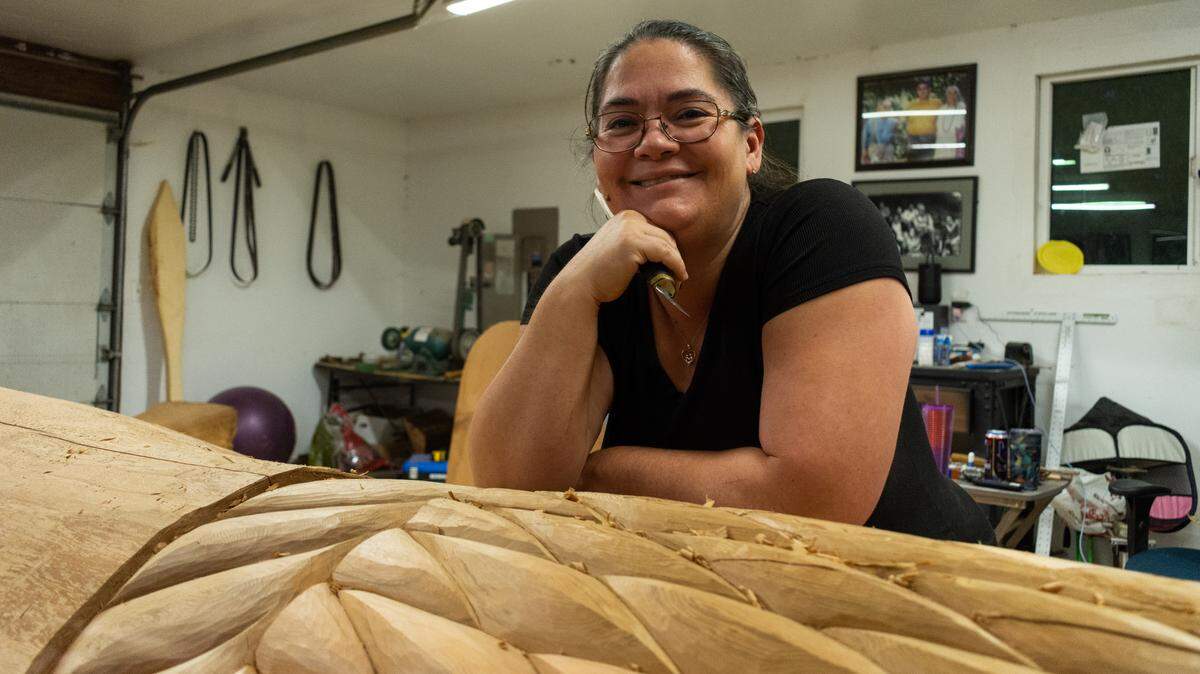
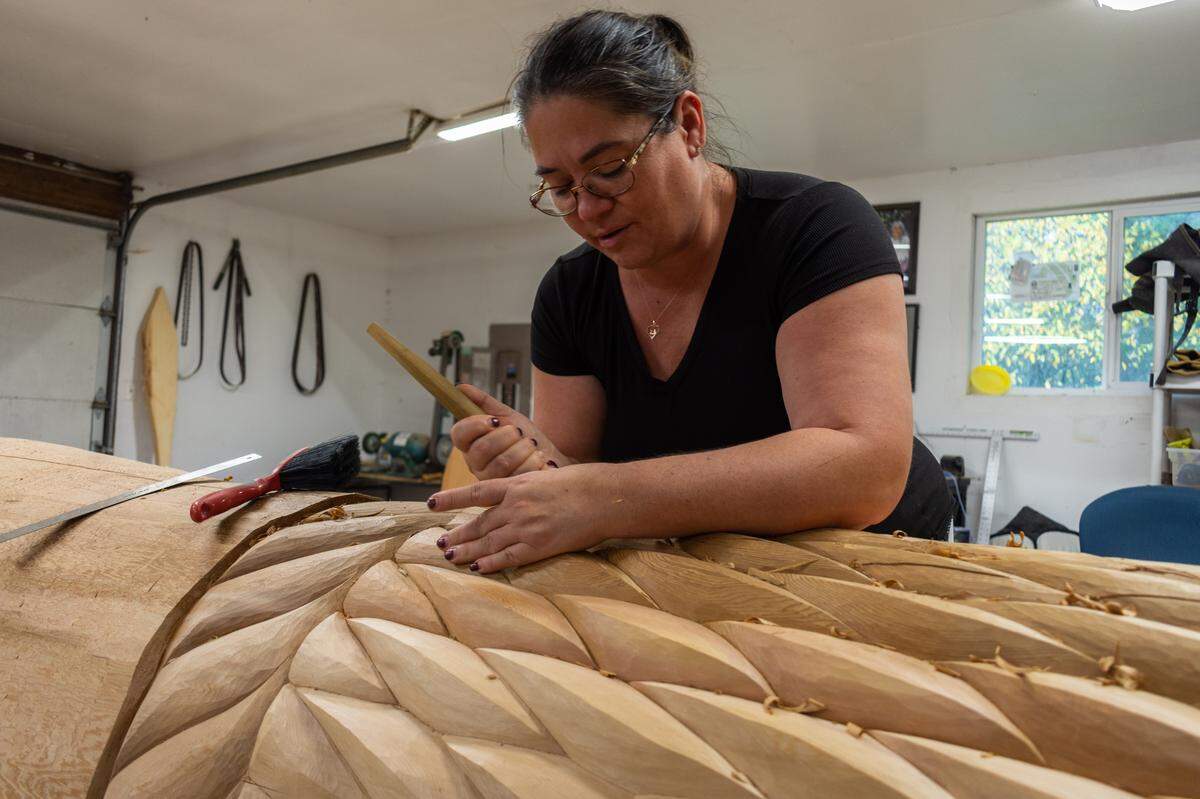
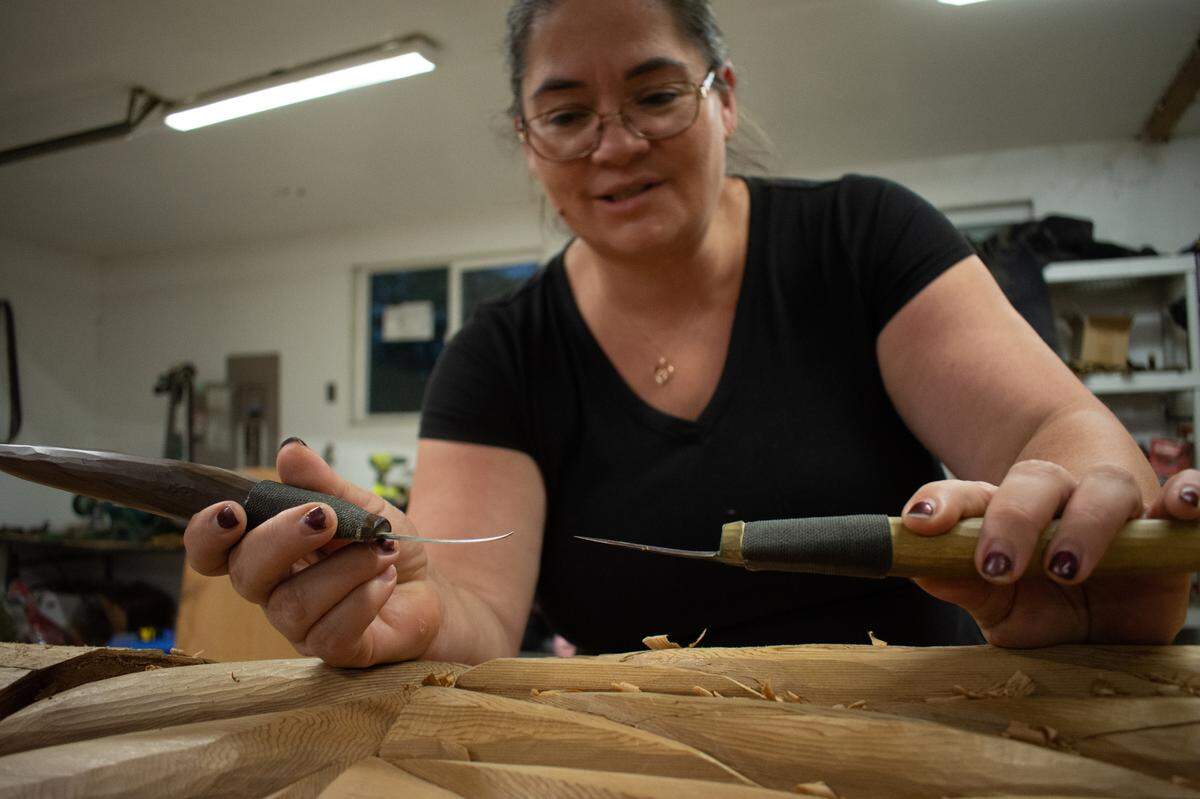
“It’s always said, ‘Women didn’t carve.’ That was normal and a lot of people believed it. But I come from a lot of stubborn women. You can’t tell me they didn’t pick up a knife and carve,” she said as she etched a rope-like design into a log over 20 feet long.
Just after she began carving, her mother and sister started to learn as well, Wilbur-Sigo said, noting that carving is traditionally a male-dominated practice. She recalled watching her father and grandfather carve when she was a child, always fascinated by the time-consuming practice that requires intense attention to detail.
“I’d watch them really closely and say to myself, ‘I’m gonna do that someday,’” she said.
She was inspired by the work of Bill Reid Jr., a First Nations carver, after seeing his work during a trip to the University of British Columbia when she was young.
As a member of the Squaxin Island Tribe, its museum board, and with heritage from a number of other Washington state Tribes, staying true to the Coast Salish style is important to her.
In her early days of selling her work, she was met with criticism from those who were looking for artwork that was generally Northwestern or Alaska Native style, but she stuck to the way that she was taught and is now sought out for it.
Coast Salish art
“In Coast Salish art, it’s the negative space that makes the design,” she said. “It’s important that Coast Salish art is represented on Coast Salish land.”
When she’s commissioned for a piece — like “Grandmother Frog,” which will be installed soon to watch over Chief Seattle Club’s new affordable housing development in Pioneer Square — the artist references a book of Skokomish stories she was given as well as her own teachings for an idea of what will fit what the client is looking for.
“Grandmother Frog,” who is the Creator’s wife, represents the connection between the land world and sky world, she said.
“I wanted something that will show those at Chief Seattle Club that they’re safe and welcome and this is their space,” she said.
Frogs are important to her, as she has fond memories of doing the frog dance with her fellow Tribal members. She named her very first print for the dance.
Every year, hundreds of frogs can be found around her home and workshop where she’s lived for over 20 years.
“Our family — we’re geoduck divers, we’re fishermen, we’re carvers. It’s our way of life. So when we see the frogs are out, it’s like good luck. It’s nature’s way of telling us it’s going to be a good year,” she said.
Telling Native stories
Focusing on Native stories, ideas and traditions are at the center of all her work.
“Unity” — her piece that will be installed at Eastside Street in Olympia — depicts the Tree People and People of the Water, representing a community of peace that needs each other to co-exist. One of two pieces for the Washington State Convention Center depicts a man holding a talking stick, representing that the center is a place for people to gather and share their voice.
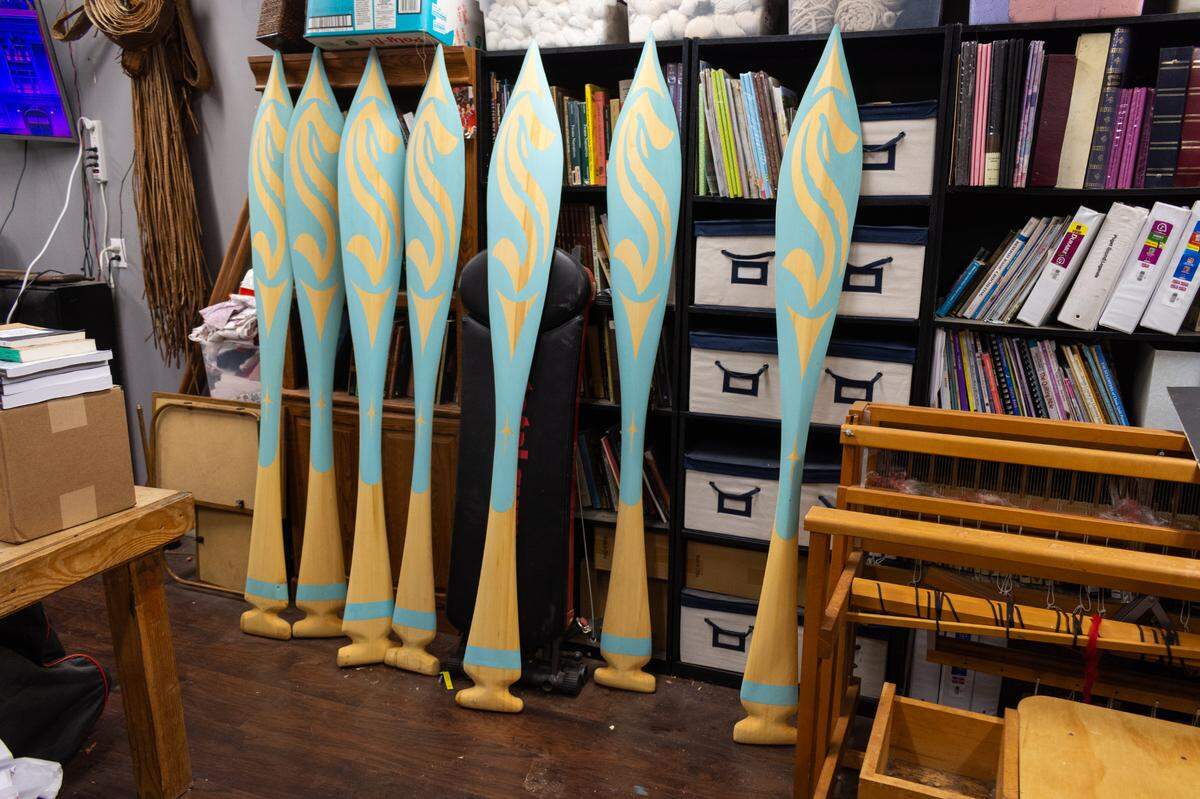
When she was commissioned by the Seattle Kraken, Wilbur-Sigo wanted to put together a piece to represent the seven generations — the Indigenous concept of looking forward seven generations into the future as well as taking care of and remembering the seven generations of the past, she said.
The installations will have tentacles holding seven large paddles to represent the seven generations and an eighth tentacle holding a hockey stick to represent an eighth generation — the future.
Serving the community
Many of the pieces have taken longer than expected to complete and install as the border closure, COVID shutdowns and other logistical issues have made it harder to find and ship the large, intact logs she needs or coordinate installation. But throughout the pandemic, she’s continued carving while finding other ways to serve her community.
Using her seamstress skills, Wilbur-Sigo, along with her daughter Florence, made about a thousand masks in her workshop to sell and distribute.
Though she uses a vector system to draw her designs and sewing machines her ancestors didn’t have, she joked, Wilbur-Sigo and her carving family members love to make their own tools and give them to each other on holidays.
She made her first carving knife in 1995 and refreshed her memory with a tool-making class at Evergreen College in 1999. She’s been working with the college since 1996 and teaching classes since 2000.
“I can’t say that I have a dream project or end goal — what I’m doing right now for Chief Seattle Club, Olympia, the Kraken and so many others were my dream projects, but I really want to pass these skills down. I love to teach. To train a whole generation of carvers or even just make a difference in one person’s life through carving is all I want,” she said.
Wilbur-Sigo was born at the University of Washington in 1975 and raised at her parents’ home in the Skokomish Valley — one of the only ones that didn’t flood when the water levels of the nearby river rose. The flooding would often reveal cultural artifacts or tools that she’d love to search for.
“I liked to find them and think about what my ancestors did with them,” she said.
Teaching youth
After having her first daughter, Wilbur-Sigo worked on her GED, but said she struggled to balance focusing on her education and being a single parent. To provide for her and later her second daughter, she became the youth coordinator for her Tribe at 20 years old.
BEHIND THE STORY
MOREPlease help support this reporting
Natasha Brennan covers Washington state tribes’ impact on our local communities, environment and politics, as well as traditions, culture and equity issues, for McClatchy media companies in Bellingham, Olympia, Tacoma and Tri-Cities.
She joins us in partnership with Report for America, which pays a portion of reporters’ salaries. You can help support this reporting at bellinghamherald.com/donate. Donations are tax-deductible through Journalism Funding Partners.
You can sign up for her weekly newsletter here.
“Sometimes I’d close down the center and take all the kids to my house to teach them beading and carving. It was their safe space and I still talk to the kids, who are now almost in their 30s or have teenagers of their own,” she said. “It’s how I learned that doing cultural activities and just spending time together has such an impact and why I want to continue teaching.”
She earned her certificate in information processing systems at Capital Business College and after she turned 21 worked for the Tribe’s gaming authority, but continued carving on the side.
“I’d work during the day to make ends meet and carve in the living room at night. When you first start out with carving, you’re always using the funds from the last job to pay for the materials for the next job. So it took a long time to make this sustainable for me and my family,” she said.
A few years later, she married her husband of 25 years Steven and worked with him on their geoduck business. Together they have nine children and their seventh grandchild is on the way.
Now a sought-after carver with a successful business, Wilbur-Sigo said she hopes to one day to teach a master class to help young carvers learn the craft, how to take criticism and the business side of making Native artistry their profession.
This story was originally published November 9, 2021 at 5:00 AM.