Giving Gabe Jackson a new contract in a trade another example of Seahawks’ new creativity
Wait, how does a team that had next to no salary-cap space pull off upgrading the needy offensive line and placating “frustrated” Russell Wilson at the same time?
With new creativity to fit an unprecedented time.
Seattle general manager John Schneider learned two weeks ago the Raiders were shedding salary and veterans on their offensive line faster than you can say “Las Vegas.” Gabe Jackson, a seven-year starting guard for the Raiders, was suddenly and unexpectedly available a few years into his $56 million extension with Las Vegas.
Rather than waiting for the Raiders to cut Jackson then needing to out-bid the rest of the league for him on the free-agent market, Schneider and coach Pete Carroll decided to first trade one of the scant four choices Seattle has in next month’s draft to Las Vegas. A fifth-round pick brought Jackson to the Seahawks March 17, to replace retiring guard Mike Iupati.
When trading, the acquiring team inherits that player’s contract. Jackson’s deal from the Raiders had two years and salary-cap charges of $9.6 million and $9.6 million remaining. That was not tenable for the Seahawks. They had just $4 million in space remaining under the cap for 2021 when they traded for him.
So Schneider had Matt Thomas, his salary-cap maestro executive, re-work Jackson’s contract as a condition for acquiring him. The Seahawks ripped up those final two years of Jackson’s deal with the unworkable cap charges. They gave Jackson a new contract, the veteran guard revealed Tuesday.
“I actually got a little bit longer deal than I had in Vegas,” Jackson said during an online Zoom interview with Seattle-area media from his offseason workout facility in Starkville, Mississippi.
“Just a little extension.”
Maybe little to him. But it’s a big tell in the new way the Seahawks are doing business this offseason, as the NFL salary cap has dropped to $182 million. That’s down $16 million per team from 2020.
The Seahawks in their trade gave Jackson a three-year deal worth $22.75 million, effective immediately. It includes a $9 million signing bonus. That’s $3 million per year against the cap in bonus money the team will prorate over each of the three years of his contract. The Seahawks added $7.075 million in other guarantees for Jackson, in exchange for him giving them a lower cap charge than his scheduled $9.6 million for 2021. The advantage of that for Jackson is that none of what had been left from his contract with the Raiders had been guaranteed.
Guaranteed money in king in the NFL, where a player’s next injury could result in his last paycheck.
In the end, by giving Jackson an extra year, a signing bonus and additional guarantees, Schneider and Thomas reduced the Seahawks’ cap charge for one of the league’s best pass-blocking guards to just $4,075,000 for 2021. That’s almost $5.5 million lower than what Jackson would have counted against Seattle’s cap this year if Seattle hadn’t given him a new deal with the trade.
Yes, Jackson’s cap charges will grow in 2022 and ‘23. But so will the Seahawks’ salary cap. It’s expected to go back up from $182.5 million this year to around $200 million per team in 2022, when the league and nation will emerge from the coronavirus pandemic and likely have fans in the stands this season. Tuesday, NFL commissioner Roger Goodell said the league expects stadiums to be full of fans for the 2021 season.
The cap could grow to $220 million or more per team in 2023. That’s when the league’s newly signed television and streaming-rights contracts take effect. Those deals are going to bring the NFL $10 billion per year for 10 years. The cap and thus player contracts get a proportional share of those media deals.
More cap tricks
This is new ground for the Seahawks under Schneider, Carroll and Thomas. In the 11 years that they’ve controlled the franchise, they have mostly declined to kick the can of present cap charges into the future through contract restructuring and extensions. That often gets teams in salary-cap hell, unable to stay competitive over time.
That Seattle custom applied when the salary cap was growing by $10 million and more year over year, so the team largely didn’t need to get this creative with so little cap space. This offseason is only the second one since the NFL went to a salary-cap system in 1994 that the cap has gone down. The other time was during the 2011 lockout of players during contentious negotiations on an expiring CBA.
That’s why this month, the Seahawks have used the new trick of void years in contracts. Void years allow teams to spread cap charges across additional, phantom years on deals that are essentially shorter contracts. That’s what the Seahawks did to make this week’s re-signing of lead running back Chris Carson affordable under their tightly fitting 2021 cap. Theoretically, the deal is three years and $24,625,000. In reality, it’s two years and $14,625,000. Carson’s third year and other $10 million is a void year. The Seahawks included that to thin and spread his salary-cap charges over three years instead of two.
Carson won’t see that $10 million or third year of his contract, and the Seahawks won’t be paying it. But they will be carrying a prorated portion of his signing bonus under its cap that year. That’s the price of having a lower cap charge for him this year.
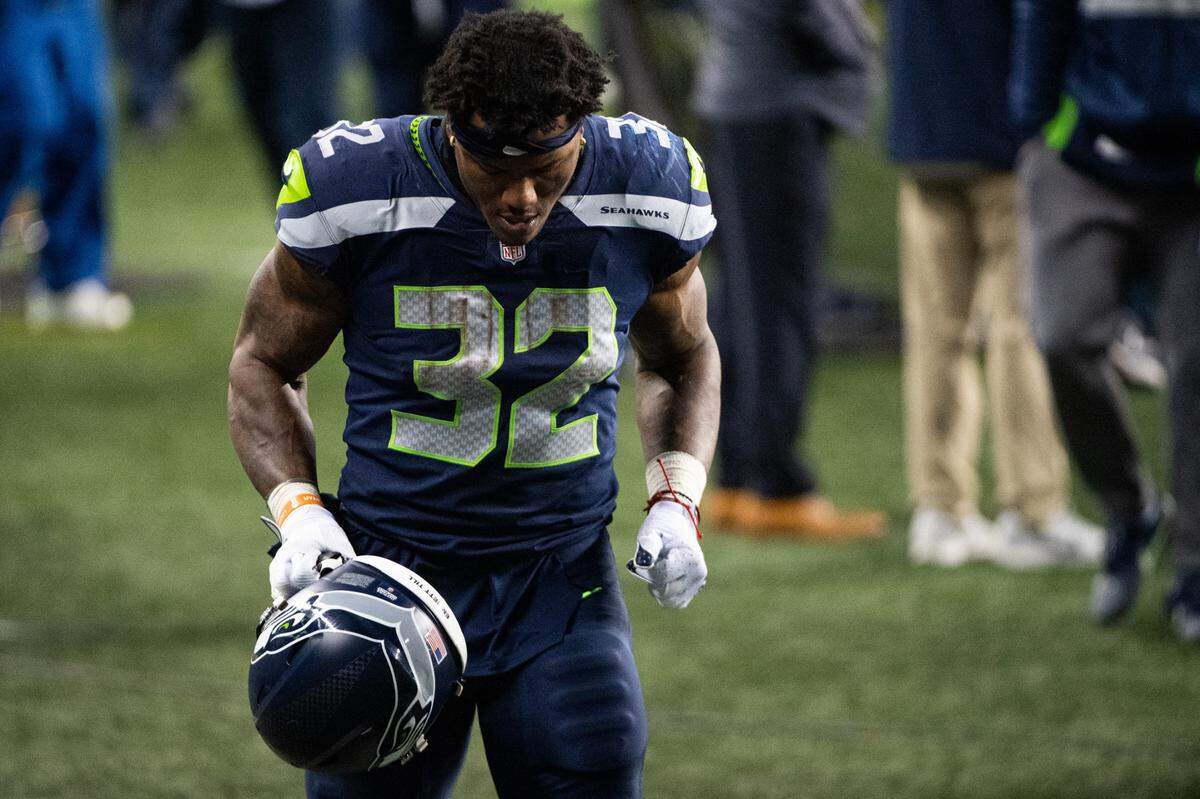
Defensive end Benson Mayowa’s deal is another example of how Schneider, Carroll and Thomas have gotten creative this month. Mayowa’s is a four-year contract with two void years. The contract for the 29-year-old pass rusher is essentially two years, $7.62 million with $4.1 million guaranteed and a $3 million signing bonus. Mayowa’s $1.1 million salary for this year is guaranteed. His salary-cap charge is only $2.24 million, thanks to the deal’s two void years.
At that rate, the team will have prorated signing-bonus charges of $750,000 in 2023 and ‘24, so-called “dead money” in the void years in Mayowa’s deal.
Seattle did the same thing while re-signing Carlos Dunlap. They also did it in signing Kerry Hyder, who had 8 1/2 sacks last season for San Francisco. Hyder will be the new defensive end opposite Dunlap and Mayowa in the Seahawks’ remade (again) pass rush.
Agent Erik Burkhardt confirmed to The News Tribune Hyder, 29, signed a three-year deal worth $16.5 million, with a chance to earn another $1 million with incentive bonuses. That third year is a voidable year. That makes it a two-year deal worth $6.5 million, with bonuses that could push it to $7.5 million.
Void years explain how Schneider and Thomas signed Dunlap and Hyder for millions less in cap charges for 2021 than the $14 million Dunlap would have cost Seattle against the cap this year—if the Seahawks hadn’t cut Dunlap this month on the eve of free agency. They released the two-time Pro Bowl pass rusher not to lose him but to get him back—at their cost, not the cost they had inherited in his contract from the Bengals in October when they traded with Cincinnati for him.
They’ve added three pass rushers, two starting offensive linemen (including re-signed center Ethan Pocic, for one year, $3 million), their lead running back and a starting cornerback (former 49ers starter Ahkello Witherspoon, at one year and $4 million). They’ve lost only one veteran starter because of money. They cut defensive tackle Jarran Reed. His $9 million cap charge for this year was impossible for Seattle to keep and do all these other deals. Reed signed with Kansas City as a free agent.
That’s how the Seahawks do offseason business. It’s why they wait through the first, richest days of free agency every March.
Wilson approves
Wilson has been very noticeably applauding his team’s salary-cap gymnastics all month, online on his Twitter account.
For Seahawks fans, it sure beats Wilson proclaiming in January “I’m frustrated with getting hit too much.”
Jackson said Wilson was one of the first Seahawks he talked to upon his trade from the Raiders this month.
“He was excited,” Jackson said.
“We are both excited to work together.”
Jackson played the first two years with the Raiders at left guard, the last five starting for them at right guard. Damien Lewis was Seattle’s starting right guard from day one of his rookie year as a third-round pick in 2020. It makes sense that Lewis will stay at right guard this early in his career and with three years still remaining on his rookie contract, while Jackson will be on the left.
That would put Jackson next to veteran Pro Bowl left tackle Duane Brown, the Seahawks’ best offensive lineman, this year.
“I describe myself as ‘tough as nails,’” Jackson said.
That’ll work, for Wilson and the Seahawks’ offense. That’s the upgrade on the O-line the franchise quarterback was talking about, loudly, two months ago.
“I’m just excited to play with them,” Jackson said of his new Seahawks, “because I know we can be great.”
This story was originally published March 31, 2021 at 6:37 AM.