Why Seahawks hold ultimate leverage with Jamal Adams, plus 10 other questions at play
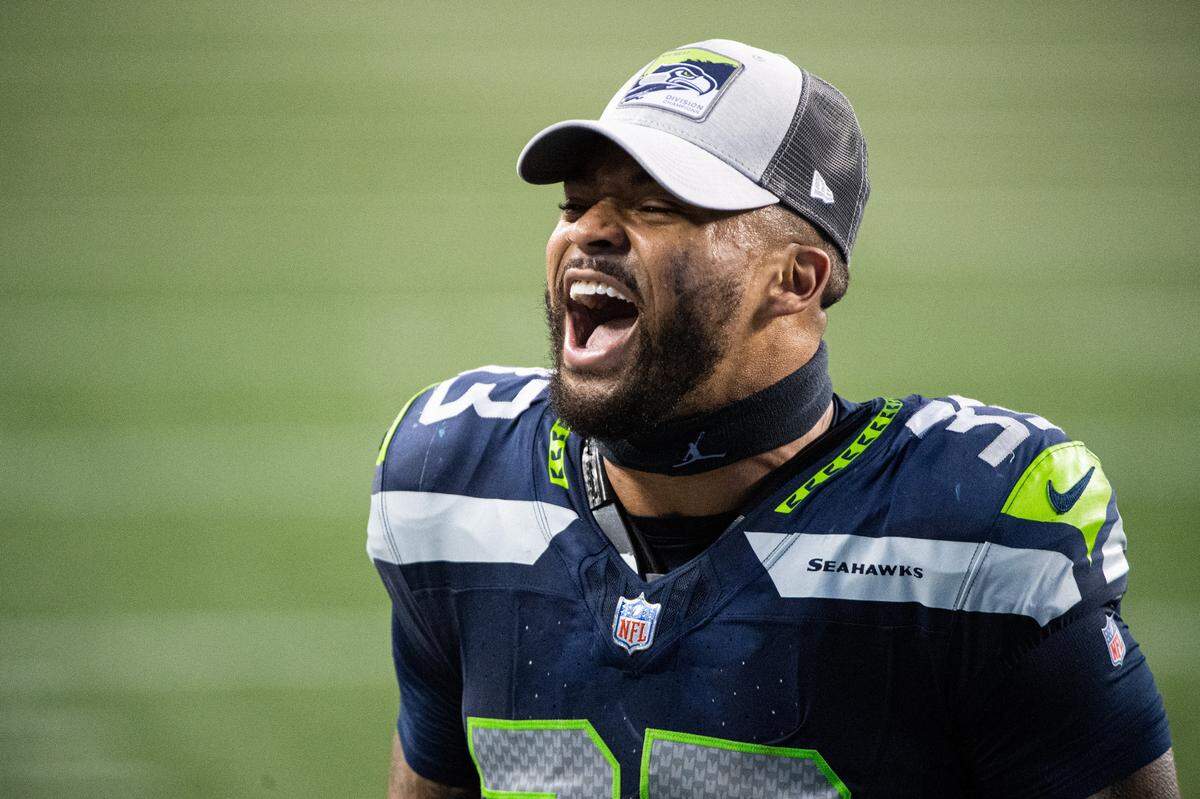
By refusing to practice, Jamal Adams is using the only leverage he really has in his hopes of getting a rich, new contract.
The Seahawks, though, hold the ultimate leverage in keeping him beyond this year.
NFL contract negotiations are all about leverage. The player seeks it in an attempt to drive up his value — particularly, and most important in this league, the value of guaranteed money in a new deal.
Adams reported to training camp on time July 28 to avoid getting fined $40,000 per day for not being there. He is attending meetings but not participating in any practices or preseason games. He is trying to create urgency in the team for getting him on the field with a signed contract that is more on his terms than the team’s.
His terms are those of the modern NFL star: as much guaranteed money as possible, a reported $40 million guaranteed, up front. That would go immediately to him, before his health or Seahawks conditions might change.
The Seahawks’ terms: $38 million guaranteed, and $70 million for four years, according to what league sources have told The Seattle Times.
That’s an average of $17.5 million per year. That’s a huge rise above the current top contract for an NFL safety: $15.25 million per year for Denver safety Justin Simmons, in a deal he signed last year.
That’s also a handsome investment for a player who is coming off two surgeries, on his shoulder and hand, and played through three injuries last season.
The Seahawks’ reported offer is just below the $18 million All-Pro linebacker Bobby Wagner earns. That’s important to the team and to Wagner. He’s been a cornerstone of the team for a decade. Adams has been here a year.
As general manager John Schneider said on the team’s radio network that aired Saturday during the pregame show before Seattle’s preseason opener at Las Vegas, when asked about the contract situations with Adams and also holding-in left tackle Duane Brown: “We have 21 guys that are in the last year of their contracts.”
The clear implication: We don’t do deals in a vacuum.
Players don’t, either.
Annual contract value is one, somewhat artificial measuring stick. Players — and fans and the media — compare their annual value to others’ to assess their market worth relative to the rest of the league. Adams set an NFL record for defensive backs when he had 9-1/2 sacks last season in his debut year with Seattle, so he thinks his market worth should be way higher than the highest safety.
But, again, guaranteed money is king for players. Specifically vital: guaranteed money up front, at the time of signing, not guarantees against injuries that teams like to include in huge contracts.
Guarantees against injury are payable at the start of successive league years, in March. Such guarantees paid in the future are hedges for the team. They are not automatic at signing but payable if the signed player remains healthy into future years of the deal.
Here are 10 of the many questions I’ve gotten on Adams’ situation:
1. Why do the Seahawks hold the ultimate leverage in this?
Schneider and salary-cap executive Matt Thomas can use the NFL’s franchise tag to keep Adams with Seattle through the 2024 season. That’s longer than Russell Wilson is under contract with the team.
Per Article 10 of the NFL collective bargaining agreement, each team gets one franchise-tag designation per year it has the option to use on a player who’s contract has expired. Players generally despise the franchise tag. It keeps them from the riches of bidding on the open market. Tags allow a team to keep a player — and keep him from the market — without having to cave to his demands on a new, longer-term contract.
2. How would Adams get with a franchise tag?
Instead of the security of longer-term deals with life-altering and mega guarantees, the franchise tag is a guaranteed, one-year contract. The value of the tag tender depends on the type of franchise tag used.
A non-exclusive franchise tag technically allows the tagged player to possibly sign with another team, but at the cost to the signing team of sending the team that tagged the player two first-round draft choices as compensation. Other teams rarely mess with that cost and don’t negotiate with a non-exclusive franchise-tagged player.
Non-exclusive franchise tags carry the contract value of the average of the top contracts from the previous season for the position at which he player played the most snaps the prior year, or 120% of his previous year’s contract, whichever is greater.
3. What could Adams seek in a franchise-tag process?
If the Seahawks’ impasse with Adams continues and they get to the tag by March, Adams may continue to assert he isn’t a true safety. Because of how often he plays near the line of scrimmage, he believes he should be paid essentially more as a linebacker or even a pass-rush end. NFL edge rushers and linebackers have richer top contracts than safeties.
Basically, Adams’ tack is he’s not a safety but a do-it-all unicorn, and thus he should be paid uniquely.
Though rare, such position disputes can end up with a league arbitrator for franchise tags. The arbitrator determines through league statistics and evidence which position a player truly played and how often to determine what position value he will get when tagged.
Former Seahawks tight end Jimmy Graham tried this when the New Orleans Saints franchise-tagged him in 2014. NFL arbitrator Stephen Burbank ruled Graham as a tight end and not, as Graham wanted, a richer wide receiver. The arbitrator ruled that even though Graham spent half the previous season on the line of scrimmage 4 yards outside the last offensive linemen he was still a stand-up tight end and not a slot wide receiver. Graham got $7.05 million, instead of the $12.3 million tag number that year for a wide receiver.
Adams would appear to have a low chance of winning an arbitration case that he’s not primarily a safety for franchise-tag purposes.
4. What’s an “exclusive” franchise tag? Would Seattle possibly use that with Adams?
The rarer, exclusive franchise tag is a guaranteed, one-year deal worth the average of the top five salaries at the player’s position in the current year, the year he is being tagged. The tagging team is the only team with which that player can negotiate a longer-term deal.
Exclusive tags are rarer because they cost more. Teams use non-exclusive tags because the chance of losing a player on a non-exclusive franchise tag to another team is low.
A team must decide whether to use its franchise tag on a qualifying veteran player with an expired contract by March within a few days of the start of the league year. This year, that was by March 9. A tagged player can continue negotiating on a longer-term deal until a league deadline of mid-July; this year it was July 15. After that date, he must play under the franchise tag and its guaranteed, one-year salary — or not play at all and not get paid at all.
Each team can use a franchise tag on one player for up to three consecutive years. The second consecutive year, his salary goes up by 20% from his previous year’s. For a third consecutive tag, it’s a 44% raise from the year before that.
5. Why not just give Adams an ultimatum and deadline now? If it passes without him agreeing, why not have him play angry headed to a franchise tag next spring?
The Seahawks could, if they really wanted to, go hardball. They could by league rules play the franchise-tag game with Adams in 2022, ‘23 and ‘24, and keep him through his 29th birthday. That’s why they hold the ultimate leverage here.
Thing is, the Seahawks under players’ coach Pete Carroll and Schneider don’t typically play hardball with foundation, All-Pro stars. They call on the strong interpersonal relationships they’ve cultivated with players in their unique locker-room environment to reason with and appeal to guys to get the deals they want done.
Carroll and Schneider have used the franchise tag just twice in their 12 years running the Seahawks. Once was to keep kicker Olindo Mare, in the first months of them turning over the roster in 2010, and on defensive end Frank Clark in March 2019. Tagging Clark proved to be a way to buy time and keep him from leaving in free agency before the Seahawks traded him. They did, to Kansas City, in April 2019.
I sense floating the franchise-tag option at Adams is the Seahawks’ way to avoid that and get him to sign their offer now instead.
6. Is this really a “final” Seahawks offer?
Maybe not, though the team likely wants him to think so.
NFL deals are rarely final until they are signed. Schneider and Thomas have likely considered coming back to Adams with a late sweetener to end this impasse. They could offer three years instead of four. That would let Adams potentially into the free-agency riches in the spring of 2024, at age 28.
The NFL salary cap is likely to be at $235 million or more per team by then. The league’s massive new media-rights deals kick in with the 2023 league year. The cap is $182.5 million this year, down $16 million over last year because of the pandemic. So there is going to be tons more money to spend on stars then than there is now.
The Seahawks’ GM and his cap guru like to prorate big signing-bonus money over as many years as they can with longer, back-ended contracts. But they have dropped a year off a contract to get a mammoth one done before.
It was with the most important player they have.
The Seahawks wanted to go five years on Russell Wilson’s second contract beyond his rookie one ending in 2015. That’s because they were giving their franchise quarterback what at the time was the richest deal in league history and would have preferred to spread his signing bonus over five years instead of four, to be more team friendly against the salary cap.
Mark Rodgers, Wilson’s agent, said then a key to Wilson breaking a logjam and ultimately signing his $87.6 million, four-year contract extension with Seattle in 2015 was getting four years instead of five years. That meant Wilson could have become a free agent for even more riches at age 30 in 2020, though he ultimately re-signed again with the Seahawks for another record, $140 million in April 2019.
“(This) puts him in a situation where he’s still a young man and he gets an opportunity maybe to talk about another contract down the road,” Rodgers said in 2015. “You don’t do a contract necessarily thinking about the next contract. But I think that’s the big difference between a four-year extension and a five-year extension. That’s a long year. That was a bit of a goal and I think we got there and he was pleased with it.”
7. So what would Adams get if the Seahawks play the tag game years in row?
The NFL franchise-tag value for safeties is expected to be $13.5 million in 2022 and $16.26 million in 2023.
Those would be nice raises from the $9.86 million Adams is scheduled to earn this year. The 2021 season is the final year of his contract the Seahawks inherited from the New York Jets, when Carroll and Schneider traded two first-round draft choices for Adams in July 2020.
But those future tag values are well below the $17.5 million per year the Seahawks have on the table to Adams.
Adams would lose $5.25 million in average annual salary over two tagged years — plus the $38 million in signing guarantees and the two more years of at that $17.5 million average salary the Seahawks reportedly have offered him.
That’s a lot of coin for not signing the team’s deal that’s now on the table.
8. Do you think he will sit out the season?
No.
Adams wants to prove his value to the league, for a new deal from any team. He can’t prove that by sitting on his couch. The 17 games of this season are 17 chances to showcase why he’s worth what he thinks he is for 2022 and beyond.
The NFL’s CBA with its players mandates a player who refuses to play loses a game check for each week of the regular season he skips. For Adams this season, that’s $547,778 per game.
Adams is seeking to earn more money, not lose more than a half million per week.
If he wants to earn the most money possible, he will be starting on the Seahawks’ defense Sept. 12 in the opener at Indianapolis. With or without a new deal.
Asked Friday by The News Tribune if he’s considered the possibility Adams won’t be playing in the opener in less than a month, Carroll said: “I can’t even imagine that.”
9. Why not franchise tag him this year, then next year trade him or just tag him again?
The Seahawks can’t use their franchise tag on Adams this year. He’s under contract for this season, the final year of his rookie deal from the Jets. The deadline for teams to use any tags for 2021 passes in March, anyway.
10. How is Adams feeling about all this?
“Great.”
That’s what he wanted all to know this past weekend.
“Great vibes, great energy! #Prez,” he wrote on his Twitter page Sunday, a players’ day off following their early-morning return from the Seahawks’ preseason opener in Las Vegas.
This story was originally published August 16, 2021 at 5:21 PM.